
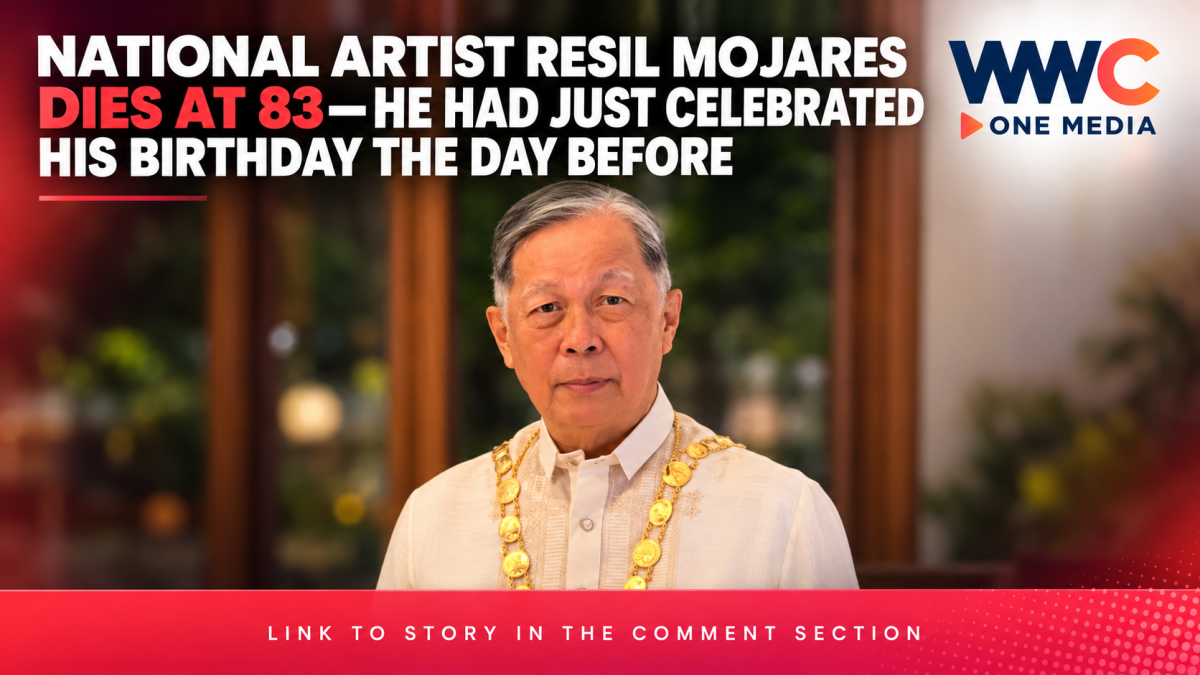
MANILA, Philippines — The Philippines has lost one of its most influential literary scholars and cultural historians.
National Artist for Literature Resil B. Mojares died early Saturday, September 5, 2026, at the age of 83, according to his family. His death came only a day after he celebrated his 83rd birthday on September 4.
His daughter, Leigh Go Mojares, announced the news, describing her father as a pillar of their family and expressing gratitude that they were able to celebrate his final birthday with him.
The news marks the passing of a scholar whose work helped reshape how Filipinos understand literature, history, culture and identity, particularly in Cebu and the Visayas.
From Zamboanga del Norte to Cebu’s literary world
Mojares was born on September 4, 1943, in Polanco, Zamboanga del Norte, to public school teachers. Although he was born in Mindanao, much of his professional and intellectual life was built in Cebu, where he became a towering figure in Cebuano and Philippine scholarship.
He studied at the University of San Carlos, earning degrees in English and Literature, before completing his doctorate in Literature at the University of the Philippines Diliman. He later became a professor emeritus at USC.
One of his most important institutional contributions was the establishment of the Cebuano Studies Center, which he directed from 1975 to 1996. The center became an important venue for research and documentation involving Cebuano language, literature, history and culture.
The “Visayan Titan of Letters”
Mojares was widely recognized as a leading historian, literary critic, essayist, teacher and cultural scholar.
His body of work covered Philippine literature and history, political biography, cultural studies and the intellectual development of the Filipino nation. Among his notable books are Origins and Rise of the Filipino Novel, Theater in Society, Society in Theater, The Man Who Would Be President, The War Against the Americans, Waiting for Mariang Makiling, Brains of the Nation and Isabelo’s Archive.
His scholarship earned multiple distinctions, including Philippine National Book Awards, while his work helped place Cebuano and Visayan history and literature more prominently in national discussions.
National Artist recognition
In 2018, Mojares was named National Artist for Literature, one of the Philippines’ highest official recognitions for artistic achievement.
He shared the 2018 National Artist recognition with other major Filipino figures, including composer Ryan Cayabyab, architect Francisco Mañosa, filmmaker Kidlat Tahimik, theater artist Amelia Lapeña-Bonifacio, visual artist Larry Alcala and writer Ramon Muzones.
The recognition was particularly significant in Cebu. Contemporary reports described Mojares as the first Cebuano to receive the National Artist honor for Literature, reflecting the national importance of the literary and historical work he developed in the Visayas.
The University of the Philippines also honored Mojares earlier this year as part of its Tanghal Tertulia program celebrating National Artists and their contributions to Philippine culture. UP described him as the “Visayan Titan of Letters” and highlighted his lifelong work in Philippine cultural and historical studies and his pioneering contributions to Cebuano studies.
A writer shaped by history
Mojares’ life was also closely connected to some of the country’s most turbulent political chapters.
Before martial law, he worked as a journalist and columnist in Cebu. When martial law was declared in 1972, newspapers were shut down and journalists and writers were among those targeted by the military. Mojares was among the Cebuano journalists detained during that period.
That experience became part of the broader historical context through which he examined Philippine society, memory and political life.
Rather than limiting his scholarship to conventional literary criticism, Mojares repeatedly explored the relationship between history, culture, power and the Filipino experience.
More than a literary scholar
What made Mojares particularly influential was the breadth of his work.
He moved between literature and history, national politics and local memory, academic scholarship and journalism. His writings helped demonstrate that the story of the Philippines cannot be fully understood without paying attention to regional histories and voices.
His work on Cebu and the Visayas helped elevate regional scholarship while connecting it to larger questions about Philippine identity.
The Cebuano Studies Center itself continues to recognize his foundational role. According to the center, Mojares’ directorship from 1975 to 1996 helped develop the institution into an important center for cultural research and public education.
A legacy that extends beyond books
Mojares leaves behind more than a collection of acclaimed books.
He leaves an intellectual legacy built around the idea that Philippine history should be studied through many voices, places and experiences—not simply through the dominant national narrative.
For generations of students, researchers and writers, his work provided a bridge between regional identity and the wider Filipino story.
His death comes as the Philippines continues to grapple with questions about history, memory and national identity—subjects that defined much of his life’s work.
And perhaps fittingly, the final chapter of his life began with a celebration of the very day on which it started.
Resil Mojares turned 83 on September 4. He died the following morning.
The scholar who spent decades documenting the stories of others has now become part of Philippine history himself.
WWC ONE MEDIA M.J.E




Leave a Reply