
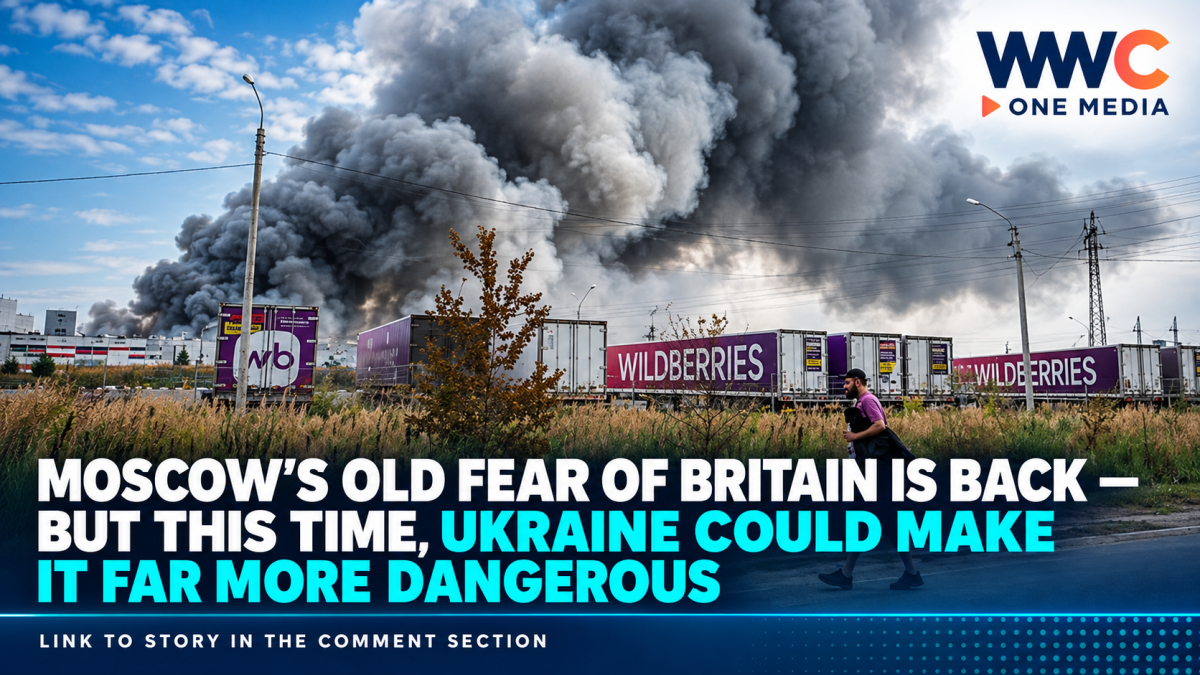
Relations between Russia and the United Kingdom are again approaching a dangerous low point, with Moscow increasingly portraying Britain as one of the principal forces behind Ukraine’s ability to strike targets deep inside Russian territory.
The argument has a striking historical echo.
A new analysis by historian Peter Whitewood, published by Asia Times and republished from The Conversation, argues that Moscow’s current portrayal of Britain resembles Soviet-era suspicions from the 1920s, when Soviet leaders frequently accused London of secretly directing countries on the USSR’s borders against Moscow.
But there is an important difference today: Britain really is providing extensive military, financial and technological assistance to Ukraine, even though Moscow’s claims about Britain’s precise role in Ukrainian operations remain contested.
That distinction is crucial to understanding the latest escalation.
Britain is no longer a distant supporter
The UK’s involvement in supporting Ukraine has become increasingly substantial.
The British government says it will provide 150,000 drones and more than 350 air-defense missiles and radars to Ukraine by the end of 2026 as part of a package worth roughly £750 million. Britain also says it has trained more than 63,000 Ukrainian personnel since Russia’s full-scale invasion.
London has also accelerated efforts to develop long-range strike capabilities for Ukraine.
In June, the UK Ministry of Defence announced that three British-designed long-range strike systems had undergone flight testing under Project Brakestop, a program intended to develop lower-cost weapons capable of striking targets more than 500 kilometers away.
More recently, Britain and France discussed establishing local assembly lines in Ukraine for the SCALP long-range missile, which uses British technology.
For Moscow, these developments represent a significant shift.
The Kremlin increasingly sees Britain not merely as a country supplying weapons, but as an important participant in building Ukraine’s long-range military capabilities.
Moscow’s warning to London has become sharper
The confrontation intensified in August after Britain announced additional support for Ukraine’s long-range missile production.
Russian officials accused London of deliberately escalating the war.
Reuters reported that Kremlin spokesman Dmitry Peskov said Britain’s decision to provide Ukraine with information related to British-made components used in SCALP cruise missiles was effectively adding fuel to the conflict. Moscow also warned that it could target Ukrainian missile-production facilities.
The Russian embassy in London subsequently warned that the deeper Britain’s involvement becomes, the greater the potential price for the UK.
Russian Foreign Ministry spokeswoman Maria Zakharova has also issued increasingly severe warnings over Britain’s role in supporting Ukrainian strikes.
The rhetoric reached another level when Russian officials suggested that British military assets could become legitimate targets in response to Ukrainian attacks using Western-supplied weapons.
Burnham refuses to back down
Britain’s new Prime Minister Andy Burnham has responded by making London’s position unusually explicit.
After Moscow warned Britain about its support for Ukraine, Burnham said the UK would support Ukraine “100%.” Reuters reported that his statement came amid Russian warnings over Britain’s growing military involvement.
The British government has since continued to describe its support for Ukraine as firm.
Following Germany’s attribution of a drone attack on Leipzig/Halle Airport to Russia, Burnham said Britain’s commitment to Ukraine was “ironclad” and that attempts to weaken European support would fail. Russia has denied responsibility for the Leipzig incident.
The result is an increasingly difficult cycle:
Russia warns Britain. Britain strengthens support for Ukraine. Moscow responds with stronger warnings. London refuses to retreat.
But the story goes back almost a century
This is where Whitewood’s historical analysis becomes particularly interesting.
In the 1920s, the Soviet leadership frequently viewed Britain as the hidden force behind threats emerging around the Soviet Union.
One of the main countries at the center of these suspicions was Poland.
Soviet officials increasingly struggled to imagine Poland acting independently and instead interpreted Polish actions as part of a wider British conspiracy against Moscow.
After Józef Piłsudski’s 1926 coup in Poland, senior Soviet officials accused Britain of supporting the change in power.
Soviet security chief Feliks Dzerzhinsky reportedly believed the coup had British backing, while other Soviet officials described Piłsudski in terms suggesting that he was effectively Britain’s instrument in Eastern Europe.
The suspicions became even more extreme after the 1927 assassination of Soviet representative Pyotr Voikov in Warsaw.
Soviet leader Joseph Stalin suspected British involvement, despite competing assessments from Soviet diplomats who questioned the conspiracy narrative.
Whitewood argues that this historical pattern provides a useful lens for understanding how Russian officials today portray British involvement in Ukraine.
Ukraine has replaced Poland in Moscow’s narrative
The parallel should not be overstated.
The Soviet Union of the 1920s and today’s Russian Federation are completely different states operating in radically different geopolitical circumstances.
More importantly, Britain genuinely is supporting Ukraine militarily today.
That is a major difference from some of the more exaggerated Soviet claims of British manipulation during the 1920s.
But there is still a similarity in the way Moscow’s official rhetoric can portray neighboring countries as acting primarily as instruments of a larger British or Western strategy.
Whitewood argues that Russia’s current narrative gives Britain an outsized role in an anti-Russian coalition — a portrayal that resembles the Soviet tendency to see the “hand of England” behind developments that threatened Moscow.
Ukraine’s battlefield strategy is making the dispute more dangerous
The historical argument is becoming relevant at a particularly sensitive moment in the war.
Ukraine has dramatically expanded its use of drones and long-range attacks against Russian military and economic targets.
The Associated Press reported that more than 43,300 Ukrainian drones were intercepted over Russia and Crimea between June and August, nearly six times the number recorded during the same period a year earlier. The attacks have disrupted airports, fuel supplies and other aspects of civilian life inside Russia.
Russia, meanwhile, has intensified its own attacks on Ukraine.
Reuters reported that Russian drone attacks on Kyiv have escalated, with the Ukrainian capital experiencing increasingly frequent attacks involving more advanced drones.
A Russian drone also struck the headquarters of Ukraine’s SBU security service in Kyiv on September 4, according to Reuters, underscoring how rapidly the conflict is expanding beyond traditional front lines.
The peace effort is happening at the same time
The escalation is unfolding alongside renewed diplomatic efforts.
U.S. special envoys Steve Witkoff and Jared Kushner arrived in Moscow on September 5 for discussions with Russian officials as Washington attempts to revive negotiations aimed at ending the war.
That creates an extraordinary contradiction.
On one side, diplomacy is attempting to find a way out of the war.
On the other, Russia and Ukraine are intensifying long-range attacks while Britain and other European governments continue strengthening Ukraine’s military capabilities.
The danger is that military escalation and diplomatic negotiations are now moving simultaneously rather than sequentially.
Britain is also deepening its European security role
London’s involvement goes beyond weapons deliveries.
Britain is increasingly working with France, Germany and other European governments on defense coordination and support for Ukraine.
A June statement from European leaders said they intended to strengthen cooperation on air defense, unmanned systems, artificial intelligence and long-range fire power while accelerating work on European precision-strike capabilities.
The UK’s relationship with Europe has therefore become an important part of its broader security strategy.
Burnham’s government has also emphasized cooperation with European allies, including France, on Ukraine and wider regional security.
For Moscow, that makes Britain’s role potentially more consequential because London is not acting entirely alone.
Russia and Britain are now operating in a dangerous feedback loop
The latest confrontation is therefore about more than historical mistrust.
Britain is materially supporting Ukraine.
Ukraine is increasingly capable of striking deep inside Russian territory.
Russia is increasingly blaming Western military assistance for those attacks.
Britain responds by reaffirming its support.
And Moscow then warns that deeper British involvement could bring retaliation.
That feedback loop creates a serious risk of miscalculation.
At the same time, it would be inaccurate to say Britain is secretly controlling Ukraine’s military operations. The available evidence instead shows a publicly acknowledged British commitment to supplying weapons, training, technology and financial assistance while Ukraine retains its own military and political decision-making.
The historical lesson may be the most important part
The most revealing part of the story may not be whether today’s Kremlin is literally repeating Stalin’s worldview.
It is how persistent British-Russian strategic mistrust has been across generations.
A century ago, Soviet leaders saw Britain as a potential hidden organizer of threats along their borders.
Today, Russian officials openly portray Britain as one of the principal Western powers backing Ukraine and accuse London of helping prolong the conflict.
The circumstances are dramatically different.
But the political psychology — the belief that Britain is working behind the scenes to contain or weaken Russia — has a remarkably long history.
And with Ukraine now capable of striking deep into Russian territory, that old suspicion has acquired a much more dangerous modern dimension.
The question is no longer simply whether Moscow distrusts London.
It is how far that distrust could go before diplomacy manages to put the brakes on an increasingly dangerous confrontation.
WWC ONE MEDIA M.J.E

Leave a Reply