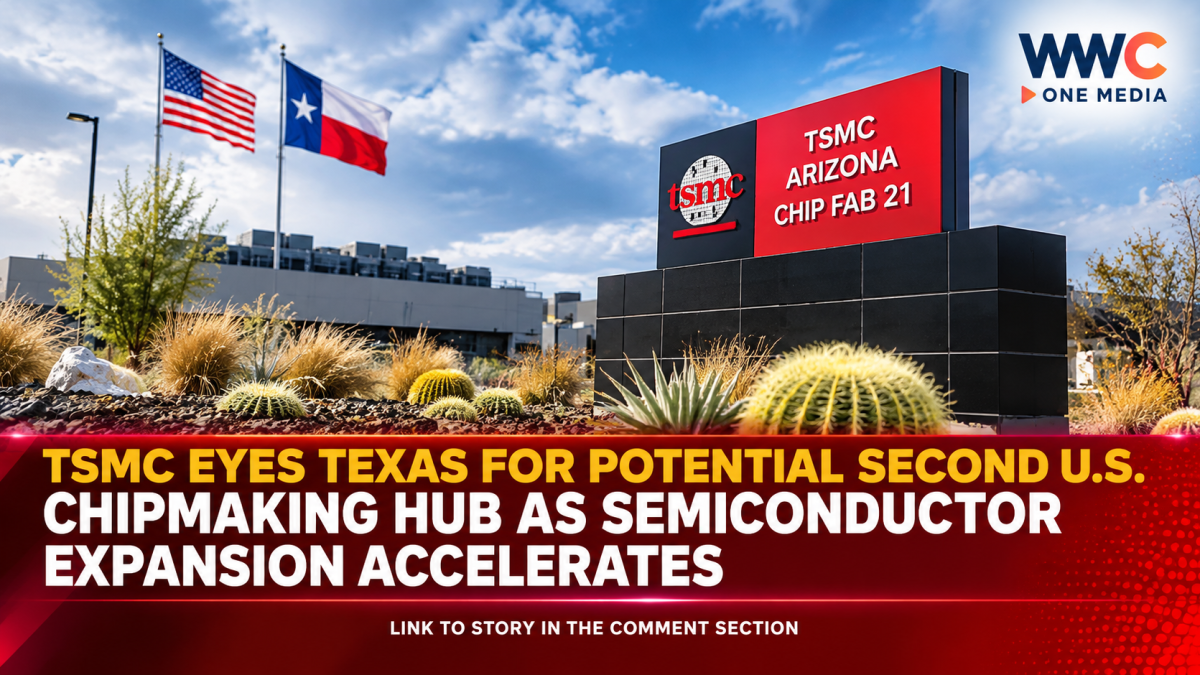
TAIPEI — Taiwan Semiconductor Manufacturing Co. (TSMC) is reportedly considering Texas as the site of a second major U.S. chipmaking hub, potentially creating a new semiconductor corridor alongside its expanding operations in Arizona.
According to a report by United Daily News cited by Taiwan News, Dallas is among the leading candidates for the proposed campus. If the project moves forward, its investment could potentially exceed the NT$8.42 trillion (US$265 billion) that TSMC has planned for its Arizona operations.
The possibility of a Texas expansion comes as TSMC continues to bring more advanced semiconductor manufacturing closer to its major U.S. customers while seeking to diversify its global production footprint.
Industry sources reportedly told UDN that several supply-chain companies have heard discussions about the potential Texas project. However, they said TSMC has not yet contacted suppliers, underscoring that the proposal remains under consideration rather than being a finalized expansion.
Why Texas Is Emerging as a Candidate
North Texas has developed a significant technology and semiconductor ecosystem, earning the nickname “Silicon Prairie.” The region already has semiconductor manufacturing, silicon-wafer suppliers, optical communications businesses and defense-related industries.
Companies including Texas Instruments, Samsung, Coherent and Tesla have operations in the area, potentially giving a future TSMC campus access to an established industrial and technology network.
Texas could also address some of the challenges TSMC has encountered in Arizona, including constraints involving water, electricity and labor availability. Industry sources cited by UDN said Texas could offer a larger workforce, lower taxes and a stable power supply.
U.S. Customers Are Driving the Push
The reported expansion is also closely tied to growing demand from major American technology companies.
Industry sources cited Nvidia, Intel, AMD and Apple as companies seeking greater access to domestically produced advanced chips. At the same time, U.S. pressure for more semiconductor manufacturing on American soil has intensified.
TSMC’s customer base provides another reason for expanding closer to the U.S. market. UDN reported that U.S. customers represented approximately 75.64% of TSMC’s revenue during the first half of 2026.
The shift could also help TSMC reduce exposure to geopolitical and trade risks while bringing production closer to customers.
A New Semiconductor Corridor?
One of the most significant possibilities is the creation of a broader U.S. manufacturing network connecting TSMC’s Arizona operations with Texas’ technology ecosystem.
Such a footprint could strengthen the domestic semiconductor supply chain while giving TSMC greater flexibility in where it manufactures chips for U.S. customers.
But there is still an important caveat: TSMC’s board has not made a final decision, although supply-chain sources reportedly believe the site evaluation is approaching its final stages.
For now, Texas remains a reported possibility rather than a confirmed TSMC commitment.
Still, if the plan advances, the move could mark another major step in the reshaping of global chip manufacturing — and potentially make Texas an even bigger player in the race to build America’s next-generation semiconductor industry.
WWC ONE MEDIA G,A