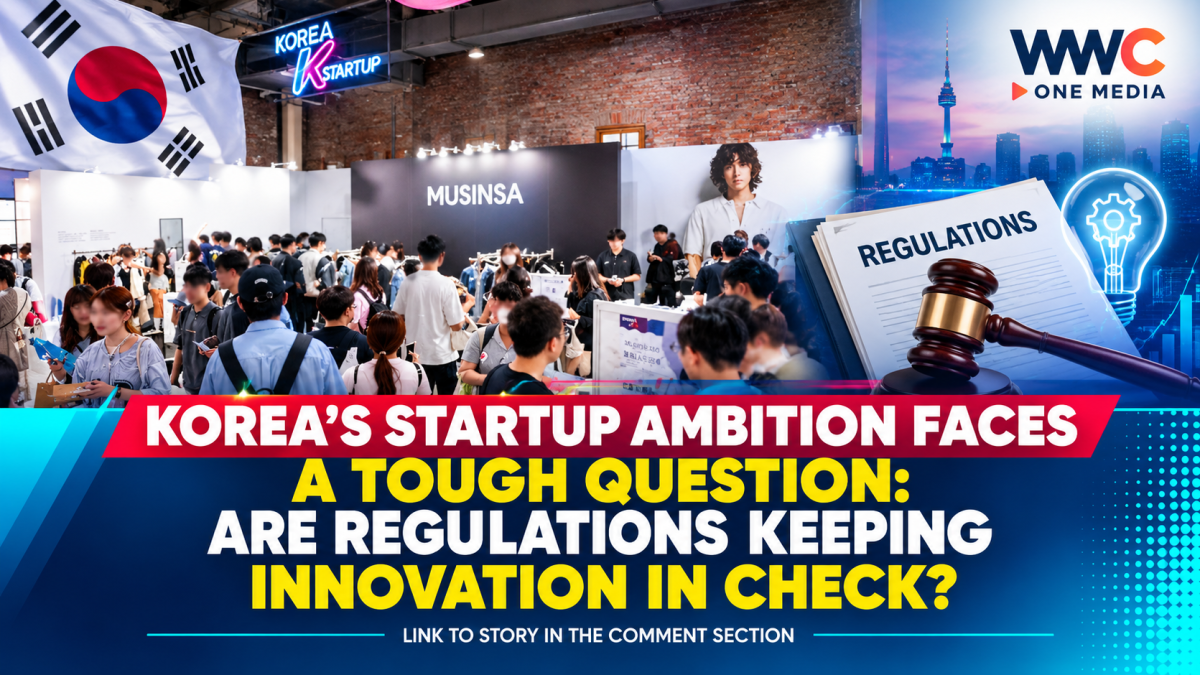
SEOUL — South Korea has invested heavily in building a stronger startup ecosystem, but a growing debate is emerging over whether entrepreneurs have enough regulatory certainty and room to experiment as they try to turn innovative ideas into major businesses.
The question has gained attention following the Seoul Regional Tax Office’s investigation into Musinsa CEO Cho Man-ho over alleged corporate-fund appropriation involving his real-estate investment affiliate, Lapel. The allegations remain subject to the ongoing investigation and have not been established as wrongdoing.
The case comes after a separate Fair Trade Commission investigation into Musinsa’s arrangements with partner brands concluded earlier this month without a finding that the practices violated fair-trade law, according to The Korea Times.
But beyond the individual case, the report raises a broader question for Korea’s startup ecosystem: How can entrepreneurs take risks and experiment with new business models when the regulatory boundaries are difficult to predict?
Musinsa’s Rise Shows What Korean Startups Can Become
Musinsa began in 2001 as an online community for sneaker enthusiasts before developing into one of South Korea’s largest fashion platforms.
Its growth illustrates how a relatively small digital venture can eventually become a major domestic business.
That type of entrepreneurial success is important to Korea’s broader innovation ambitions because startups can introduce new products, services and business models while creating opportunities for investment and employment.
But the Korea Times argues that entrepreneurs need more than financial support to make those businesses possible.
They also need a business environment where regulations are sufficiently clear for companies to understand what is permitted, what requires approval and what consequences may follow if rules are broken.
Regulation and Innovation Need to Move Together
The issue is not whether startups should be exempt from laws.
Rather, the debate concerns predictability.
Innovative companies frequently operate in areas where existing rules may not have been designed for emerging technologies or new business models. Regulatory sandboxes and other experimental frameworks can provide a controlled environment in which companies test new services while regulators assess potential risks.
The OECD has previously identified regulatory barriers, limited access to financing and weak startup exit mechanisms as areas that can affect Korea’s innovation ecosystem. It has also recommended strengthening startups’ global connectivity and improving access to finance.
That makes regulatory clarity particularly relevant for startups attempting to scale beyond Korea.
Government Expands Startup Support
The South Korean government has been expanding measures designed to provide startups with greater access to capital.
According to The Korea Times, the Financial Services Commission recently announced financing measures aimed at promising companies, including some with lower credit ratings, while Korea Strategic Technology Partners is being launched to provide longer-term funding for startups working on strategically important technologies.
The government has also pledged to increase state-backed venture investment and strengthen the country’s startup ecosystem.
Financial support can help companies survive their early stages, but capital alone cannot solve every barrier to growth.
For startups, access to customers, skilled workers, technology, international markets and a predictable regulatory environment can be equally important.
Work Rules Are Another Pressure Point
Labor policy is also part of the broader startup debate.
A Korea Startup Forum survey of 324 startup workers and executives, conducted Aug. 13-26, found that 76% of respondents favored a more flexible approach to the 52-hour workweek system. The figure was 92.2% among executives and C-level officers and 61.3% among general employees.
The survey is not a nationwide poll of all Korean workers, but it illustrates one concern raised within the startup sector: work demands can become concentrated around product launches, research and development and other critical periods.
At the same time, labor protections remain an important part of the regulatory framework, meaning any changes involve balancing business flexibility with worker protections.
AI Adds Another Layer to the Innovation Challenge
South Korea’s startup environment is also being reshaped by artificial intelligence.
Recent research cited by Seoul Economic Daily found that only 24% of companies surveyed considered themselves sufficiently or very well prepared for next-generation AI such as agentic AI and physical AI. Among startups, the figure was 43%. Respondents cited shortages in AI and digital capabilities, technology and data barriers, talent shortages and limited access to infrastructure.
The OECD has similarly noted that Korea has strong digital infrastructure but that the adoption of digital technologies among small and medium-sized enterprises has been comparatively slow.
That means the challenge facing Korean startups is broader than regulation alone.
Companies must also compete for talent, adopt emerging technologies and secure sufficient capital while navigating increasingly complex rules.
The Bigger Question for Korea’s Startup Ecosystem
South Korea has many of the ingredients needed for a strong innovation economy: advanced technology infrastructure, major corporations, research institutions, venture investors and a large pool of highly educated workers.
The challenge is making those elements work together in a way that allows startups to experiment and scale without sacrificing legal compliance.
The Musinsa case has therefore become part of a wider discussion about what kind of business environment Korea wants to create for its next generation of entrepreneurs.
Clear rules do not mean fewer rules. And startup support does not mean immunity from regulation.
The central issue is whether entrepreneurs can understand the boundaries clearly enough to make informed business decisions, while regulators retain the ability to address genuine violations.
For Korea, that balance could become increasingly important as the country looks for the next company capable of following a path from a small startup to a globally recognized business.
WWC ONE MEDIA G,A