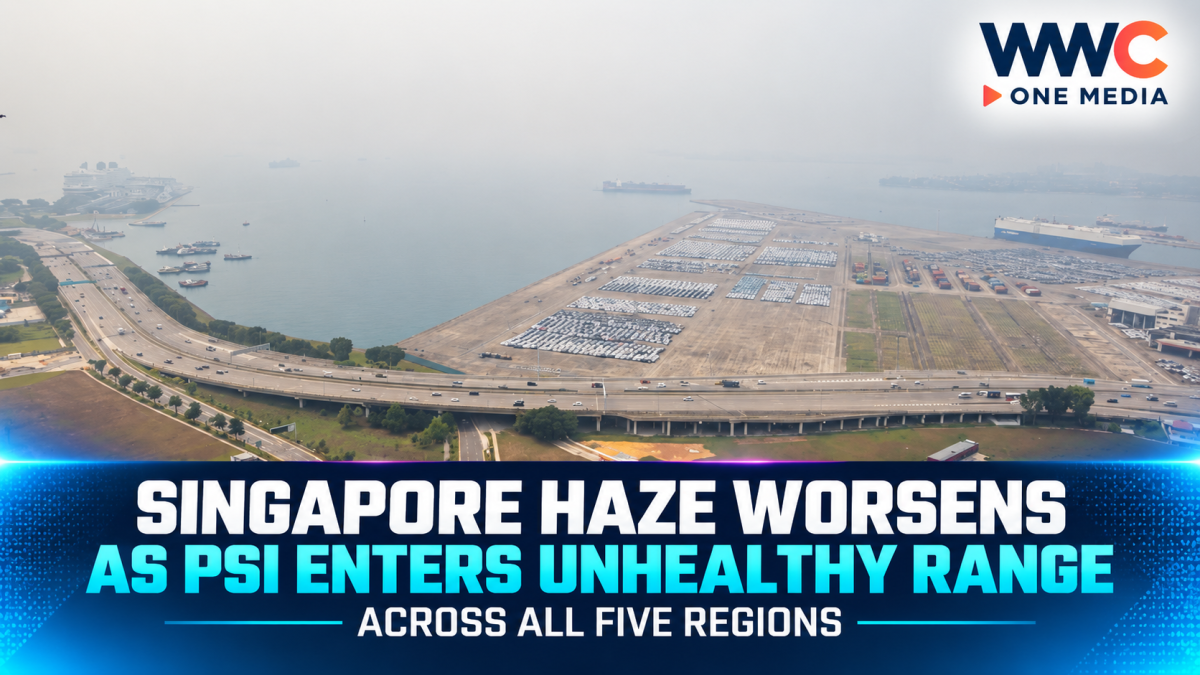
Singapore woke to worsening haze on Tuesday, with the 24-hour Pollutant Standards Index (PSI) entering the unhealthy range across all five regions as smoke from fires in Indonesia continued to drift over the island.
At 8am on Sept. 29, PSI readings ranged from 103 to 158. Central Singapore recorded the highest reading at 158, followed by the west at 143, east at 130, south at 129 and north at 103.
The deterioration began on Monday evening. Central and southern Singapore entered the unhealthy range at 8pm, while the western region followed at 9pm. The eastern region crossed the threshold at midnight, and the northern region reached unhealthy levels at 7am on Tuesday.
One-hour PM2.5 readings were also elevated in most parts of the country. Central Singapore recorded 116, western Singapore 100, eastern Singapore 80 and northern Singapore 67, while the southern region remained in the normal band at 51.
The one-hour PM2.5 concentration reached the high band for the first time during the current haze episode, recording 165 at midnight. Readings between 151 and 250 fall within the high band.
The worsening conditions have been linked to moderate to dense smoke haze from fires in southern Sumatra and Kalimantan. Prevailing winds from the east or southeast are expected to continue carrying smoke towards Singapore, creating a risk that haze will persist.
Authorities have advised residents to consider both the 24-hour PSI and one-hour PM2.5 readings when making decisions about outdoor activities. The 24-hour PSI is intended to guide planning for the following day, while one-hour PM2.5 readings provide a more immediate indication of air quality.
The health impact of haze can vary depending on an individual’s health condition, the pollution level and how long they remain outdoors. People who are more vulnerable to air pollution may need to take additional precautions when conditions deteriorate.
The latest readings mark another significant deterioration during Singapore’s 2026 haze season, after periods of unhealthy air quality were recorded earlier in September.
With smoke continuing to drift from fires across parts of Indonesia and winds expected to remain favourable for haze transport, Singapore’s air quality could remain unsettled in the coming days. Residents are being urged to monitor official air-quality updates as conditions develop.