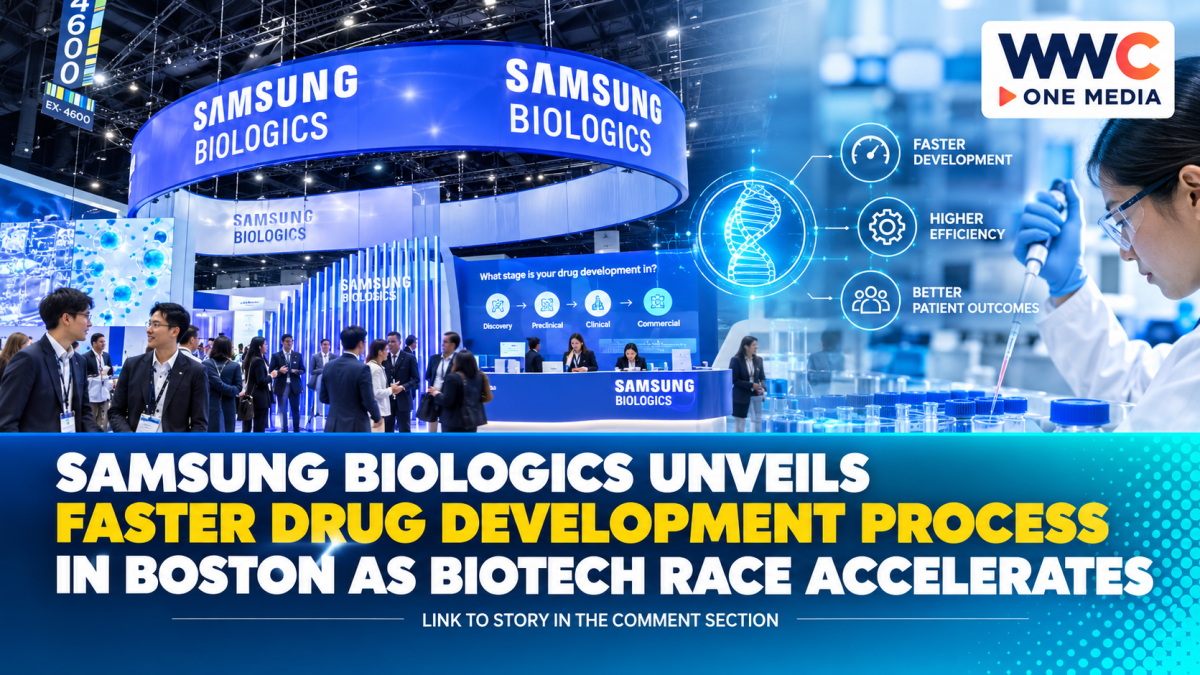
Samsung Biologics is showcasing new manufacturing and development technologies aimed at shortening the time needed to develop biopharmaceuticals, with the company presenting a case in which a customized process reduced development time from 13 months to 9.5 months.
The South Korean biopharmaceutical company unveiled the results during the 2026 BioProcess International (BPI) conference in Boston, held from Sept. 22 to 25. The event brought together more than 3,000 biopharma professionals and about 250 companies, according to Samsung Biologics and Korean media reports.
The 9.5-month timeline represents a reduction of about 27 percent, or roughly 3.5 months, compared with the 13-month development period used in the cited case.
A Faster Route From Development to Manufacturing
At BPI, Samsung Biologics highlighted an integrated chemistry, manufacturing and controls (CMC) approach designed around the characteristics of individual drug molecules.
During a Sept. 23 presentation titled “From Complexity to Confidence,” Taeheui Lee, vice president of Antibody Purification Process Development, presented the case study showing how molecule-specific process design shortened development time while maintaining product quality.
The company says the approach is particularly relevant to increasingly complex biopharmaceuticals, including bispecific and multispecific antibodies, which can require more complicated development and manufacturing strategies.
The message from Boston was clear: speeding up development does not necessarily mean sacrificing process controls or quality.
Cell Culture Productivity Also Gets a Boost
Samsung Biologics also presented results from its proprietary S-Tensify culture-process intensification platform.
According to the company, the technology can increase cell density and achieve up to a twofold improvement in titer, a measure of the amount of desired product generated during a production process, while maintaining product quality.
That matters because improving productivity can potentially allow manufacturers to produce more biological drug substance from a given production process.
The technology was presented alongside other advances in cell-line development and biopharmaceutical analytics.
Samsung Biologics Pushes an End-to-End Strategy
The BPI appearance was also an opportunity for Samsung Biologics to promote its ability to support multiple stages of the biopharmaceutical lifecycle.
The company presented capabilities spanning contract research, contract development and contract manufacturing, commonly referred to as CRO, CDO and CMO services.
Samsung Biologics has participated in BPI for nine consecutive years since 2018, using the conference to engage with pharmaceutical companies, technology providers and other industry specialists.
This year’s showcase also included Samsung Organoids and manufacturing services covering multiple drug modalities.
The Push Extends Beyond Traditional Biologics
Samsung Biologics’ BPI program was not limited to conventional antibody manufacturing.
The company also participated in the Cell & Gene Therapy International conference held alongside BPI, where it presented an analytical strategy for assessing the proportion of full capsids in adeno-associated virus, or AAV, products.
Accurate characterization of AAV products is an important part of developing and evaluating gene-therapy products.
Together, the presentations demonstrated how the company is expanding its technology portfolio across different areas of biopharmaceutical development and manufacturing.
Why Faster Development Matters
For pharmaceutical companies, time is a major factor in bringing potential medicines from laboratory development toward clinical and commercial manufacturing.
A process that reduces development time while maintaining quality could help companies move through manufacturing-development stages more efficiently.
Samsung Biologics’ latest presentation therefore comes as the global CDMO sector continues investing heavily in automation, process intensification, advanced cell lines and integrated development strategies.
Industry research has similarly highlighted process intensification as a way to shorten production timelines, increase throughput and potentially reduce manufacturing costs.
Samsung Biologics’ latest results are company-reported case studies rather than evidence that every drug-development program will achieve the same timeline.
Still, the numbers presented in Boston underline the direction of the industry: faster development, higher productivity and increasingly integrated manufacturing processes are becoming central to the global biopharmaceutical race.
And as drug programs become more complex, the ability to cut months from development timelines could become an increasingly important part of the competition.
WWC ONE MEDIA G,A