
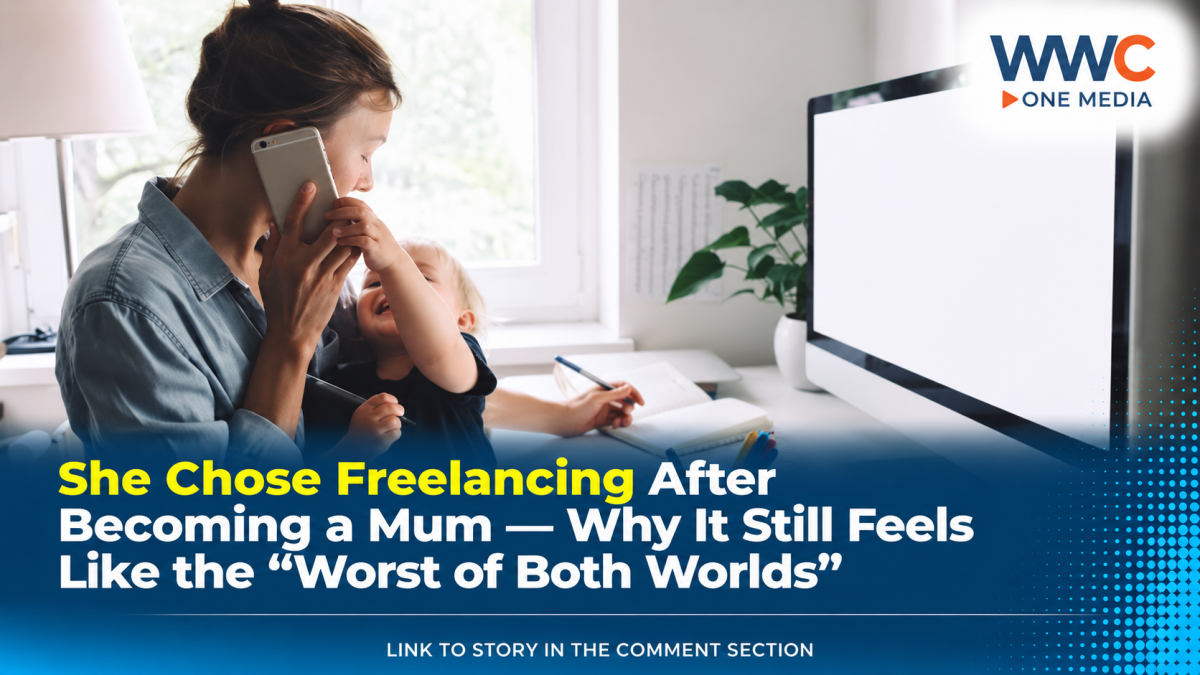
SINGAPORE — For some mothers, returning to work after having children can feel like walking into a no-win situation.
Work full-time and you may be accused of choosing your career over your children.
Work freelance and you may be viewed as not being committed enough to a “real” career.
That is the dilemma described by Singapore-based writer Priyanka Elhence, who argues that motherhood should not automatically mean giving up professional ambitions — or living under a constant cloud of guilt.
After having twins, Elhence eventually returned to the workforce through freelancing rather than going back to a full-time role.
For her family, the arrangement offered something a conventional job could not: flexibility.
But flexibility does not necessarily mean an easier life.
In fact, freelancing can bring its own pressures, including unpredictable work and the need to constantly hustle for the next opportunity. Elhence notes that freelancers can be among the first to lose work when budgets tighten.
Why she chose freelance work
Elhence says she left her full-time hospitality career when her twins arrived.
Six years later, she began freelancing.
Even now, she says she would not return to full-time employment because of the flexibility freelancing provides.
For her, the decision is not about choosing work over family.
It is about finding an arrangement that works for her household while allowing her to remain professionally active.
Singapore’s high cost of living can also make additional household income important for families, she argues.
But she believes mothers should not have to justify wanting both a career and a family.
Being a mother should not mean becoming only “mum”.
The guilt never completely disappears
One of the biggest challenges, she says, is the feeling that working mothers are constantly being judged.
There can be pressure to prove that working does not make someone a less devoted parent.
At the same time, stepping away from work completely can leave some mothers feeling disconnected from their professional identity.
Elhence’s answer is to reject what she describes as the culture of guilt.
Rather than asking whether a mother is doing everything perfectly, she believes the more useful question is whether the arrangement is working for her family.
There will inevitably be compromises.
The goal is to understand those trade-offs rather than treating them as evidence of failure.
Her first rule: remember why you went back to work
Elhence recommends that mothers remind themselves why they chose to return to work.
Perhaps it is financial.
Perhaps it is professional fulfilment.
Perhaps they simply enjoy having an identity outside parenthood.
Whatever the reason, she argues that mothers should not feel ashamed of it.
She also believes parents need to accept that there will be sacrifices whichever path they choose.
There is no perfect arrangement.
A full-time career has trade-offs.
Freelancing has trade-offs.
Staying home with children has trade-offs.
The important thing, she says, is to choose the arrangement that fits the family’s circumstances rather than trying to satisfy other people’s expectations.
Then came firmer boundaries
For Elhence, one of the biggest lessons was learning to separate work time from family time.
When she is working, she tries to focus on work and trust that her child is safe and cared for.
When she is home, she wants to be genuinely present rather than mentally stuck on unfinished assignments or client messages.
That distinction can be particularly difficult for freelancers because work does not necessarily end when an office closes.
A laptop can stay open.
Messages can arrive at any hour.
And another assignment can always be waiting.
Singapore’s Ministry of Manpower recognises flexible working arrangements as one way working parents can manage employment and caregiving responsibilities. Formal requests for flexible work arrangements are covered by the Tripartite Guidelines on Flexible Work Arrangement Requests, which took effect in December 2024.
But flexibility only works when boundaries exist.
Without them, a flexible job can easily become a job that is always on.
Presence matters more than perfection
Another lesson Elhence shares is to focus on the quality of time spent with children rather than obsessing over the number of hours.
A working mother may not be physically beside her child throughout the day.
But when they are together, she believes being attentive and engaged can matter more than simply being present in the same room.
She also rejects the idea that mothers need to be perfect.
Children can cope with routines, caregivers and periods when their mother is working.
What matters, in her view, is maintaining a meaningful connection and making the time together count.
Missing one moment doesn’t make you a bad mum
Elhence admits that working-parent guilt can be triggered by seemingly small things.
She recalls missing a school performance because of a work commitment.
She felt terrible about it.
But her children moved on.
The next time she made it to an event, the earlier disappointment was no longer defining their relationship.
Her takeaway is simple: one missed moment does not erase everything else a parent does.
That mindset can be difficult for mothers who feel pressure to be everywhere, all the time.
But trying to achieve perfection can itself become exhausting.
“Good enough” can be enough
Elhence says she has also learned to forgive herself.
There will be days when work goes badly.
There will be days when parenting feels difficult.
And there will be days when neither side gets as much attention as she would like.
Instead of treating every imperfect day as a personal failure, she advocates accepting that some days are simply about getting through them.
The concept is not about lowering standards.
It is about recognising that perfection is not a realistic measure of successful parenting or professional life.
What are children learning from working mums?
Elhence also looks beyond the immediate challenges.
She believes children learn from what they see at home.
A child who grows up seeing a mother who works, manages responsibilities and remains fulfilled may develop a different understanding of what family and careers can look like.
She argues that boys can learn that household responsibilities should be shared, while girls can grow up seeing that professional ambition and family life do not have to be mutually exclusive.
Those are her personal reflections rather than guarantees about how children will develop.
But they highlight a larger question facing modern families:
What example do parents want their children to see?
Singapore’s workplace is changing — but the balancing act remains
The challenge of combining employment and caregiving is not unique to freelancers.
Singapore’s government has been promoting flexible work arrangements as part of efforts to help parents balance work and family responsibilities.
The Ministry of Manpower says flexible arrangements can include working from home, staggered hours and part-time or reduced-load arrangements.
Yet flexibility does not eliminate the underlying pressures.
Parents still have financial commitments.
Employers still have operational needs.
Freelancers still have to find clients.
And children still need time, attention and care.
That is why the debate is not simply about whether mothers should work.
It is about whether families have enough flexibility to decide how work and caregiving can coexist.
There may be no perfect answer
For some mothers, full-time employment may be the right choice.
For others, freelancing may provide the flexibility they need.
Some may choose to take a career break and return later.
Others may build businesses around their family commitments.
None of these choices automatically makes someone a better or worse parent.
Elhence’s central argument is that mothers should be allowed to make those decisions without being weighed down by guilt.
Because the reality of motherhood is already demanding enough.
Adding the pressure to prove that you have made the “right” career choice only makes it harder.
Perhaps the real problem is not that working mums are trying to have it all — but that society keeps making them feel guilty whichever path they choose.
Editorial note
This article is based primarily on Priyanka Elhence’s first-person commentary and experiences published in August 2026. Statements about her career history, twins, freelancing and approach to motherhood should therefore be attributed to her rather than presented as universal experiences shared by all working mothers.
Singapore’s flexible-work policies provide broader context, but they do not mean every employer must approve every flexible-work request. Under the Tripartite Guidelines, employers assess formal requests and may reject them on reasonable business grounds.
WWC ONE MEDIA J.M.D




Leave a Reply