
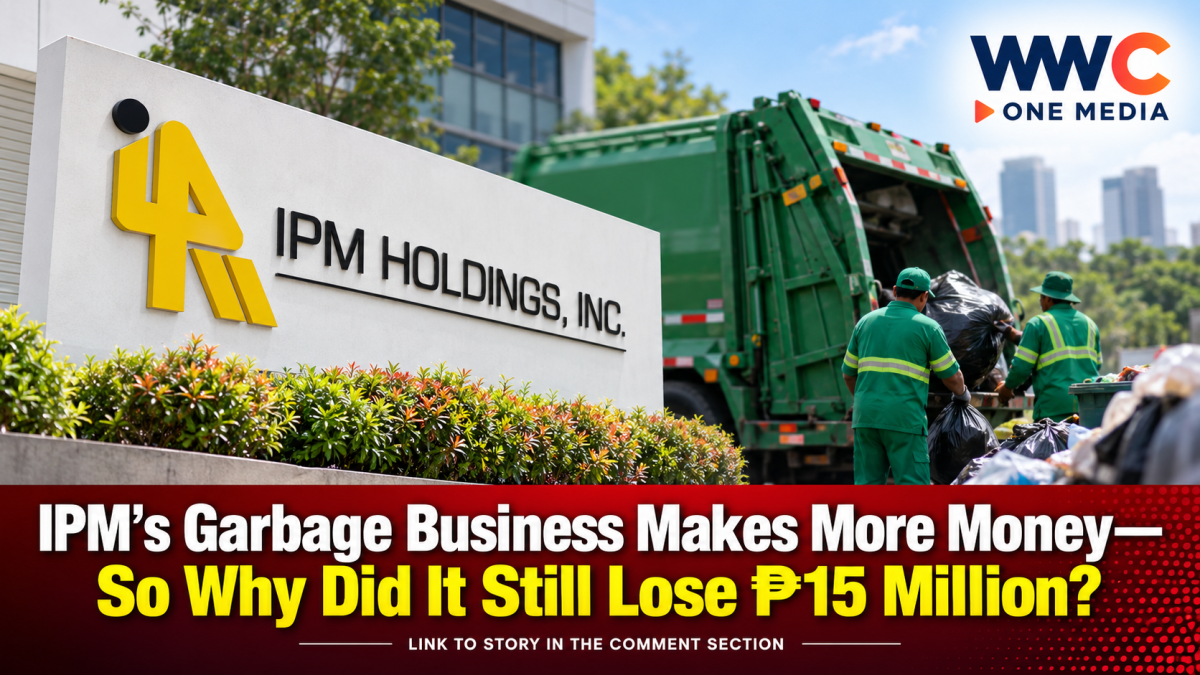
The listed company, whose core environmental-services operations are largely carried out through subsidiary Basic Environmental Systems & Technologies Inc. (BEST), reversed from a ₱11.59 million net profit in the same period last year.
IPM’s latest financial report showed that service income rose 3 percent to ₱122.30 million in the first six months of 2026 from ₱118.76 million a year earlier. But the increase was overwhelmed by expenses.
Cost of services surged 35.8 percent to about ₱118.65 million, leaving only a narrow margin from the company’s main operations before accounting for overhead, financing costs and other expenses. In practical terms, roughly ₱97 of every ₱100 generated from service income went back into delivering those services.
Higher waste revenue, but even higher costs
IPM’s waste-management business generated more income from landfill operations during the period.
Tipping fees—the charges paid for waste disposal at landfill facilities—rose to ₱87.83 million from ₱78.42 million, remaining the group’s biggest source of service income.
Hauling revenue also edged higher to ₱22.31 million from ₱21.38 million.
However, not all revenue streams moved in the same direction. Income from the group’s Trash to Cashback recycling program dropped to ₱9.43 million from ₱16.23 million, adding further pressure to the company’s overall earnings mix.
The bigger problem, however, was on the cost side.
IPM’s expenses were hit by higher salaries and wages, equipment rentals, depreciation and amortization, fuel and oil costs, bidding expenses and other operating requirements, according to its quarterly filing.
Among the biggest increases:
- Equipment and other rentals climbed to ₱27.24 million from ₱20.33 million
- Depreciation and amortization jumped to ₱22.76 million from ₱14.06 million
- Fuel and oil expenses increased to ₱11.94 million from ₱7.90 million
- Bidding expenses reached ₱4.15 million, compared with none in the previous year
The pressure was also visible in the second quarter alone. IPM recorded a ₱5.54 million net loss for the April-to-June period, reversing from a ₱1.23 million profit a year earlier. The company attributed the deterioration primarily to higher service and operating costs.
BEST remains at the center of IPM’s basura business
IPM owns a 75 percent stake in BEST, which handles much of the group’s environmental-services operations, including waste hauling and disposal, landfill construction and operations, sanitation services and recycling programs.
The business generates revenue from several waste-management activities, including landfill tipping fees and hauling services for commercial establishments, private entities and local government units.
BEST also operates and manages waste-related facilities and projects in different parts of the country, including the Passi City integrated waste facility in Iloilo and a sanitary-landfill venture involving the provincial government of Bataan.
But IPM’s filings also show that the company is navigating structural challenges in parts of its waste-management network.
Its associate Metro Clark Waste Management Corp. (MCWM), for example, was unable to continue landfill operations after the expiration of its long-term sanitary landfill lease in October 2024. MCWM has continued providing hauling services while a related company works toward developing a new landfill facility in South Luzon.
Cash position remains relatively strong
Despite the earnings reversal, IPM is not immediately facing a liquidity crisis.
The company ended June 2026 with approximately ₱106.44 million in cash, up from the end of 2025. Its current assets also remained substantially higher than current liabilities, providing the group with a measure of short-term financial flexibility.
Still, a significant portion of IPM’s balance sheet remains tied to related-party transactions.
As of June 30, related parties owed the company ₱334.87 million in trade receivables, including amounts due from IPM Construction and IPM Environmental Services Inc.
IPM also carried approximately ₱390.92 million in advances for land acquisitions involving related parties.
Combined, those trade receivables and land advances totaled around ₱726 million, equivalent to nearly half of IPM’s roughly ₱1.53 billion in total assets, according to the company’s financial disclosures.
A wider earnings problem after a difficult 2025
The first-half setback follows an already challenging 2025 for IPM.
For the full year ended December 31, 2025, IPM reported ₱265.64 million in gross revenue but ₱272.89 million in gross expenses, while its annual filing showed a net loss for the year. The company’s total assets stood at about ₱1.56 billion at the end of 2025.
The latest numbers suggest that while IPM is still finding ways to increase revenue from its waste-management operations, profitability remains heavily dependent on whether management can control the rapidly rising costs of running those services.
For now, the message from the first half is clear: more garbage may be generating more revenue—but it is also becoming increasingly expensive to collect, haul, process and dispose of.
And unless IPM can bring those costs under control, investors may soon be asking an uncomfortable question: Can the company’s growing waste business turn profitable again—or will rising operating expenses continue to bury the gains?
WWC ONE MEDIA J.M.S

Leave a Reply