
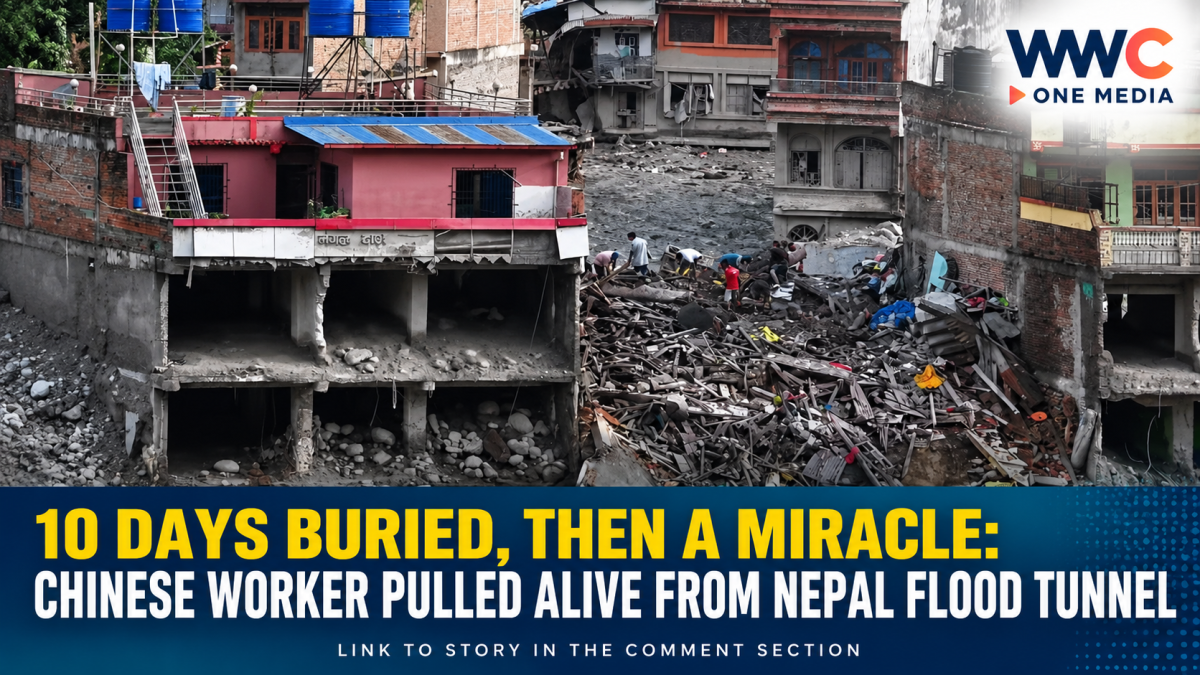
KATHMANDU, Nepal — Hope has returned to Nepal’s devastated flood zone after rescuers pulled a Chinese worker alive from a buried hydropower tunnel 10 days after catastrophic floods and landslides swept through the Nepal-Tibet border region.
The survivor, identified as Lu Haitao, was rescued on Saturday from about 225 meters inside a tunnel at the Upper Trishuli-1 Hydropower Project in Rasuwa district, according to Nepalese authorities and international reports.
Images released by the Nepal Army showed rescuers carrying Lu out of the tunnel. He appeared conscious and alert, although covered in mud. Authorities said his condition was being assessed after the rescue.
The dramatic rescue came just one day after two Nepalese hydropower workers were pulled alive from another tunnel at the Upper Trishuli 3A Hydropower Project after surviving underground for nine days.
Those rescues have given families and emergency teams renewed hope that other people could still be alive inside blocked tunnels across the disaster zone.
Survivors found as rescue teams race against time
The latest breakthrough came as international and Nepalese rescue teams intensified operations at hydropower facilities buried beneath enormous quantities of mud, rock and flood debris.
At least 12 hydropower projects were severely affected by the disaster, while hundreds of workers were reported missing. Authorities have focused particular attention on underground tunnels, where some workers may have survived in pockets containing air and possibly water.
Rescue operations have received assistance from specialists from India, China, Australia and South Korea, working alongside Nepalese emergency personnel. Engineers have also been sharing technical information, maps and other data to help rescuers determine where tunnels and possible survivors may be located.
The earlier rescue of Sanjay Sah and Kabir Maharjan was particularly significant. Their tunnel entrance had been buried beneath roughly 170 meters of mud and debris, forcing rescuers to use excavation equipment, old maps, satellite imagery and controlled blasts to reach the trapped workers.
Disaster death toll continues to climb
The rescues have brought moments of relief amid one of Nepal’s worst recent disasters.
The floods and mudslides followed a massive glacial and rock collapse on August 26, sending a wall of water, ice, mud and debris through communities along the Trishuli and Bhotekoshi river systems.
More than 1,300 people have died in Nepal, while roughly 5,000 remain missing, according to figures reported by international media and Nepalese authorities. Across the border in Tibet, Chinese authorities have reported additional deaths and hundreds of missing people.
Reuters reported that the disaster has caused billions of dollars in damage and devastated entire settlements, with roads, bridges, homes and hydropower infrastructure swept away or buried.
The scale of the destruction has also created an enormous identification challenge. Nepalese authorities have collected DNA samples from recovered remains, while hundreds of families continue to wait for confirmation about missing relatives.
A second miracle deepens the hope
The tunnel rescues are particularly significant because they came after days in which expectations of finding survivors were rapidly declining.
On Friday, rescuers first located two Nepalese workers after hearing voices from inside a damaged tunnel. The discovery led teams to accelerate excavation efforts and eventually reach the trapped men.
A 64-year-old Nepalese woman, Chandika Shrestha, was also rescued alive from beneath the remains of her home in Betrawati after being missing for days. Her family had already begun performing death rituals for her before she was found alive.
Together, the rescues have transformed the mood of search teams from despair to cautious optimism.
Still, officials stress that the situation remains extremely dangerous, and the discovery of survivors does not mean large numbers of people will necessarily be found alive.
Families refuse to give up
Across the affected region, families of missing workers and residents continue to wait for news as rescuers dig through collapsed infrastructure.
For many, the recent rescues have become a powerful reason to keep searching.
The survival of people trapped underground for nine and 10 days demonstrates that some victims may have endured in protected spaces despite the extreme destruction above ground.
Rescue teams are therefore continuing to search tunnels and other enclosed areas while heavy machinery clears massive amounts of mud and rock.
For a country still counting its dead and missing, every voice heard beneath the rubble now carries extraordinary significance.
And after 10 days of devastation, Nepal’s rescuers have been given something the disaster had nearly taken away: hope.
WWC ONE MEDIA J.M.S




Leave a Reply