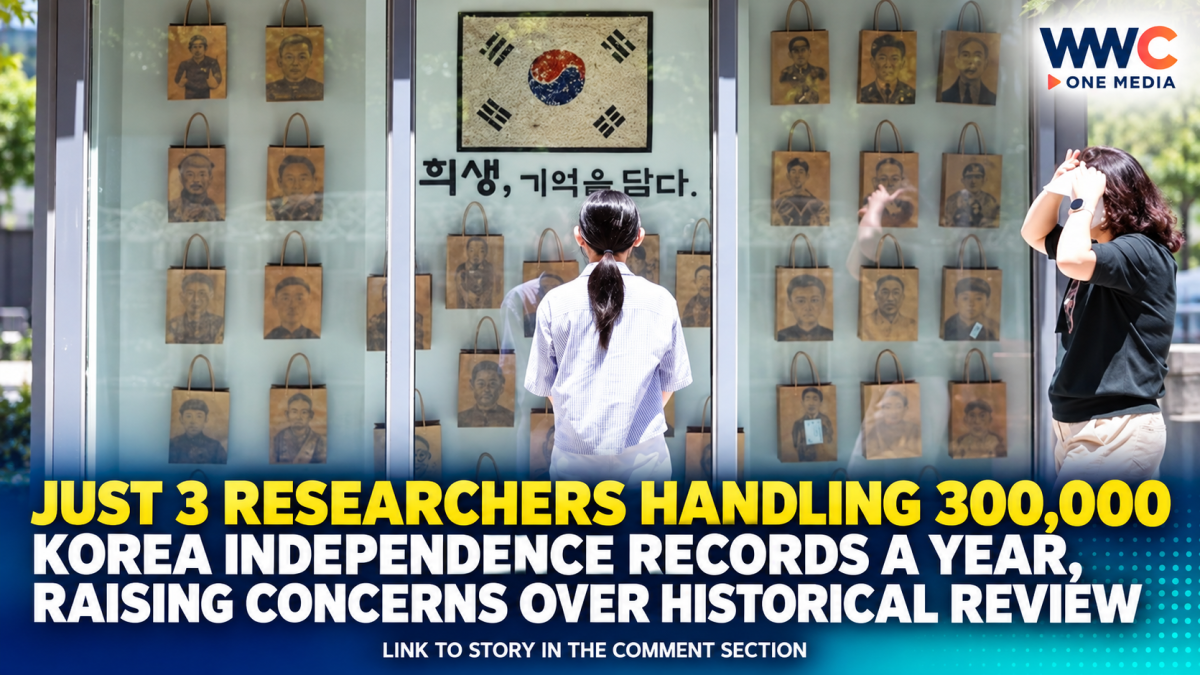
SEOUL — South Korea’s effort to uncover and recognize people who contributed to the country’s independence movement is facing a major workload challenge: only three personnel are assigned to collect and manage historical records, despite roughly 300,000 records being gathered each year.
The figures, disclosed by the Ministry of Patriots and Veterans Affairs, show that just three of the 37 personnel in its Patriots and Veterans Archives Management Division are specifically responsible for collecting and managing records related to Korea’s independence movement against Japanese colonial rule from 1910 to 1945.
That works out to roughly 100,000 records per researcher each year, based on the ministry’s estimate of about 300,000 records annually.
A Growing Historical Record Backlog
The staffing issue comes as South Korea continues efforts to identify independence activists who have not yet received official state recognition.
The veterans ministry has announced plans to honor more than 600 previously unrecognized independence activists in 2026, an increase from 502 people recognized in 2025.
The ministry had identified and honored 408 independence fighters as of August, according to the latest figures reported by Yonhap.
The records being reviewed can be crucial in determining whether individuals involved in Korea’s independence movement qualify for official state honors. A separate group of 21 personnel is tasked with reviewing historical records concerning activists who have not yet received such recognition. Their findings are considered by an evaluation committee responsible for determining whether an individual’s contributions warrant state honors.
A ministry official acknowledged the continuing shortage of personnel, saying the volume of independence-movement records continues to grow as researchers uncover information about additional potential activists.
Millions May Have Taken Part — But Recognition Remains Limited
The scale of the historical investigation becomes clearer when placed against estimates of the independence movement itself.
An estimated 3 million people are believed to have participated in Korea’s struggle for independence from Japanese colonial rule. Yet, as of August, only 19,059 people had officially received state honors for their contributions — less than 1 percent of that estimated total.
The gap does not necessarily mean all unrecognized individuals will qualify for official honors. Rather, it highlights the enormous volume of historical evidence that authorities must examine before individual contributions can be formally evaluated.
Verification Is Also Taking Years
The staffing issue comes alongside a separate government effort to reexamine the records of people who have already received independence-related state honors.
According to Yonhap, a comprehensive review launched in 2019 had examined 7,835 of the 15,180 people who had been honored through 2018 by August 2026 — a completion rate of 51.6 percent.
The project was originally scheduled to finish in 2023 but was extended to 2028 because of the volume of domestic and overseas records requiring examination. The review has so far resulted in the cancellation of honors involving 43 people over issues including duplicate or false claims, while five family-related recognition cases were also canceled.
Meanwhile, South Korea is also examining historical sites connected to the independence movement overseas. The veterans ministry is conducting on-site surveys of 1,032 overseas historical sites, with the work scheduled to continue through 2028. South Korea and Kazakhstan also recently agreed to strengthen preservation of independence-movement sites and related historical records in Kazakhstan.
The Historical Race Continues
South Korea’s independence movement produced an enormous body of records spanning decades, countries and generations of activists. Preserving and verifying those materials is essential to determining how individuals and events are officially remembered.
But with hundreds of thousands of records entering the system each year and only a small team assigned to collect and manage them, the latest figures reveal the scale of the challenge facing officials as South Korea continues searching its archives for stories that may have remained undocumented or unrecognized for generations.
WWC ONE MEDIA G,A