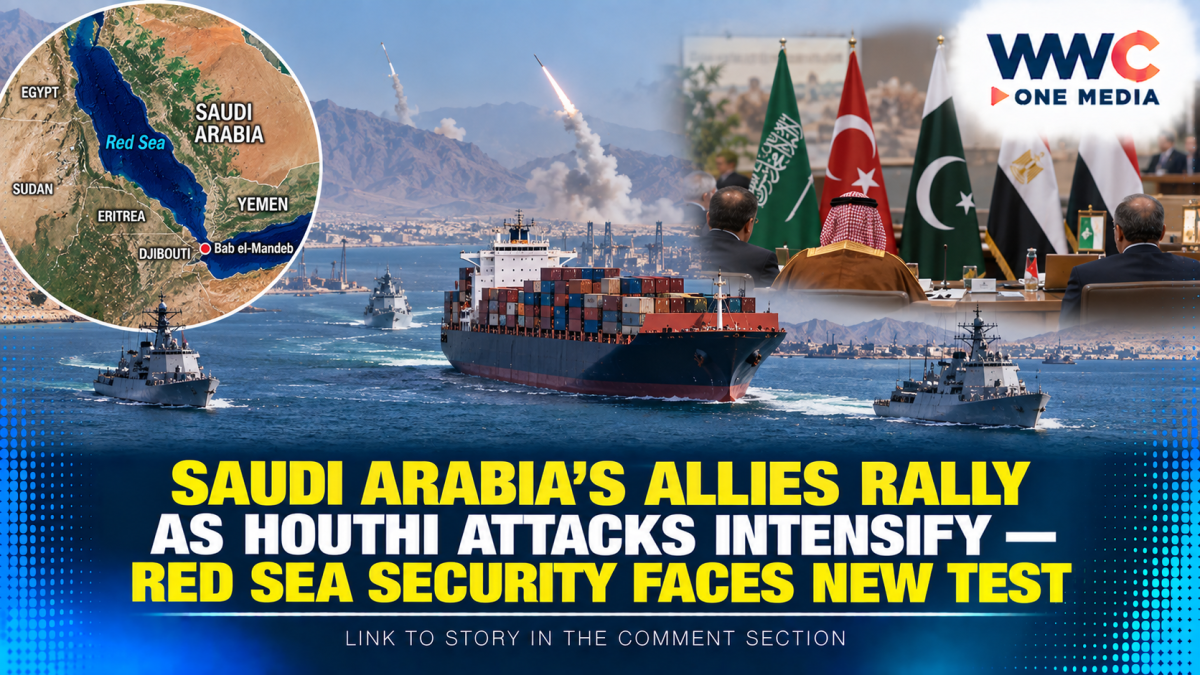
RIYADH/CAIRO — Saudi Arabia is turning to its regional defense partners as attacks by Yemen’s Iran-aligned Houthi movement intensify, raising fresh concerns over security around the Red Sea and the region’s vital energy routes.
Saudi Arabia, Turkey and Pakistan are preparing an urgent high-level meeting of their military chiefs to discuss ways to support the kingdom under the three countries’ recently established Mecca Joint Defence Agreement.
The agreement provides for mutual defense if one of its members is attacked, making the planned meeting a significant development as Houthi strikes increasingly reach Saudi territory.
Six Missiles Intercepted Over Saudi Arabia
Saudi authorities said their forces intercepted six ballistic missiles launched by Houthi fighters toward areas including Taif and the Yanbu region on Thursday.
Emergency alerts were issued for several locations, including Jeddah and the holy city of Mecca, although Reuters reported that it was not immediately clear whether the missile attacks caused casualties or significant damage in the targeted areas.
The Houthis separately claimed they had launched dozens of missiles and drones against Saudi targets.
The competing accounts underscore the rapidly changing security situation as the Yemen conflict becomes increasingly connected to the wider regional war.
Turkey and Pakistan Prepare to Stand With Riyadh
Saudi, Turkish and Pakistani foreign ministers have already met under the framework of the Mecca agreement.
They condemned attacks targeting Saudi Arabia and civilian sites and affirmed Riyadh’s right to defend itself, according to Saudi authorities cited by Reuters.
The ministers then discussed arranging an emergency meeting between the three countries’ chiefs of staff to consider how the agreement could be implemented in response to the attacks.
The development matters because Turkey and Pakistan are now formally linked to Saudi Arabia through a mutual-defense arrangement, adding another layer to an already complicated regional security picture.
Iran Distances Itself From Houthi Actions
The escalation is also putting renewed attention on the relationship between Tehran and the Houthis.
Iranian President Masoud Pezeshkian said in a Fox News interview that the Houthis are responsible for their own actions, distancing Tehran from direct responsibility for the group’s operations.
At the same time, Reuters reported that Yemeni, Iranian and regional sources have described Iranian involvement in the Houthis’ military advance in Yemen, illustrating the continuing dispute over the extent of Tehran’s operational influence.
That distinction could become increasingly important as Saudi Arabia and its partners consider their response.
Why the Red Sea Matters to the Global Economy
The confrontation is not limited to military positions.
The Red Sea and its approaches are critical routes for international shipping, while Saudi Arabia is the world’s largest oil exporter.
Houthi attacks have already disrupted shipping around the southern entrance to the Red Sea, while the wider conflict has placed additional pressure on energy routes through the region. Reuters reported that the attacks have contributed to disruptions affecting Saudi oil exports.
The latest missile attacks also coincided with renewed concern in oil markets. Reuters reported that Brent crude settled at $106.60 a barrel on Sept. 24, up 3.4%, following the Houthi attack and renewed fears about supply disruptions.
G7 Had Already Condemned the Escalation
The latest diplomatic response comes days after G7 leaders called on the Houthis to stop military operations and attacks on civilian shipping.
The G7 also urged Iran to end its support for the Houthi movement.
The statements came after the Houthis expanded their military activity along Yemen’s Red Sea coast and launched an attack on Riyadh, developments that have increased concerns about international trade and energy security.
A New Test for the Regional Defense Pact
The planned Saudi-Turkish-Pakistani military meeting could become an important test of how the new defense arrangement operates during an active regional conflict.
For now, the three countries are discussing support rather than announcing a specific military response.
Meanwhile, the Houthis continue to pose a security challenge to Saudi Arabia, while the broader conflict is placing pressure on some of the world’s most important energy and shipping routes.
What happens next could determine whether the latest escalation remains a contained confrontation — or becomes another front in a widening Middle East crisis.
WWC ONE MEDIA G,A