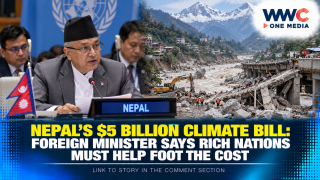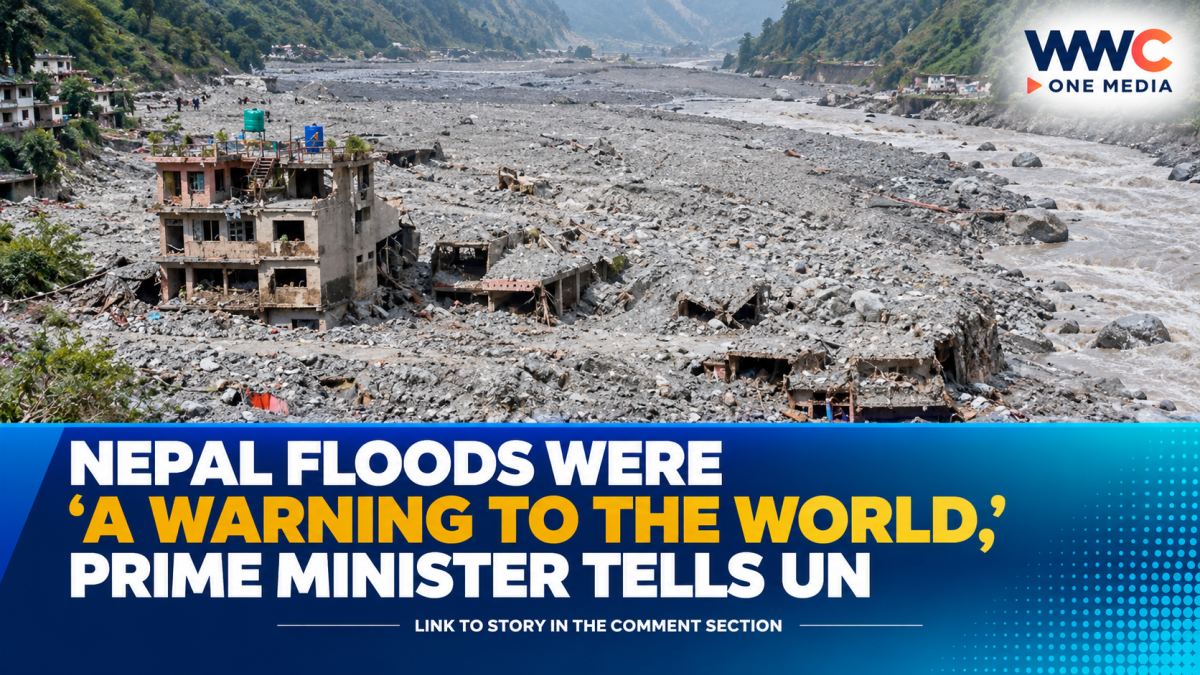
NEW YORK — Nepal’s catastrophic floods have become the centerpiece of a warning to the international community, with Prime Minister Balendra Shah telling the United Nations that the disaster was not simply a national tragedy but a signal of the growing dangers facing the Himalayan region.
Speaking at the 81st United Nations General Assembly, Shah said the devastating flooding in Nepal last month should be viewed as a warning for countries around the world as climate change increasingly affects fragile mountain ecosystems.
“A Warning to the World”
Shah described the disaster in the Bhotekoshi-Trishuli region as a major climate warning and asked the international community to recognize that the risks facing Nepal extend beyond its borders.
“The Bhotekoshi flood was a warning to the world,” Shah said during his address, according to Nepalese reports.
He argued that warming temperatures are destabilizing the Himalayan environment, contributing to melting glaciers and permafrost and increasing the potential for dangerous events.
The disaster struck on August 26 after a high-altitude glacial collapse triggered devastating flooding and landslides along the Nepal-China border region.
Himalayan Communities Face Growing Risks
The disaster caused extensive destruction across northern Nepal, damaging homes, roads, bridges and other infrastructure.
Reuters reported earlier this month that at least 1,386 people had died and more than 5,130 remained unaccounted for on the Nepal side of the border. The scale of the destruction left entire communities buried under mud and debris.
The United Nations had already launched a $49.6 million emergency appeal to support more than 84,000 people affected by the floods and landslides. The UN said the disaster had destroyed critical infrastructure and left some communities without reliable transportation, electricity, water and sanitation.
Nepal Calls for International Climate Support
Shah used his UN address to call for greater international assistance as Nepal works to recover and prepare for future climate-related disasters.
Nepal has argued that vulnerable countries should have greater access to climate finance, particularly grants that do not add to their debt burden.
The country’s government has also sought stronger international cooperation on disaster preparedness, early-warning systems and climate resilience in the Himalayan region.
The Warning Extends Beyond Nepal
Nepal’s message comes amid growing concern about the vulnerability of the Himalayan region to climate change.
The government says melting glaciers, unstable mountain terrain and changing weather patterns are creating increasingly difficult conditions for communities living in high-risk areas.
During his UN visit, Shah also met Secretary-General António Guterres, who expressed condolences over the Bhotekoshi disaster and discussed issues including riverbank resettlement, green reconstruction and the continuing risk of glacial lake outburst floods.
The UN has separately emphasized the urgent humanitarian needs created by the disaster, particularly before winter conditions make access to high-altitude communities even more difficult.
From National Disaster to Global Warning
For Nepal, the flood disaster has become more than a recovery challenge. Officials are using it to push for stronger international action on climate adaptation, disaster preparedness and financial assistance.
The message from Kathmandu is straightforward: what happened in the Himalayas cannot be treated as an isolated event.
Nepal has endured the disaster. Now its leaders are asking whether the rest of the world will treat the warning as seriously as the country that experienced it.
WWC ONE MEDIA G,A