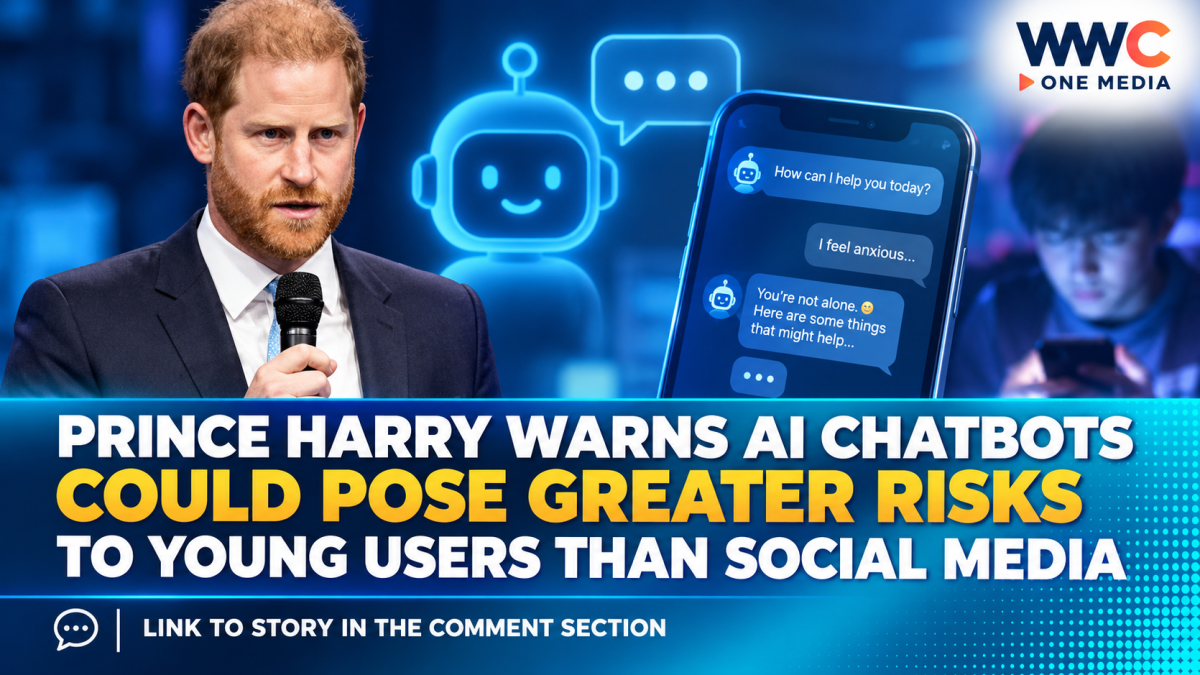
Prince Harry has warned that artificial intelligence chatbots designed to provide companionship could pose even greater risks to young people than social media, arguing that AI is moving beyond capturing attention and increasingly influencing personal relationships.
Speaking at the Clinton Global Initiative in New York on Sept. 23, the Duke of Sussex said AI technology is becoming “more persuasive, more intimate, and more powerful” as young users increasingly interact with systems capable of simulating conversation, friendship and emotional support.
Harry said social media had learned how to capture people’s attention, while AI is now learning how to enter relationships. His concern is particularly focused on companion-style chatbots that can maintain prolonged, personalised conversations and potentially encourage emotional attachment.
The comments build on Harry and Meghan Markle’s work through their Archewell Foundation’s Parents Network, which was launched in 2024 to support families affected by harmful experiences involving social media and young people. Harry said that while progress had been made in addressing social-media risks, rapid advances in AI had made the challenge more difficult.
Harry’s warning comes as governments and technology experts are increasingly examining how children interact with AI systems.
In the United Kingdom, the government said in July that it would introduce additional safeguards for children using AI chatbots. Its consultation found particular concern about chatbots that mimic friendship, with 80% of respondents saying there were specific risks associated with that feature. Among young respondents aged 16 to 21 who took part, 68% agreed that chatbot systems mimicking friendship presented particular risks.
The British government has also said it plans to prevent under-18s from accessing AI chatbot services primarily offering sexualised content, alongside stronger age-verification requirements and other online safety measures.
Concerns are also emerging from within the technology industry itself. Tom Siegel, a former head of Google’s Trust and Safety team, recently warned that AI could potentially cause even greater harm to children than social media. He has called for stronger age verification and independent safety standards, arguing that technology companies cannot be expected to address the risks entirely through self-regulation.
The debate is complicated by the fact that AI chatbots can also provide legitimate benefits for young people, including education, creativity and access to information. The challenge for regulators and technology companies is determining how to preserve those benefits while limiting features that could encourage excessive dependence or expose minors to harmful content.
Harry’s comments also come amid a broader reckoning over social-media companies and children’s online experiences. Governments have introduced or considered restrictions on minors’ access to social platforms, while technology companies face increasing pressure to demonstrate that their products include effective protections for younger users.
For Harry, the central issue is not simply how much time children spend using technology but how deeply technology can become embedded in their lives. Companion AI differs from conventional social media because its interaction is direct, personalised and conversational, potentially making the relationship feel more intimate to users.
His remarks do not establish that AI chatbots are inherently more harmful than social media; rather, they represent his warning about the potential risks of increasingly persuasive and emotionally responsive AI systems.
The bigger question now is whether regulators and technology companies can establish effective safeguards for young users before AI companions become an even more deeply embedded part of childhood and adolescence.