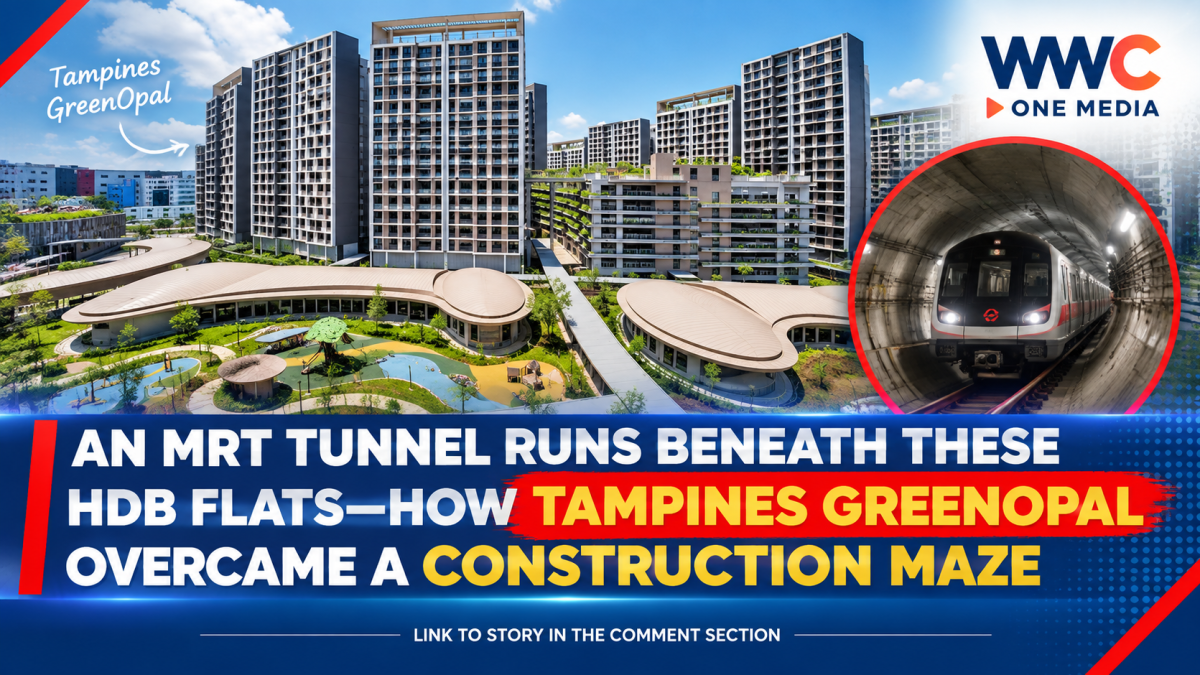
SINGAPORE — Beneath the homes of Tampines GreenOpal, an MRT tunnel runs through the heart of the development.
Above it, construction crews had to build eight residential blocks, two multi-storey car parks with roof gardens and two childcare centres—while navigating underground utilities, limited manpower and the disruption caused by the Covid-19 pandemic.
The complex project has now earned Vico Construction a major milestone: its first Certificate of Merit in the construction category at the HDB Awards 2026. The recognition comes for the company’s first HDB Build-To-Order (BTO) project undertaken as the main contractor.
The challenge was hidden underground
One of the biggest obstacles at Tampines GreenOpal could not be seen from the surface.
The Downtown Line MRT tunnel runs beneath the centre of the development, placing more than half of the project site within the Land Transport Authority’s Railway Protection Zone.
That meant foundation works had to be carefully planned to protect the existing rail infrastructure.
But the tunnel was not the only underground complication.
Existing utilities also had to be identified before foundation works could proceed. Vico carried out multiple trial holes to determine exactly where underground services were located and how deep they ran.
The information was then used with project consultants to determine where foundation piles could safely be installed.
Then Covid hit the construction schedule
The project faced another major test after the pandemic disrupted construction manpower.
Following Singapore’s circuit breaker period, a key supplier experienced a shortage of workers needed to fabricate rebar cages—steel reinforcement structures required for the foundation piles.
Instead of waiting for the supplier to recover its workforce, Vico trained its own employees to fabricate the cages internally.
The company ultimately produced about 30 per cent of the rebar cages itself, according to project director and senior project manager Poh Kim Siah.
The approach helped save approximately three months and kept the foundation works moving.
Technology became another construction tool
Vico also turned to digital technology to reduce mistakes and improve coordination.
The team used Building Information Modelling (BIM) to create three-dimensional representations of the development before construction.
The digital models allowed the team to identify potential clashes involving pipes, openings and other building services earlier in the process.
That reduced the need for physical mock-ups and helped minimise rework.
The project also used QR codes to track precast components, allowing the team to monitor components from factory production through delivery and installation.
For a large project where delays in one component can affect several construction stages, knowing what had been produced, delivered or was still missing helped the team coordinate more efficiently.
A change to the roof structure saved 700 man-days
Another productivity improvement came from the way certain roof structures were constructed.
Instead of building roof structures higher than 5m entirely on site, Vico proposed using precast components manufactured in a controlled environment before transporting them to Tampines GreenOpal for installation.
According to the company, the change saved approximately 700 man-days across the eight residential blocks.
It also reduced the amount of work employees needed to carry out at height, addressing both productivity and safety considerations.
Safety remained a major focus
The project reached about 500 to 600 workers at its peak, and Vico said it recorded 5.4 million accident-free man-hours during construction.
Daily toolbox meetings were held so workers could review the risks associated with the day’s activities and the protective equipment required.
The company also conducted regular meetings with subcontractors to review site conditions and address safety concerns.
What was finally delivered?
Tampines GreenOpal consists of:
- Eight residential blocks
- Two multi-storey car parks with roof gardens
- Two childcare centres
- Community and recreational facilities for residents
What makes the project notable is not simply the scale of the finished development, but the constraints under which it was built.
The MRT infrastructure beneath the site meant that foundation works required additional planning. Covid-related labour shortages added pressure to the construction schedule, while the project also required coordination across suppliers, consultants and subcontractors.
Why the HDB award matters
The HDB Awards recognise companies and consultants involved in delivering public housing, including achievements involving construction quality, project management and site management.
For Vico Construction, the Tampines GreenOpal recognition is particularly significant because it was the firm’s first BTO development as the main contractor.
The company had previously worked on projects including Thomson Impressions, Marina Bay Cruise Centre and commercial developments, but taking responsibility for an HDB BTO project presented a different set of challenges.
The project illustrates how Singapore’s public-housing construction is increasingly combining conventional building expertise with prefabrication, digital modelling, component tracking and productivity-focused construction methods.
And there is an intriguing detail residents may never see from their flats:
While families live above ground, one of Singapore’s MRT tunnels runs beneath the estate—making the foundations of Tampines GreenOpal part of a much bigger underground story.
WWC ONE MEDIA G,A