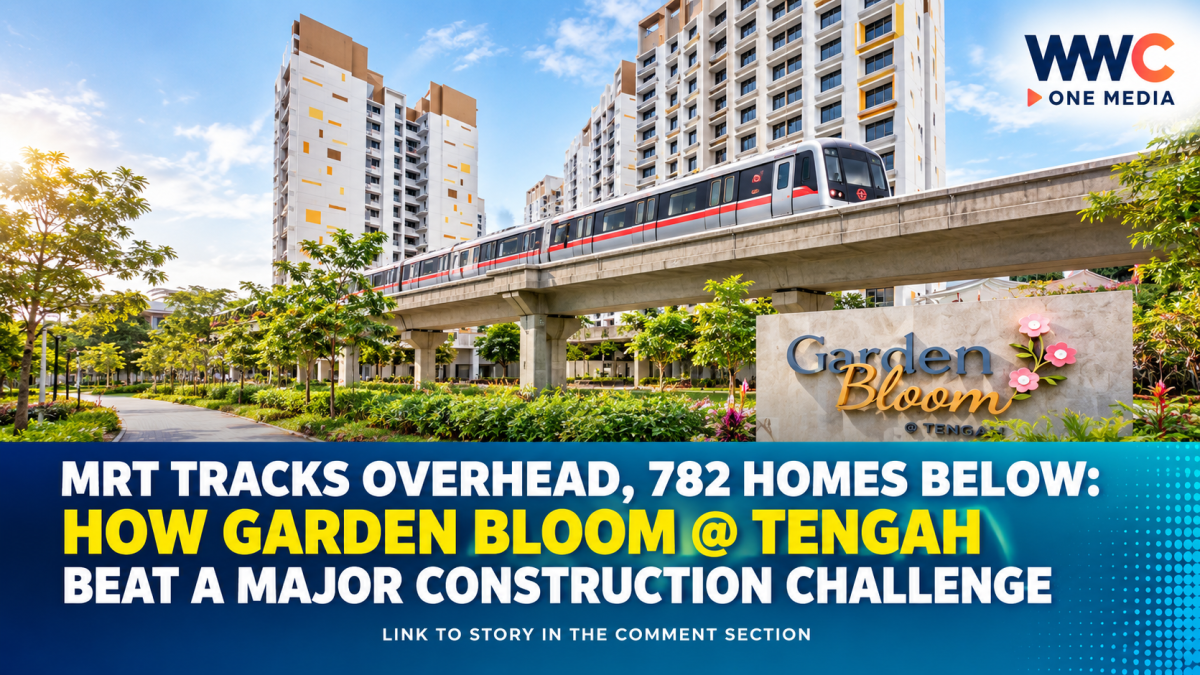
SINGAPORE — Building a new HDB estate is already a massive undertaking. But at Garden Bloom @ Tengah, the construction team had another problem literally hanging over the project: two Jurong Region Line (JRL) MRT viaducts were being built across part of the site at the same time.
The 782-unit Build-To-Order (BTO) project had to be completed while rail construction, heavy machinery, workers and housing works operated in close proximity.
That unusually complex environment has now helped put Chiu Teng Construction in the spotlight after the company received a Certificate of Merit in the Construction category at the HDB Awards 2026.
Two MRT viaducts cut through the estate
Garden Bloom @ Tengah comprises seven 15-storey residential blocks in Tengah’s Garden District.
But during the project’s construction, two JRL viaducts crossed through the estate’s common green area. One passed above a ramped linkway and children’s playground, while another ran alongside facilities including a multi-purpose court and fitness stations and in front of the childcare centre.
The MRT works occupied roughly 15% of the BTO project’s site throughout Chiu Teng’s 30-month construction contract, significantly reducing the space available for construction activities and material storage.
The JRL is being developed to serve Tengah and other parts of western Singapore, with the line scheduled to open progressively from 2027.
Construction had to be carefully choreographed
Rather than treating the two major projects as separate operations, Chiu Teng coordinated closely with the MRT contractor.
Teams worked together on equipment movements, construction sequences and safety zones, while schedules were reworked so critical activities would not interfere with one another.
The common green area was divided into three work zones for facilities including playgrounds, fitness stations, a multi-purpose court and rain gardens.
Safety measures included fixed barricades around viaduct support columns and additional surveillance cameras. Construction activities in the common green area were also required to finish by 7pm, allowing sufficient daylight for visibility and supervision.
Chiu Teng additionally installed three solar-powered cameras providing 360-degree monitoring across the work zones.
The bigger problem: where to put everything
The overlapping MRT works created another headache: space.
With parts of the site occupied by rail construction, internal routes became fragmented and there was less room to store building materials.
Chiu Teng responded by adopting a just-in-time delivery system, particularly for the prefabricated modules used to construct the flats.
Instead of having large quantities of materials sitting around the site, deliveries were coordinated around the construction schedule so modules arrived when they were needed.
The company said this helped cut site congestion by as much as 50%, while improving material-handling efficiency by 25% and reducing manpower required for those operations by 15%.
3,839 prefabricated modules helped build the estate
Garden Bloom @ Tengah was constructed using 3,839 prefabricated prefinished volumetric construction (PPVC) modules.
PPVC involves manufacturing room-sized modules in a controlled factory environment before transporting them to the construction site, lifting them into position and joining them together.
For a site already squeezed by major infrastructure works, the approach reduced the amount of construction activity that had to take place directly on the ground.
Chiu Teng estimates that PPVC generated manpower and productivity savings of around 30% and shortened construction time by approximately 15%.
The project also used building information modelling (BIM) to plan construction digitally, while QR codes on prefabricated modules helped the team track them through production and delivery.
What residents get at Garden Bloom @ Tengah
Despite the construction constraints, the completed development includes more than the seven residential blocks.
The estate has four playgrounds, five fitness stations, a multi-purpose court, a roof garden, a childcare centre, common green spaces, two precinct pavilions and an eight-storey multi-storey car park.
HDB’s project information describes Garden Bloom @ Tengah as being located in the Garden District of Tengah, bounded by Tengah Central and Tengah Garden Walk. The development consists of 782 units comprising 2-room Flexi, 4-room and 5-room flats.
Garden Bloom is also part of Tengah’s broader transformation into a new housing town designed around greenery and car-lite living. HDB has previously said Tengah will eventually provide about 42,000 new homes across five districts.
Why the project earned HDB recognition
The HDB award was not simply about completing another BTO development.
The recognition reflects how the construction team handled a highly constrained site where housing construction had to coexist with major MRT infrastructure works.
By combining tighter coordination, re-sequenced construction activities, enhanced safety monitoring, just-in-time material deliveries, BIM and extensive prefabrication, Chiu Teng was able to keep the project moving despite the unusual site conditions.
For Singapore’s rapidly expanding Tengah town, Garden Bloom @ Tengah offers a glimpse of how future housing projects may increasingly have to integrate with major transport and infrastructure works happening around them.
And the striking part is not simply that 782 homes were built beneath an MRT construction zone.
It is how the project team managed to make the limited space work — without allowing the infrastructure above to derail the homes being built below.
WWC ONE MEDIA G,A