
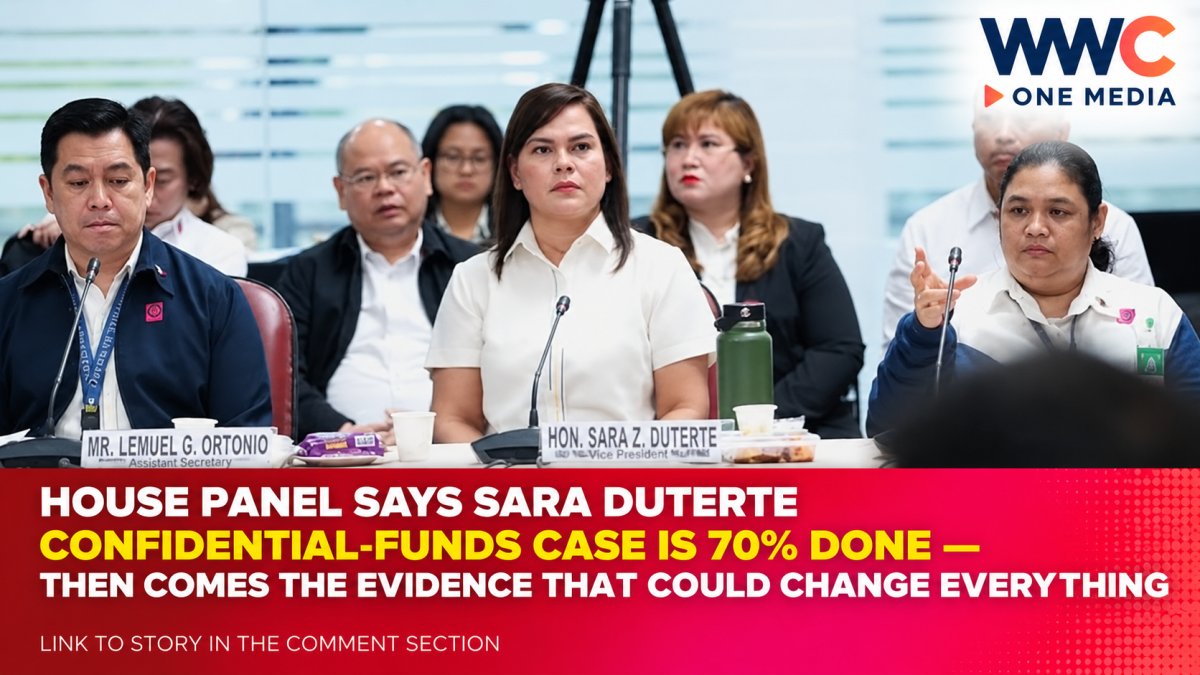
Co said a large portion of the evidence and witnesses connected to Article I has already been presented before the Senate impeachment court.
The prosecution plans to bring in additional people who allegedly have direct knowledge of how confidential funds were handled by offices under Duterte before closing its presentation.
Among those already presented are two managers from government-owned banks, two Commission on Audit auditors, two military officials and two former executives who served under Duterte.
The panel’s target is to complete Article I by Wednesday, September 9.
That deadline is consistent with an earlier announcement by lead prosecutor Gerville Luistro, who said the House team was aiming to finish its confidential-funds evidence by September 9, subject in part to agreements with the defense on facts that do not need lengthy testimony.
The ₱612.5-million question
Article I concerns allegations surrounding ₱612.5 million in confidential funds associated with Duterte’s tenure as vice president and education secretary.
According to the House prosecution panel, this includes ₱500 million allocated to the Office of the Vice President from 2022 to 2023 and ₱112.5 million allocated to the Department of Education while Duterte was education secretary.
The prosecution argues that problems surrounding the release, transfer, liquidation and documentation of the funds demonstrate serious violations of government rules.
However, these remain allegations being litigated before the Senate impeachment court. A prosecution claim or witness testimony is not the same as a final finding of guilt.
COA findings are at the center of the case
One of the most important parts of the prosecution’s presentation has involved testimony from Commission on Audit officials.
Former COA state auditor Roderick Wamil testified that documents submitted by the OVP to account for an initial ₱125 million confidential-fund release contained irregularities.
Among the issues raised were the use of acknowledgment receipts rather than sales invoices or official receipts and questions over whether the documentation adequately identified recipients and the activities supposedly financed.
The prosecution has also pointed to COA findings involving ₱375 million in OVP confidential funds released in 2023.
GMA News reported that a COA auditor testified that the OVP’s spending violated provisions of the 2015 Joint Memorandum Circular governing confidential funds. The prosecution has emphasized testimony that the money was handled by Col. Raymund Lachica, even though he was not the accountable officer.
Why the transfer of the money matters
Former OVP special disbursing officer Gina Acosta testified that she turned over four ₱125-million tranches of confidential funds to Lachica on Duterte’s instruction.
The House prosecution has argued that the transfer was problematic because the rules governing confidential funds prohibit transferring such funds from one accountable officer to another.
Prosecutors have also questioned Lachica’s multiple roles in the process, including his involvement in preparing plans, receiving funds and submitting documents related to their utilization.
The prosecution has characterized this as evidence of a problematic chain of control.
The defense, however, has disputed the prosecution’s characterization of the transactions and continues to challenge the evidence presented in the impeachment court.
The mystery surrounding the recipients
Another major issue involves the identities and documentation of people listed as recipients of confidential-fund disbursements.
During testimony presented to the Senate impeachment court, COA officials discussed acknowledgment receipts and recipient names that prosecutors said required further explanation.
PNA reported that Wamil testified that the OVP’s original and revised submissions did not fully establish the identities of recipients, specific confidential activities and supporting proof for several payments.
The prosecution has argued that confidential spending cannot simply become unaccountable because the underlying operations are classified.
BusinessMirror similarly reported that prosecutors questioned receipts, names, dates, purposes and supporting documents and repeatedly returned to the basic issue of tracing public funds to their actual recipients and purposes.
Duterte’s camp pushes back
The allegations remain contested.
The defense has challenged the prosecution’s interpretation of the audit documents and testimony, including questions surrounding whether particular activities constituted legitimate intelligence or protective operations.
BusinessMirror reported that defense lawyers presented protective intelligence reports involving activities such as threat assessments, surveillance and coordination with police and military personnel, arguing that these demonstrated legitimate intelligence work.
That distinction is important because the Senate impeachment court, not the House prosecution panel, will ultimately determine the weight and sufficiency of the evidence.
Prosecutors say the evidence is building
The House panel says the testimony already presented is beginning to establish what it considers a pattern in the handling of Duterte’s confidential funds.
In August, the House prosecution team described testimony from Acosta as exposing what it called a “modus operandi” involving the transfer and handling of the money.
But prosecutors themselves have acknowledged that the ultimate determination belongs to the Senate impeachment court.
More recently, House prosecutors have argued that Duterte remains the key person who can explain the transactions because several officials who handled portions of the funds testified that they did not know how the money was ultimately spent.
What happens after Article I?
The September 9 target is significant because finishing Article I would allow the impeachment court to move forward with the prosecution’s presentation of other allegations.
The prosecution has already considered dropping or streamlining some articles to shorten the trial, according to ABS-CBN News.
The Senate impeachment court has also been pushing the parties to stipulate facts where possible and avoid calling witnesses when their testimony would merely establish facts already sufficiently proven by documents or previous testimony.
That could determine how quickly the entire trial moves toward the defense’s presentation and eventually the Senate’s deliberations.
The bigger political battle
The confidential-funds controversy is only one part of Duterte’s impeachment case.
The proceedings have become one of the most consequential political battles in the Philippines, with the vice president facing allegations that could affect both her political future and the balance of power ahead of the country’s next presidential cycle.
For now, however, the Senate impeachment court has not issued a final judgment on the allegations.
The House prosecution still has to complete its evidence, the defense has its opportunity to respond, and the senator-judges will ultimately decide whether the constitutional standard for impeachment has been met.
The question everyone will be watching
The House says it is roughly 70% finished with Article I.
The next few days could therefore be crucial.
More witnesses are expected. More documents could be placed before the impeachment court. And prosecutors are expected to make their final push to establish their narrative about the handling of the confidential funds.
But the decisive question remains:
Will the evidence presented by the House prosecution be enough to convince the Senate impeachment court that the alleged irregularities amount to betrayal of public trust?
That answer is still to come.
WWC ONE MEDIA M.J.E
Leave a Reply