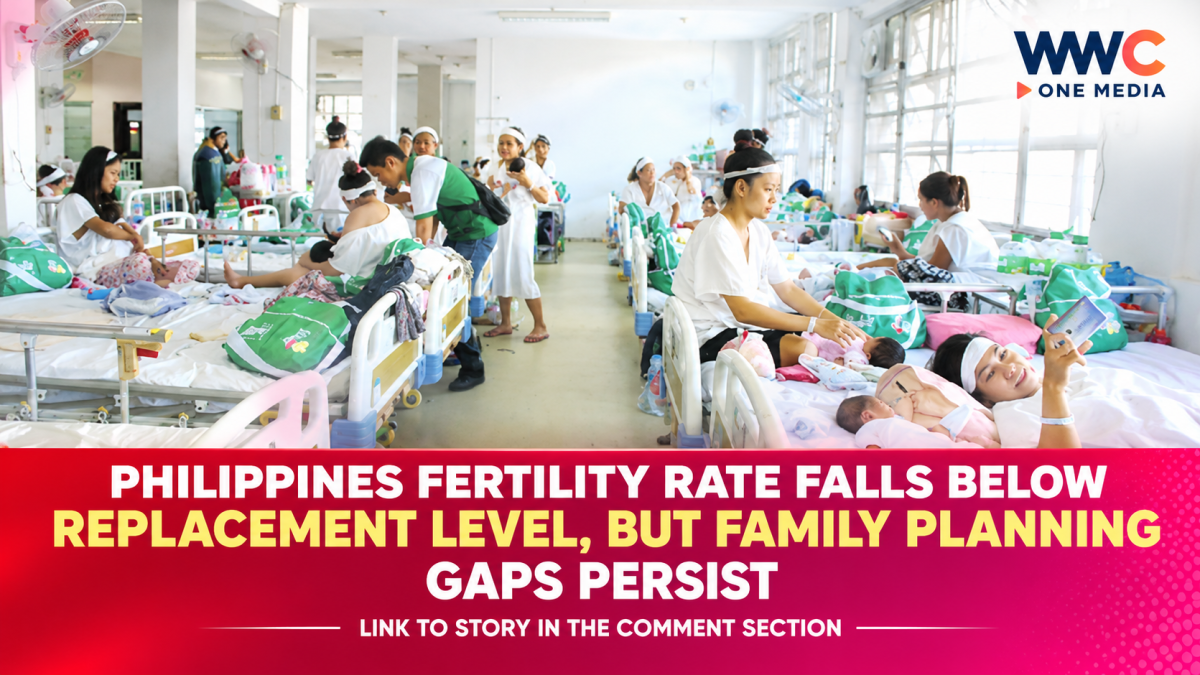
The Philippines’ fertility rate has fallen below the level needed to maintain a stable population, but advocates say the decline does not eliminate the need for accessible family-planning services, particularly for poorer women and communities with limited access to health care.
The country’s total fertility rate fell to 1.7 children per woman in 2025, down from 4.1 in 1993 and below the replacement-level benchmark of about 2.1 children per woman. The latest figures come from the 2025 National Demographic and Health Survey conducted by the Philippine Statistics Authority.
The national average, however, masks significant differences across income groups. Women in the poorest wealth quintile had an average of 2.8 children, compared with just 1.1 among women in the richest quintile. Fertility also remained higher in rural areas than in urban communities.
At a recent population and reproductive-health forum, Commission on Population and Development Deputy Executive Director Lolito Tacardon said the decline makes family planning more relevant because the focus is increasingly on ensuring that women have the ability and information to make decisions about whether and when to have children.
Despite declining fertility, access to contraception remains uneven. Only 44.5% of currently married women aged 15 to 49 were reported to be using modern family-planning methods, while the 2025 NDHS found that 12.5% of currently married women had an unmet need for family planning. About seven in 10 had a demand for family planning, with 62.5% of that demand satisfied through modern methods.
The gaps are particularly pronounced among some vulnerable groups. The 2025 survey found unmet need for contraception was highest among married women aged 15 to 19, at 38.5%, while women in the poorest wealth quintile and those with no formal education also recorded higher levels of unmet need. BARMM had the highest regional unmet need at 29.2%.
Advocates say physical access, limited health workers and the availability of contraceptive supplies remain challenges. Some women may also struggle to visit health facilities because of work schedules, family circumstances or concerns about judgment when seeking reproductive-health services.
Family-planning needs also extend beyond married couples. Figures presented at the forum showed that 48% of sexually active unmarried women had an unmet need for family planning, highlighting continuing gaps in access to information and services.
The demographic picture is also changing as population growth slows, the working-age population continues to expand and the share of older Filipinos rises. The PSA said the fertility decline could create opportunities for the country to benefit from a demographic dividend if accompanied by sustained investments in health, education and social protection.
The latest data therefore point to two demographic realities occurring at the same time: Filipino families are having fewer children overall, while some women and communities continue to face barriers to making their own reproductive choices. For health authorities and policymakers, the challenge is ensuring that family-planning services remain available to those who need them as the country’s population profile continues to change.