
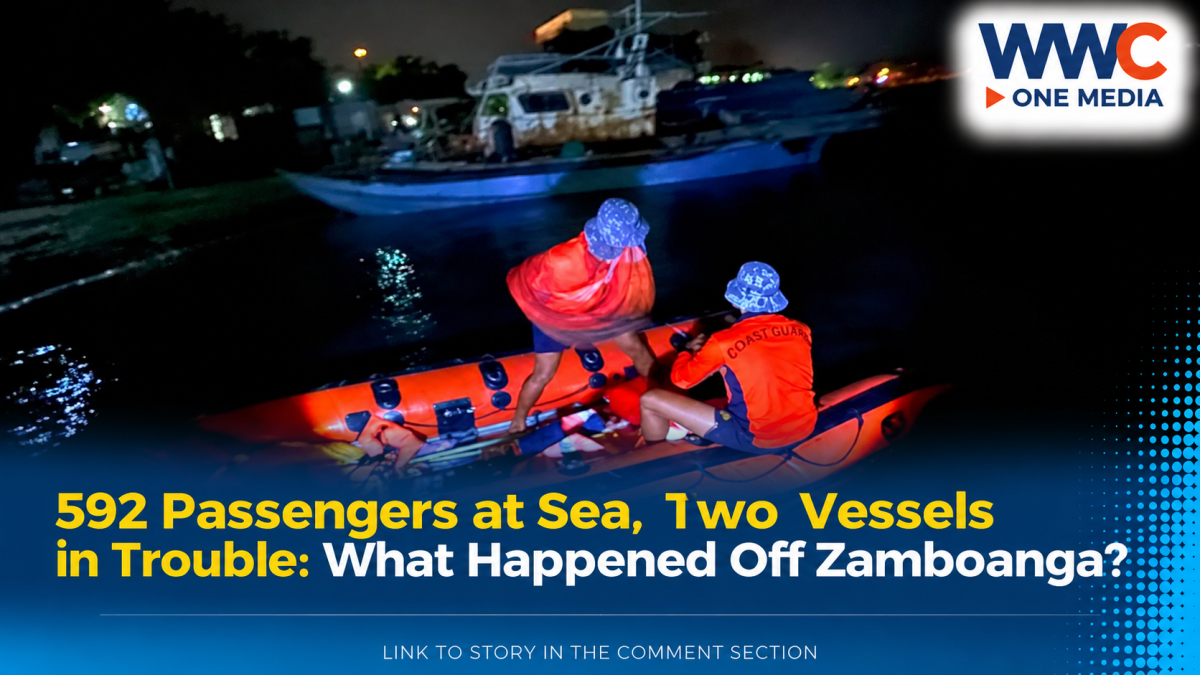
ZAMBOANGA CITY, Philippines — Two passenger vessels carrying a combined 592 passengers and 32 crew members encountered separate mechanical problems off Zamboanga City on the same Friday evening, prompting an immediate response from the Philippine Coast Guard.
Fortunately, all passengers and crew members were safely assisted, with both vessels returning to the Port of Zamboanga.
But the twin incidents, which happened within minutes of each other on the evening of Sept. 4, 2026, have now prompted the Philippine Coast Guard to order follow-up safety inspections on both ships.
First vessel develops transmission trouble
The first incident involved MV Prince Glory, a passenger vessel operated by Ibnerizam Shipping Lines.
The ship had departed Zamboanga City Port for Jolo, Sulu, at around 8:30 p.m. carrying 369 passengers and 18 crew members.
But shortly after departure, the vessel developed a mechanical problem involving its transmission coupling and flywheel, according to the Coast Guard Station-Zamboanga.
The mechanical failure forced the cancellation of the vessel’s voyage.
Authorities coordinated tugboat assistance and safely brought the ship back to the Port of Zamboanga.
PCG assists passengers during disembarkation
Coast Guard personnel immediately deployed a rubber boat and additional responders to assist the passengers.
The priority was to ensure the safe disembarkation of everyone aboard.
The Coast Guard also provided land transportation to help passengers reach the designated boarding area after the vessel returned to port.
The quick response meant that the mechanical problem did not escalate into a more serious maritime emergency.
Second vessel encounters engine trouble minutes later
Just minutes after the first incident, another passenger vessel reported trouble.
At around 8:35 p.m., MV Magnolia Liliflora encountered an engine problem while sailing toward Siasi, Sulu.
The vessel, operated by Magnolia Shipping Lines, was carrying 223 passengers and 14 crew members.
According to the Coast Guard, the problem was caused by a leakage in the vessel’s main engine lube oil piping.
The ship safely returned to the Port of Zamboanga.
Personnel from the Coast Guard Sub-Station in Corcuera then assisted passengers during disembarkation.
More than 600 people were involved
Combined, the two incidents involved:
- 592 passengers
- 32 crew members
- 624 people in total
Despite the large number of people affected, authorities reported that the passengers and crew were safely assisted.
There were no casualties reported in the Coast Guard’s account of the two incidents.
The close timing of the two mechanical emergencies also highlighted the importance of rapid maritime response along one of the country’s busiest sea routes connecting Zamboanga City with Sulu and other island provinces.
PCG orders safety inspections
The incidents are not over from a regulatory standpoint.
The Philippine Coast Guard, through its Maritime Safety and Services Unit-Southwestern Mindanao, is set to conduct Vessel Safety Enforcement Inspections on both passenger vessels.
The inspections will examine whether the ships comply with existing maritime safety standards, rules and regulations.
Authorities will focus particularly on:
- Machinery condition
- Engine operation
- Mechanical systems
- Safety-related equipment
- Compliance with maritime regulations
The Coast Guard said the inspections are part of follow-up safety measures after the two vessels experienced separate mechanical problems.
Incidents also reported to MARINA
The Coast Guard Station-Zamboanga has also reported both incidents to the Maritime Industry Authority (MARINA) for appropriate action under existing maritime safety regulations.
The move could determine whether further corrective measures are needed before the vessels resume regular operations.
For passengers, the follow-up inspection is particularly important.
The two ships were carrying hundreds of people when the mechanical problems occurred.
While both vessels were able to return safely, authorities now need to establish whether their machinery and safety systems meet the standards required for commercial passenger operations.
Why the Zamboanga-Sulu route remains closely watched
The latest incidents come amid continued maritime safety challenges in Southwestern Mindanao.
Earlier this year, the Philippine Coast Guard and maritime police rescued around 200 passengers after a vessel developed mechanical trouble while travelling toward Zamboanga City from Banguingui, Sulu.
In another February incident, the Coast Guard rescued 253 people, including crew members, after a passenger vessel encountered trouble off Basilan during severe weather conditions.
These separate incidents involved different vessels and circumstances.
However, they underscore the heavy reliance of communities in Sulu, Basilan, Tawi-Tawi and nearby areas on sea transportation.
For many island communities, passenger ships are not optional.
They are essential links for:
- Travel
- Trade
- Medical access
- Education
- Government services
- Family connections
- Movement of goods
That makes vessel safety especially critical.
Mechanical trouble can quickly become a maritime emergency
Engine and machinery failures do not automatically result in a disaster.
But at sea, a mechanical problem can become dangerous depending on weather conditions, currents and the vessel’s location.
A ship that loses propulsion can drift.
In rough seas, that can increase the risk of collision, grounding or other emergencies.
That is why the Coast Guard’s immediate response in the latest Zamboanga incidents was crucial.
Both vessels were able to return safely before the situation worsened.
Passengers safe, but safety questions remain
For the hundreds of passengers affected, the immediate crisis ended safely.
Both MV Prince Glory and MV Magnolia Liliflora returned to Zamboanga after experiencing separate mechanical problems.
But the Coast Guard’s decision to conduct Vessel Safety Enforcement Inspections means authorities are now looking beyond the immediate rescue.
The key questions include whether the mechanical failures were isolated incidents and whether both vessels’ machinery and safety systems comply with operational requirements.
MARINA has also been informed for possible action under maritime regulations.
Two ships, 624 people and one busy night at sea
Within minutes, two passenger vessels travelling from Zamboanga City toward Sulu encountered mechanical trouble.
One suffered a problem involving its transmission coupling and flywheel.
The other developed a leakage in its main engine lube oil piping.
Together, the incidents affected 624 people, including passengers and crew.
Everyone was safely assisted.
But now the ships themselves face another test.
The rescue operation may be over, but the safety inspections are just beginning.
And for hundreds of passengers who rely on these sea routes every day, the next question is just as important:
What will the Coast Guard’s inspection find?
WWC ONE MEDIA J.M.D

Leave a Reply