
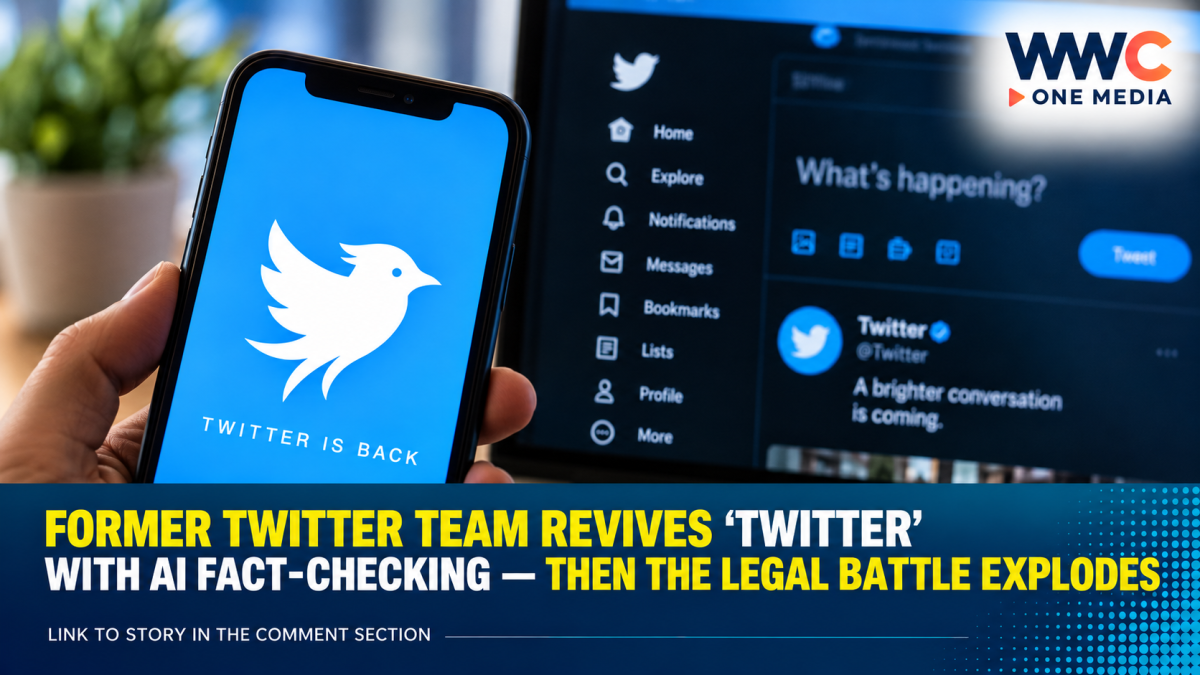
SAN FRANCISCO — Twitter is back — at least in part.
A startup founded by former Twitter personnel has launched Twitter.now, a new social-media platform designed to resemble the Twitter of the pre-Elon Musk era while adding one major difference: an artificial-intelligence system that attempts to assess the truthfulness of posts in real time.
But the platform’s comeback is unfolding alongside a fierce legal battle with X Corp., creating an unusual collision between technology, artificial intelligence and one of the internet’s most recognizable brands.
And the legal situation has already changed dramatically since Twitter.now launched.
A familiar Twitter-style platform — with a new AI layer
Twitter.now was launched by Operation Bluebird, a Virginia-based startup whose founding team includes Stephen Coates, a former Twitter general counsel and trademark lawyer.
The platform closely resembles the Twitter many users remember, including timelines, replies and repost-style functions.
But Operation Bluebird says its biggest innovation is not the nostalgia.
It is AI-powered verification.
The system, called Vera, is described as a Gemini-based “veracity engine for real-time analysis.” It is designed to analyze posts, identify factual claims and provide users with an indication of how trustworthy those claims appear to be.
Coates has demonstrated the system by posting deliberately false statements, including an incorrect claim about George Washington’s presidency, to show how Vera can identify obvious factual errors.
The idea is to create a platform where speech remains visible while its potential reach can be controlled.
Operation Bluebird has described the philosophy as “freedom of speech, not freedom of reach.”
How Twitter.now’s AI fact-checking works
Rather than simply deleting posts that are considered false, Twitter.now’s approach is designed to give users more control over what enters their feeds.
The platform’s AI evaluates claims and generates credibility information, with the company envisioning tools that allow users to determine how much potentially unreliable material they want to see.
That represents a different philosophy from traditional content moderation.
Instead of asking only, “Should this post be removed?”, the system asks another question:
“How much reach should this post receive?”
The concept could become increasingly important as social-media platforms struggle with AI-generated misinformation, manipulated media and rapidly spreading false claims.
However, AI fact-checking is not infallible. Automated systems can misunderstand context, struggle with disputed claims and potentially make mistakes when dealing with rapidly developing events.
That means Vera’s scores should be viewed as an automated credibility signal rather than an absolute determination of truth.
The bigger story: Why is it called Twitter?
The name itself is at the center of the controversy.
Operation Bluebird argues that Elon Musk’s 2022 acquisition and subsequent rebranding of Twitter as X amounted to abandonment of the old Twitter identity and associated trademark rights.
The startup therefore launched Twitter.now under the theory that the old brand had been left behind.
When the platform launched, however, the trademark dispute was still unresolved.
Ars Technica reported that Twitter.now initially had only hundreds of users but deliberately recreated much of the familiar Twitter experience. The startup also emphasized that it was not affiliated with X Corp.
Then came the court ruling
The legal situation changed on September 3.
A Delaware federal judge granted X Corp.’s request for a preliminary injunction blocking Operation Bluebird from using the Twitter name and other Twitter-related word marks while the lawsuit continues.
Judge Colm Connolly found that X was likely to establish that Operation Bluebird’s use of “Twitter” would confuse consumers and infringe X’s trademark rights.
That is a significant setback for the startup.
But the ruling was not a complete victory for X.
The judge also found that X had abandoned its rights to the word “Tweet” and the original Twitter bird logo, citing statements by Musk about moving away from the old Twitter branding.
Operation Bluebird’s Stephen Coates said the company would comply with the order and welcomed the ruling concerning the “Tweet” mark and bird logo.
The case remains ongoing.
A trademark battle unlike most tech disputes
The dispute is unusual because Operation Bluebird is not simply building another social network.
It is attempting to resurrect a brand that was one of the most recognizable names in social media before Musk’s takeover.
Musk acquired Twitter for $44 billion in 2022 and later transformed the company’s branding into X. Operation Bluebird subsequently argued that the change created an opening for a new company to claim the abandoned identity.
X Corp. strongly disputes that argument.
The company sued Operation Bluebird, saying its Twitter brand remains protected and accusing the startup of attempting to take the trademark.
The case is X Corp. v. Operation Bluebird Inc., in the U.S. District Court for the District of Delaware.
Could AI fact-checking become Twitter.now’s biggest advantage?
Despite the trademark fight, the AI component could ultimately prove to be the platform’s most interesting experiment.
Social networks have struggled for years with misinformation because the fastest-spreading posts are not necessarily the most accurate.
A major MIT study previously found that false news spread farther, faster and more broadly than true news on Twitter, with false political information particularly prone to rapid diffusion.
Twitter.now is effectively attempting to attack that problem at the distribution stage.
Its philosophy is not necessarily to silence questionable claims.
Instead, the platform wants to make users more aware of their credibility and give them greater control over what gains visibility.
That could become increasingly relevant as AI-generated content makes it easier to produce convincing but false text, photographs, audio and video.
But AI cannot replace human judgment
There is a major caveat.
An AI-generated trust score does not automatically make a claim true or false.
A system can correctly identify obvious factual errors while still struggling with breaking news, incomplete information, satire, political disputes or legitimate disagreements among experts.
Recent research into AI-based credibility indicators has also raised concerns about users becoming overly dependent on automated judgments. An AI system can itself make an incorrect assessment, potentially giving a misleading claim an appearance of authority.
That makes transparency particularly important.
Users need to know why an AI system considers a claim questionable — not simply whether an algorithm assigns it a high or low score.
The comeback has become a legal showdown
Twitter.now’s launch was already unusual.
But the latest court ruling has transformed the project into something much bigger than a social-media startup trying to attract former Twitter users.
It is now part of a high-profile legal battle over who controls one of the internet’s most recognizable names.
Operation Bluebird has shown that it can build the platform.
Its AI fact-checking technology gives it a distinctive pitch.
But whether it can continue operating under the Twitter name is now a question for the courts.
For users nostalgic for the old blue-bird platform, the experiment is fascinating.
For Elon Musk’s X, it is a challenge to a brand Musk spent years replacing.
And for the wider technology industry, Twitter.now is testing a provocative idea:
What if social media stopped deciding what people can say — and instead used AI to decide how far those words should travel?




Leave a Reply