
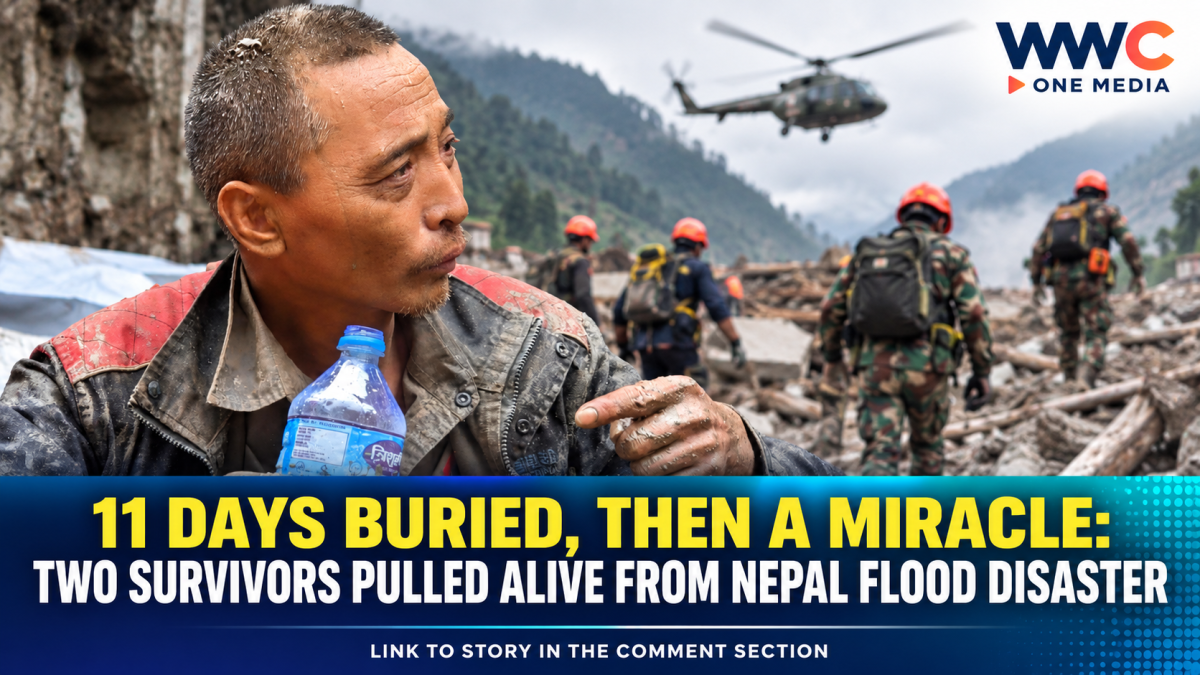
KATHMANDU, Nepal — Hope returned to disaster-stricken Nepal after rescuers pulled two people alive from separate locations on the 11th day of search-and-rescue operations following catastrophic floods that devastated communities along the Bhotekoshi and Trishuli river corridors.
A Chinese national was rescued from a hydropower tunnel in Rasuwa district, while a 64-year-old Nepali woman was found alive inside the upper floor of a mud-buried house in Betrawati, Nuwakot, according to Nepalese authorities and multiple international reports.
The rescues came more than a week after the August 26 disaster, which unleashed enormous amounts of water, mud, rocks and debris across several parts of Nepal. Authorities believe the flooding was linked to a glacier collapse in the Himalayan region.
Chinese worker found alive inside 225-meter tunnel
One of the most dramatic rescues involved Chinese national Lu Haitao, who was discovered inside a roughly 225-meter tunnel at the Upper Trishuli-1 hydropower project in Rasuwa.
Nepali Army personnel, working with South Korean disaster experts, reached him after carefully advancing through the damaged tunnel. Lu was subsequently evacuated by helicopter for medical assessment.
Reuters reported that Lu was stable and showed signs of mild hypothermia, but had no visible major injuries. His rescue made him the third person pulled alive from hydropower tunnels in the Trishuli area since the disaster.
His rescue followed the dramatic recovery of two Nepalese hydropower workers, Sanjay Sah and Kabir Maharjan, from another tunnel at the Upper Trishuli 3A project the previous day.
The two men had reportedly spent nine days trapped approximately 170 meters inside the tunnel before rescue teams reached them. Their survival had already raised hopes that others might still be alive underground.
64-year-old woman rescued from buried house
In a separate operation in Nuwakot, rescuers found 64-year-old Chandika Shrestha alive on the upper floor of a four-storey house in flood-hit Betrawati.
The structure had been heavily buried by mud and debris. A nine-member rescue team from the Nepali security forces eventually reached her and brought her to safety.
She was given water before being evacuated for medical treatment, with reports saying she was later airlifted toward Kathmandu.
The rescue provided another extraordinary moment of hope in an operation that has been dominated by devastation and uncertainty.
Thousands are still missing
Despite the two latest rescues, Nepal’s disaster remains enormous.
According to Nepal’s Ministry of Foreign Affairs, 1,344 bodies had been recovered and around 5,000 people remained missing as of September 5. More than 13,000 people had been rescued, including more than 300 foreign nationals.
The government said search-and-rescue teams remain focused on damaged hydropower facilities, tunnels and other heavily affected areas.
Authorities estimate that around 900 hydropower workers remain missing, with roughly 500 believed to be trapped inside tunnels across a number of projects.
That has turned the country’s hydropower sites into some of the most critical locations in the continuing search.
International teams join Nepal’s rescue effort
The rescue operation has become an international effort.
Specialized teams and equipment from India, China and South Korea are working alongside Nepalese authorities, while teams and assistance from other countries have also been deployed.
Nepal’s Foreign Ministry said tunnel-rescue operations were continuing at several hydropower projects, including Upper Trishuli-1, Upper Trishuli-3A, Upper Trishuli-3B, U216 Haku, Chilime and Langtang.
The government also reported that Australia and Malaysia had sent disaster-response teams to assist the operation.
Disaster leaves massive damage behind
The floods have caused extensive destruction across Rasuwa, Nuwakot, Dhading and other areas along the affected river systems.
Nepal’s preliminary damage assessment found that approximately 7,570 houses affecting more than 32,900 people had been impacted. At least 55 kilometers of roads, 37 motorable bridges and 68 suspension bridges were also damaged.
Thirteen hydropower projects were affected, along with a solar power facility and two transmission lines. Authorities estimate that about 783 megawatts of hydropower capacity has been affected.
The full scale of the economic and humanitarian damage is still being assessed.
Hope amid one of Nepal’s darkest disasters
For families still waiting for news of missing relatives, the latest rescues have brought a powerful message: survival remains possible even after days buried beneath debris or trapped underground.
The discovery of Lu Haitao after 10 days, following the rescue of Sah and Maharjan after nine days, has encouraged teams to continue searching tunnels where voices or other signs of life may still be detected.
But with thousands still missing and hundreds potentially trapped underground, rescuers face a race against time.
For Nepal, the latest rescues are more than isolated victories. They are a reminder that, amid a disaster that has already claimed more than a thousand lives, hope has not disappeared beneath the mud and rubble.
WWC ONE MEDIA J.M.S




Leave a Reply