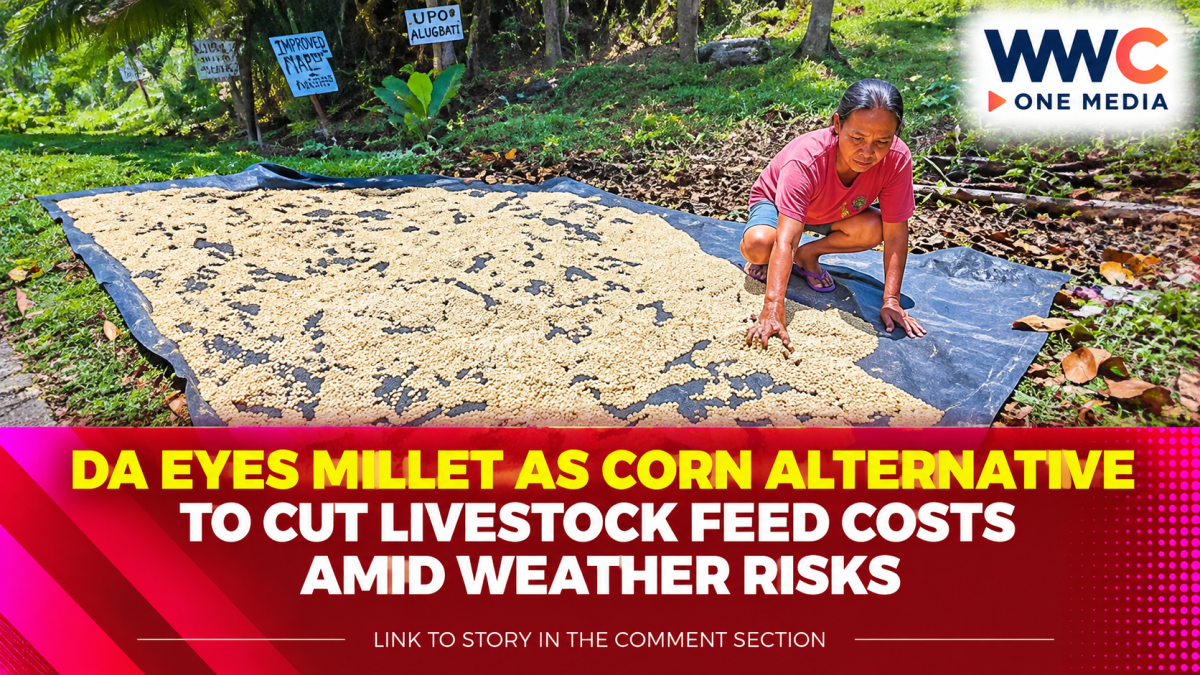
The Department of Agriculture is exploring millet as an alternative to corn in animal feed as the government looks for ways to lower livestock production costs and reduce the industry’s exposure to weather-related disruptions.
Agriculture Secretary Francisco Tiu Laurel Jr. examined millet and other feed ingredients during a recent trip to India, where the drought-tolerant crop is widely used. The DA is studying whether similar applications could help Philippine livestock producers manage feed costs and supply risks.
Millet is a group of small-seeded cereal grasses used for both human consumption and animal feed. It generally requires less water than corn and can grow under relatively dry conditions, making it potentially useful when drought affects conventional feed crops.
Corn remains a major ingredient in livestock feed, so disruptions in domestic production can translate into higher costs for farmers and feed manufacturers. The DA said alternative feed sources could provide greater flexibility, although commercial adoption would still depend on factors such as crop yields, nutritional value, processing requirements and overall cost.
The proposal comes as the country’s corn supply faces potential pressure from weather conditions. Philippine Statistics Authority data cited by the DA showed that corn production is projected to fall 14.4% year on year to 2.08 million metric tons in the third quarter, from 2.43 million tons a year earlier.
The government is also pursuing measures to strengthen the domestic livestock and dairy industries. The Philippine Carabao Center recently launched a P237.9-million facility in Nueva Ecija for sex-sorting buffalo semen, allowing breeders to target female offspring for dairy production or males for meat and farm work.
The facility uses flow cytometry to separate sperm carrying X and Y chromosomes with about 90% accuracy. The PCC aims to produce around 170,000 sex-sorted semen straws annually, primarily to increase the number of female offspring and expand the country’s dairy herd.
The push comes against a significant gap in domestic milk production. The DA said Philippine milk output currently meets less than 5% of national demand, leaving the country dependent on imported dairy products and breeding stock. Local production of sex-sorted semen could reduce procurement costs and provide breeding material better adapted to Philippine conditions.
For the agriculture sector, the millet initiative is therefore part of a broader effort to strengthen domestic livestock production by addressing both feed supply and herd expansion. If millet proves economically and nutritionally viable at commercial scale, it could give farmers another option when corn supplies are disrupted by drought and other extreme weather conditions.
The next challenge will be determining whether millet can be produced, processed and incorporated into Philippine animal-feed systems at a cost that makes it competitive with corn. The DA’s current initiative is still exploratory, but it signals a push toward more diversified and climate-resilient feed supplies.