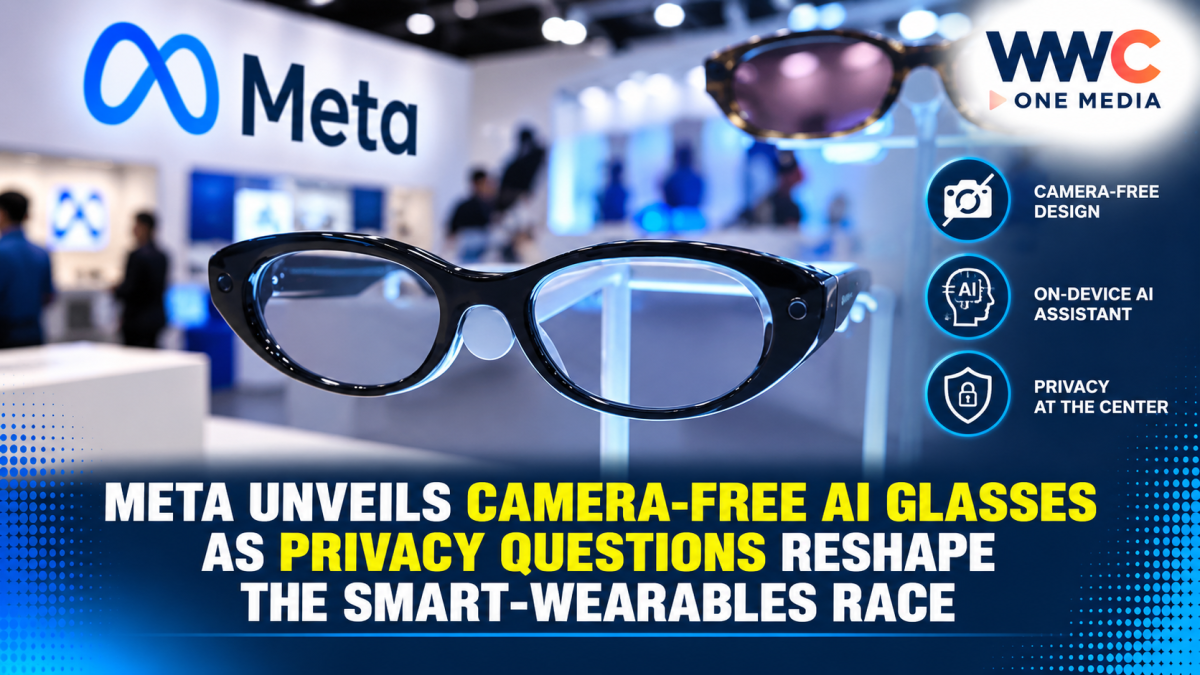
MENLO PARK, California — Meta is changing its approach to AI-powered eyewear as privacy concerns surrounding camera-equipped smart glasses continue to grow.
At its Meta Connect event on September 23, the company introduced Ray-Ban Meta Audio, its first smart-glasses model without a camera, while simultaneously expanding its broader AI-glasses lineup and introducing new AI capabilities through its Muse personal assistant.
The move comes as Meta faces growing scrutiny over the ability of wearable devices to capture images and audio in public and private settings.
A Smart Glasses Model Without a Camera
Unlike Meta’s existing camera-equipped glasses, Ray-Ban Meta Audio focuses on audio and AI interaction.
The company says the new glasses are its lightest smart-glasses offering and can provide up to 12 hours of battery life on a single charge. The glasses are priced at $349, with shipments scheduled to begin October 13, according to USA Today.
The design allows users to interact with AI, listen to audio and make calls without carrying a device that can capture photographs or video.
That distinction could become increasingly important as consumers and businesses debate where camera-equipped wearables should be allowed.
Privacy Concerns Are Driving the Conversation
Meta’s decision comes against a backdrop of mounting concern over smart glasses.
Reuters reported that several businesses in the United Kingdom have restricted the use of Meta’s camera-equipped glasses, while privacy lawsuits have also been filed in the United States. One proposed California class action alleges that footage captured by the glasses was reviewed by human annotators during AI training. Meta disputes the allegations and has said it will defend itself.
Meta has emphasized that its camera-equipped glasses contain an LED indicator intended to alert people when photographs or videos are being captured. The company has also introduced measures designed to prevent recording when that privacy indicator is deliberately disabled or tampered with.
The controversy has nevertheless raised a broader question: Can wearable AI become socially acceptable when the technology is constantly listening or observing its surroundings?
Removing the Camera Doesn’t End the Privacy Debate
The camera-free design addresses one obvious concern, but it does not eliminate every privacy issue.
Reuters cited analysts who warned that microphones and audio collection could generate similar concerns, although potentially to a lesser extent than cameras. Users and people around them may still want clear indications about when audio is being captured or processed.
That creates a complicated trade-off for Meta.
Removing the camera may make the glasses easier to accept in places where photography is restricted, but it also removes one of the features that helped distinguish smart glasses from ordinary wireless earbuds.
Meta Is Expanding the Camera-Equipped Lineup Too
Despite the privacy controversy, Meta is not abandoning camera-equipped smart glasses.
The company also introduced Ray-Ban Meta Gen 3, featuring a 12-megapixel camera, 3K Ultra HD video recording, improved battery life and a six-microphone system designed to reduce background noise.
Meta says the Gen 3 models can provide up to nine hours of battery life, while retaining the recording indicator light used on previous generations.
The company also unveiled additional styles and a collection developed with K-pop star LISA, giving consumers more design choices as Meta attempts to make AI glasses a mainstream wearable category.
Muse Turns the Glasses Into an AI Assistant
Meta’s hardware push is also being accompanied by a major software expansion.
The company announced Muse, an AI agent designed to work across its wearable devices and perform tasks on behalf of users.
According to Meta and AFP reporting, Muse is intended to help with tasks such as making appointments, placing certain orders and interacting with connected services through voice commands. Meta has announced partnerships involving services including Instacart, Shopify and Expedia, while Walmart, Best Buy, Gap and Sephora are also among companies Meta says are partnering with Muse.
This pushes Meta’s glasses beyond the traditional concept of headphones with a microphone.
The company’s longer-term vision is for eyewear to become an always-available interface between people and AI.
Meta Is Betting on a Post-Smartphone Future
Meta CEO Mark Zuckerberg has described AI glasses as a major future computing platform.
The company is also expanding into other wearable formats and announced a new Meta VR Glasses product that is scheduled to launch in spring 2027 for $1,299. The headset uses an external battery and memory pack connected by a cable, allowing the glasses themselves to be considerably lighter than conventional VR headsets.
Meta’s strategy therefore goes beyond one new pair of glasses.
It is building an ecosystem around AI that includes audio-only eyewear, camera-equipped glasses, augmented-reality technology and AI agents.
The Bigger Test Is Trust
Meta’s latest launch highlights the central challenge facing the emerging AI-wearables industry.
Consumers want technology that is increasingly capable, hands-free and personalized. But the more these devices can hear, see and understand about their surroundings, the more questions arise about consent, data collection and privacy.
The camera-free Ray-Ban Meta Audio may help Meta address one part of that problem, but the debate over microphones, cloud processing and AI data collection is unlikely to disappear.
For Meta, the next stage of the smart-glasses race may therefore depend on more than better hardware.
The company now has to convince people that AI glasses can be useful without making everyone around the wearer uncomfortable.
WWC ONE MEDIA G,A