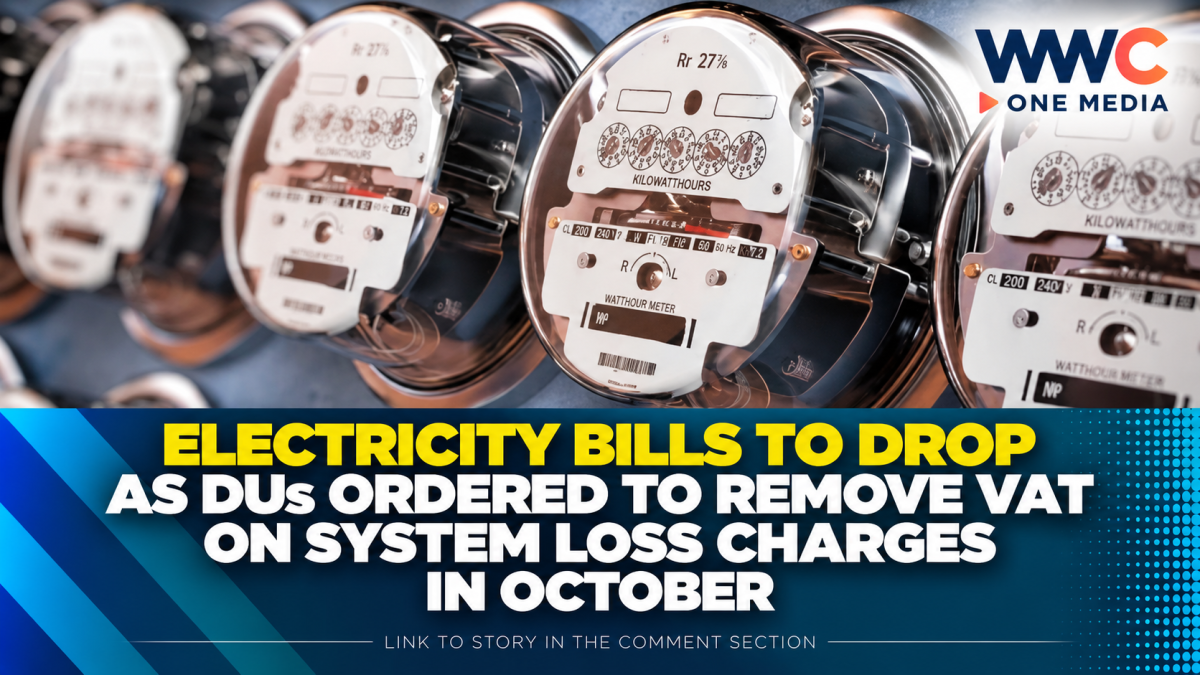
Electricity consumers are set to receive relief on their power bills beginning with October billing cycles after the Energy Regulatory Commission ordered distribution utilities to stop applying value-added tax to allowable system loss charges.
The ERC issued an advisory directing distribution utilities to implement the VAT exemption while allowing temporary billing arrangements for companies that need additional time to reconfigure their systems. The move follows the Bureau of Internal Revenue’s decision to remove the 12% VAT from allowable system loss charges.
System loss refers to electricity that is generated and paid for but lost before reaching consumers. It includes technical losses from power lines, transformers and other equipment, as well as nontechnical losses associated with issues such as electricity pilferage, illegal connections and meter tampering. Only losses within the limits approved by the ERC can be passed on to consumers.
Under the new arrangement, distribution utilities may keep their existing billing format temporarily but must clearly identify the charge as “System Loss (Govt-Mandated)” and apply a zero-percent VAT rate. Another option allows utilities to retain their current line-item description while adding a notation that the government-mandated charge is not subject to VAT.
Utilities may also fully adopt the billing format prescribed under ERC Resolution No. 28 once their billing systems have been reconfigured. Regardless of which interim option is used, the allowable system loss charge must not be included in gross sales for VAT purposes and must be clearly shown on consumers’ bills.
The tax change follows the BIR’s Revenue Memorandum Circular No. 097-2026, issued on Sept. 14. The circular excludes allowable system loss charges from gross sales for VAT purposes, meaning the 12% output VAT previously applied to the charge will no longer be collected. The exemption does not extend to income tax treatment.
The ERC had earlier classified the allowable system loss charge as a government-mandated pass-through cost rather than income earned by power distributors. It said the clarification was intended to ensure that consumers are not charged VAT on a cost that utilities recover under the regulatory framework.
The Department of Energy has also indicated that the government is looking beyond the VAT exemption and considering ways to gradually reduce and eventually eliminate system loss charges from consumers’ bills. Energy Secretary Sharon Garin said the removal of the VAT could save an average household at least around P20, although the actual savings will vary depending on electricity consumption and the amount of system loss charged.
For consumers, the October billing change means the savings from the VAT exemption should begin appearing directly on electricity statements, although the reduction will differ among households and utilities.
The ERC said distribution utilities must submit proof that they have complied with the new billing requirements. The commission will continue to require full implementation of the prescribed billing format once utilities complete the necessary system changes.
The bigger issue now is whether the government’s broader effort to reduce system losses will eventually produce larger and more lasting reductions in electricity bills beyond the immediate VAT relief.