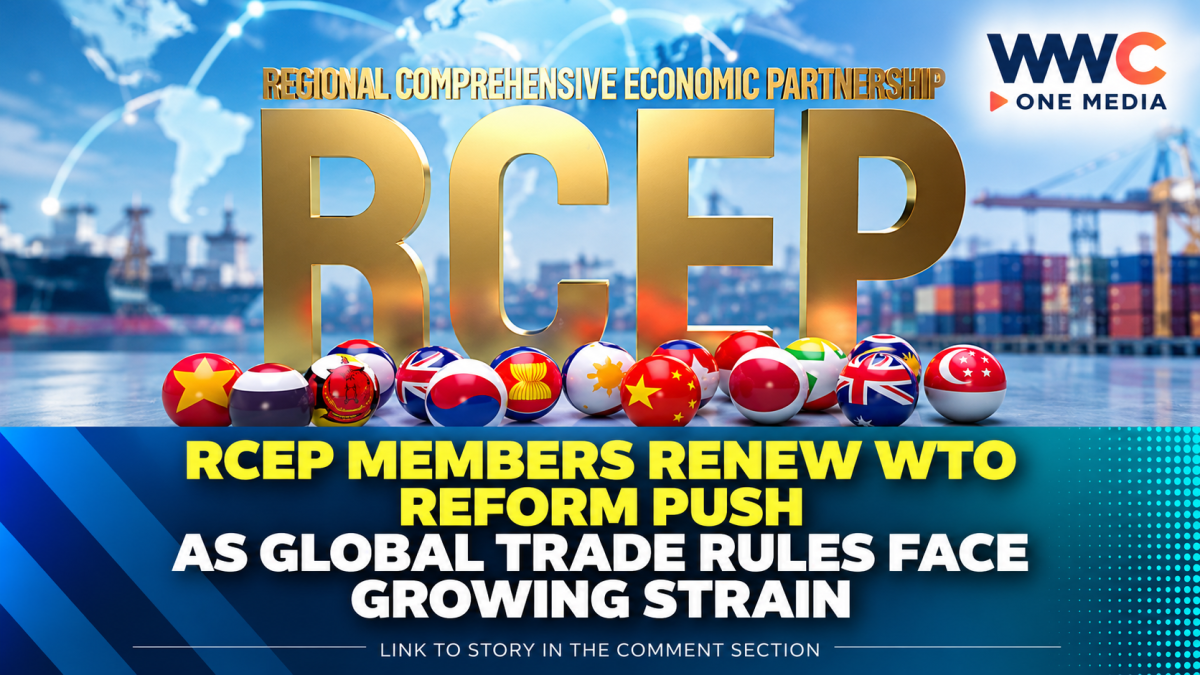
Members of the Regional Comprehensive Economic Partnership have renewed their support for reforming the World Trade Organization and maintaining a rules-based global trading system as repeated trade disruptions put pressure on international commerce and investment.
Trade ministers from the 15 RCEP economies made the commitment during the bloc’s fifth ministerial meeting in Manila on September 21. They reaffirmed support for an open, free and fair multilateral trading system with the WTO at its core, while also calling for the removal of unnecessary trade barriers and stronger investment facilitation.
The push comes as the global trading environment faces increasing uncertainty, including shifts in trade policies, supply-chain disruptions and growing use of measures that can affect cross-border commerce. RCEP ministers said strengthening the multilateral system remains important to regional economic resilience.
New Zealand representative Shane Reti said repeated disruptions over the past year have tested the resilience of the global and regional rules-based trading system. He said RCEP, as the world’s largest free trade agreement by participating economies, can help strengthen regional integration and collective resilience.
The RCEP bloc represents the 10 ASEAN members plus Australia, China, Japan, New Zealand and South Korea. Collectively, the economies account for roughly 30% of global GDP. Indonesia’s trade vice minister said trade among RCEP members reached about $5.6 trillion in 2024, underscoring the scale of commerce covered by the agreement.
The ministers’ renewed WTO commitment comes as the organization itself continues a broad reform process. WTO members have been discussing changes to the institution’s functions, decision-making, development issues, transparency and other areas since agreeing at the 2022 ministerial conference to undertake a comprehensive review.
The WTO’s own latest economic assessment has highlighted the pressure facing the multilateral trading system. It said global trade policy and the WTO are experiencing some of the most serious and sustained disruptions since the system was created, while arguing that the institution’s rules still play an important role in reducing trade costs and supporting international commerce.
RCEP members are also preparing to review their own trade agreement. The bloc has begun work toward its first General Review in 2027, with the RCEP Joint Committee tasked with preparing a joint scoping paper identifying possible areas and elements for an upgrade. The review could consider modern and emerging issues to keep the agreement relevant as the global economy changes.
The ministers also approved an ad hoc Accession Working Group to advance the accession process for Bangladesh, Chile, Hong Kong, China and Sri Lanka. Uruguay’s expression of interest in joining RCEP, submitted in February 2026, was also noted by the members.
For the Philippines, which hosted the ministerial meeting, the discussions highlight the importance of keeping regional trade channels open while global trade rules are being reassessed. The next major milestone will come in 2027, when RCEP members are expected to formally launch the agreement’s upgrade process and continue discussions on the future direction of the regional trading bloc.