
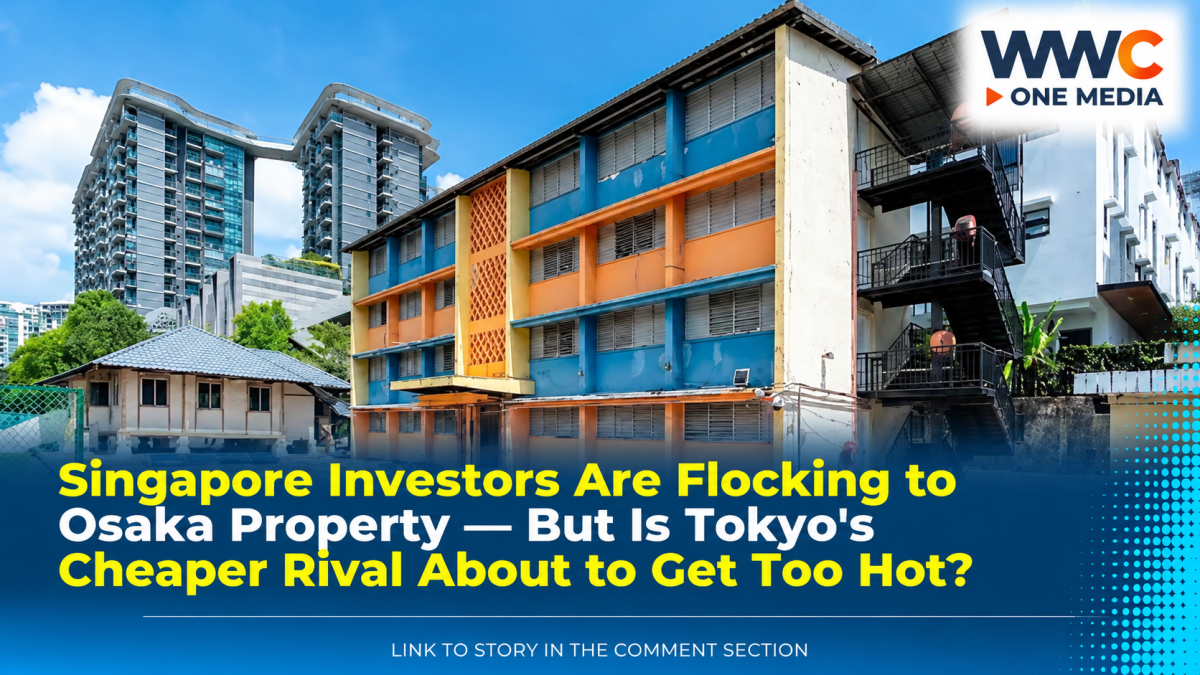
Singapore Investors Are Flocking to Osaka Property — But Is Tokyo’s Cheaper Rival About to Get Too Hot?
SINGAPORE — Singaporean investors looking overseas for their next property purchase are increasingly turning their attention to a Japanese city that has long lived in Tokyo’s shadow.
Osaka.
With property prices in Tokyo approaching record levels, more investors are looking at Japan’s second-largest metropolitan area for potentially lower entry prices, rising rents and stronger rental yields.
The attraction is powerful enough that property agencies catering to Singapore buyers have expanded their Osaka offerings as overseas interest grows.
But the story is bigger than cheap apartments and a weak yen.
Osaka is benefiting from a combination of changing Japanese housing patterns, growing rental demand, infrastructure investment and long-term redevelopment projects that could reshape the city’s investment appeal for years.
The big question now is whether Singapore investors are getting in early — or arriving just as competition begins to heat up.
Why Singapore investors are looking beyond Tokyo
Tokyo remains Japan’s best-known property market.
But popularity comes at a price.
Residential property prices in the Japanese capital have climbed sharply, prompting investors to search for alternatives with potentially lower acquisition costs.
That has pushed more attention toward cities such as Osaka.
Recent reporting on Japan’s residential investment market shows that investment capital continued flowing into the sector, with residential investment reaching a record ¥904.3 billion, or about S$7.2 billion, according to market figures cited in coverage of the growing Osaka trend.
For Singapore investors, Osaka offers a different equation.
Instead of competing directly for increasingly expensive Tokyo properties, they can explore a major Japanese metropolitan market with:
- Lower entry prices in some locations
- A large renter population
- Rising rents
- Major transport connectivity
- Strong tourism activity
- Ongoing redevelopment
- Potentially attractive financing conditions
That combination is turning Osaka into one of Japan’s most closely watched alternatives for overseas buyers.
Rising rents are changing the investment equation
One of the biggest reasons international investors remain interested in Japanese residential property is the rental market.
In many Japanese cities, housing affordability pressures are pushing more residents into rental accommodation.
At the same time, investors are watching rental growth.
This matters because a property’s investment appeal is not determined only by whether its sale price rises.
For many overseas buyers, the more immediate question is:
Can the property generate sustainable rental income?
Recent reporting on Osaka has pointed to rental yields reaching up to around 5 per cent annually in some cases, although actual yields vary significantly depending on the property, location, purchase price, vacancy, management fees and other costs.
That is one reason Osaka is attracting attention from yield-focused Singapore investors.
But headline yields should not be confused with guaranteed net returns.
Taxes, maintenance, agent fees, property management costs and periods without tenants can all reduce the final return.
The weak yen gave overseas buyers more buying power
Currency has also played a major role in Japan’s appeal.
A weaker Japanese yen has historically increased the purchasing power of overseas investors holding currencies such as the Singapore dollar.
That can make Japanese property appear more affordable when converted into Singapore dollars.
The currency advantage was one of the factors previously identified as driving increased Singapore interest in Osaka property.
But currency works both ways.
A Singapore investor who benefits from a weak yen when buying a property could face a different outcome when:
- Receiving rental income
- Converting money back into Singapore dollars
- Selling the property
- Paying overseas expenses
- Repaying foreign financing
That means investors should not base an entire property strategy on the assumption that the yen will remain weak.
Osaka is no longer just the cheaper alternative
The city’s appeal is also being driven by development.
Osaka has benefited from major investment connected to infrastructure, tourism and urban redevelopment.
Long-term projects, including the planned integrated resort development in Osaka, have helped strengthen investor interest in the city’s future economic activity.
Tourism and major events have also increased international attention on the region.
Earlier reporting on Osaka’s appeal to Singapore investors highlighted infrastructure investment, tourism and the planned integrated resort as important parts of the city’s long-term investment story.
For property investors, this matters because major development can affect:
- Employment
- Population movement
- Tourism
- Retail activity
- Rental demand
- Transport access
- Neighbourhood redevelopment
But infrastructure does not automatically guarantee that every property will rise in value.
The investment case can vary dramatically between a centrally located apartment near transport and a unit in an area with declining population or limited rental demand.
Singapore buyers are becoming a bigger part of the market
The growth in Singapore interest has become significant enough for agencies to specifically target Singapore investors.
FM Investment Japan previously reported that Singapore buyers had become its largest buyer group, accounting for about half of its sales at the time of the report.
The company had also increased its property events in Singapore as overseas interest in Japanese real estate expanded.
That growing interest reflects an important shift.
Singapore investors are already accustomed to a property market with:
- High prices
- Significant taxes
- Additional buyer restrictions
- Tight supply in desirable locations
Japan offers a different environment.
Foreigners can generally purchase Japanese property without a blanket foreign ownership ban.
However, ownership rules are only one part of the investment calculation.
Buying a property overseas still requires investors to understand:
- Local taxes
- Financing conditions
- Property management
- Building age
- Earthquake standards
- Rental regulations
- Vacancy risks
- Currency exposure
- Exit strategies
Japan’s banks are still part of the attraction
Financing has also been a major selling point.
Japanese mortgage conditions have historically been more favourable than in some other developed property markets.
That has helped support overseas investor interest.
However, this advantage now needs to be viewed against a changing interest-rate environment.
Japan has moved away from the ultra-low-rate environment that shaped its financial system for years.
Recent market developments have seen Japanese bond yields rise sharply, with the country’s financial environment undergoing a significant adjustment. Reuters reported that Japan’s 10-year government bond yield moved above 3 per cent for the first time since 1996, reflecting a major change in market expectations.
That means investors should be cautious about assuming yesterday’s cheap-money environment will remain unchanged.
Interest rates can affect:
- Mortgage costs
- Property affordability
- Investor returns
- Buyer demand
- Property valuations
The Osaka opportunity remains attractive to many investors.
But the financial conditions supporting Japan’s property market are evolving.
Why rental demand could remain important
Japan’s demographic story is complicated.
The country faces a long-term population decline.
But national demographics do not tell the whole story.
Large urban centres can experience very different trends from smaller towns and rural areas.
Osaka remains one of Japan’s largest economic and population centres.
For investors, that means the key question is not simply whether Japan’s population is declining.
The better questions are:
Where are people moving?
Where are jobs being created?
Which neighbourhoods have transport access?
Where do students and workers want to live?
What type of housing is in demand?
This is why city-level and neighbourhood-level research is critical.
A strong Osaka investment may perform very differently from a property located outside the main employment and transport networks.
Tokyo prices push investors toward Osaka
The Tokyo-versus-Osaka comparison is becoming increasingly important.
Tokyo remains Japan’s dominant property market.
But higher prices can reduce yields and increase the amount of capital needed to enter.
Osaka can offer investors a different balance between acquisition cost and rental income.
That does not necessarily mean Osaka is “better.”
It means the investment strategy is different.
Tokyo may offer greater global recognition and liquidity.
Osaka may offer lower entry points and potentially stronger yields in selected locations.
The best choice depends on an investor’s goals.
Someone focused on rental income may evaluate the market differently from someone focused on long-term capital appreciation.
Major investors are also betting on Japan
The growing interest in Japan is not limited to individual Singapore property buyers.
Large institutional investors are also committing significant capital to Japanese real estate.
Ares Management recently raised 612 billion yen, or about US$4 billion, for a Japan logistics development fund — its real estate unit’s largest fundraise of this type.
The fund is targeting major metropolitan markets including Greater Tokyo, Greater Osaka and Nagoya.
Residential property and logistics facilities are different asset classes.
But the investment demonstrates the broader importance of Japan’s major urban markets to international capital.
For smaller investors, however, institutional interest should not be treated as a guarantee that any individual condominium or apartment will perform well.
Large funds have access to different information, financing and risk-management capabilities.
What Singapore investors should watch before buying
The Osaka property story is compelling.
But buying overseas property requires more than looking at rental yield advertisements.
Singapore investors should examine several key risks.
1. Currency risk
The yen may strengthen or weaken against the Singapore dollar.
A currency gain can improve returns.
A currency loss can reduce them.
2. Rising interest rates
Japan’s financial environment is changing.
Mortgage costs may not remain as low as they were in previous years.
3. Building age
Japan has many older buildings.
Investors need to understand maintenance requirements, building standards and future repair costs.
4. Location matters more than the city name
“Osaka” covers a huge area.
Properties near major transport, employment and commercial centres may have very different rental prospects from units in less connected locations.
5. Vacancy risk
A property producing a strong rental yield on paper is not producing income when it has no tenant.
6. Management costs
Overseas investors often need local property managers.
Those costs must be included when calculating net returns.
7. Exit strategy
Investors should ask who will buy the property when they eventually want to sell.
Foreign buyers should not assume the same demand that attracted them will automatically exist in the future.
The 5 per cent yield question
Rental yields are among the strongest marketing tools used to attract overseas investors.
A potential 5 per cent annual yield sounds attractive.
But investors need to ask whether the number represents:
- Gross yield
- Net yield
- Current rent
- Projected rent
- Guaranteed rent
- An exceptional property
The difference can be substantial.
For example, a property might generate a high gross rental yield before deducting:
- Management fees
- Repairs
- Taxes
- Insurance
- Building charges
- Agent commissions
- Vacancy periods
The final net return could be significantly lower.
That does not make Osaka a poor investment.
It simply means investors should look beyond the headline number.
Is Osaka becoming too popular?
That may now be the biggest question.
The more investors discover Osaka, the more competition can increase.
Rising overseas demand can push up property prices.
Higher prices can eventually reduce rental yields.
And when buyers enter a market primarily because they fear missing out, investment decisions can become less disciplined.
That is why Singapore investors should resist treating Osaka as a single investment opportunity.
There is no single “Osaka market.”
There are different:
- Districts
- Property types
- Tenant groups
- Price ranges
- Building ages
- Rental strategies
A small apartment near a major station may have a completely different investment profile from a luxury condominium aimed at owner-occupiers.
The Singapore-Osaka investment connection is growing
For Singaporeans, Osaka offers something increasingly difficult to find at home.
A major international city with potentially lower property entry prices.
A sizeable rental market.
Freehold property opportunities.
And a different tax and ownership environment.
That combination is drawing more attention.
The trend is also part of a broader shift in which investors are looking beyond their domestic markets for income and diversification.
But overseas property should never be treated as a simple bargain because the purchase price appears lower than Singapore.
The cheapest property is not always the best investment.
And the highest advertised rental yield is not always the highest actual return.
So, is Osaka worth watching?
Absolutely.
Osaka has developed into one of the most interesting Japanese property markets for overseas investors.
Its appeal is supported by:
- Lower entry prices than Tokyo in some segments
- Rising rents
- Strong urban infrastructure
- Tourism
- Long-term redevelopment
- A large rental market
- Continued international investor interest
But the risks are also becoming more important.
Japan’s interest-rate environment is changing.
Currency movements remain unpredictable.
And increasing investor interest could make the best opportunities harder to find.
For Singapore investors, the Osaka story is no longer simply about buying cheap property in Japan.
It is becoming a more sophisticated investment question.
Can you find the right property, in the right location, at the right price — before rising demand changes the equation?
That is the real reason Osaka is now attracting Singapore money.
And it may also be the question that determines whether today’s buyers find a genuine opportunity — or simply become part of the next wave pushing prices higher.
WWC ONE MEDIA J.M.D

Leave a Reply