
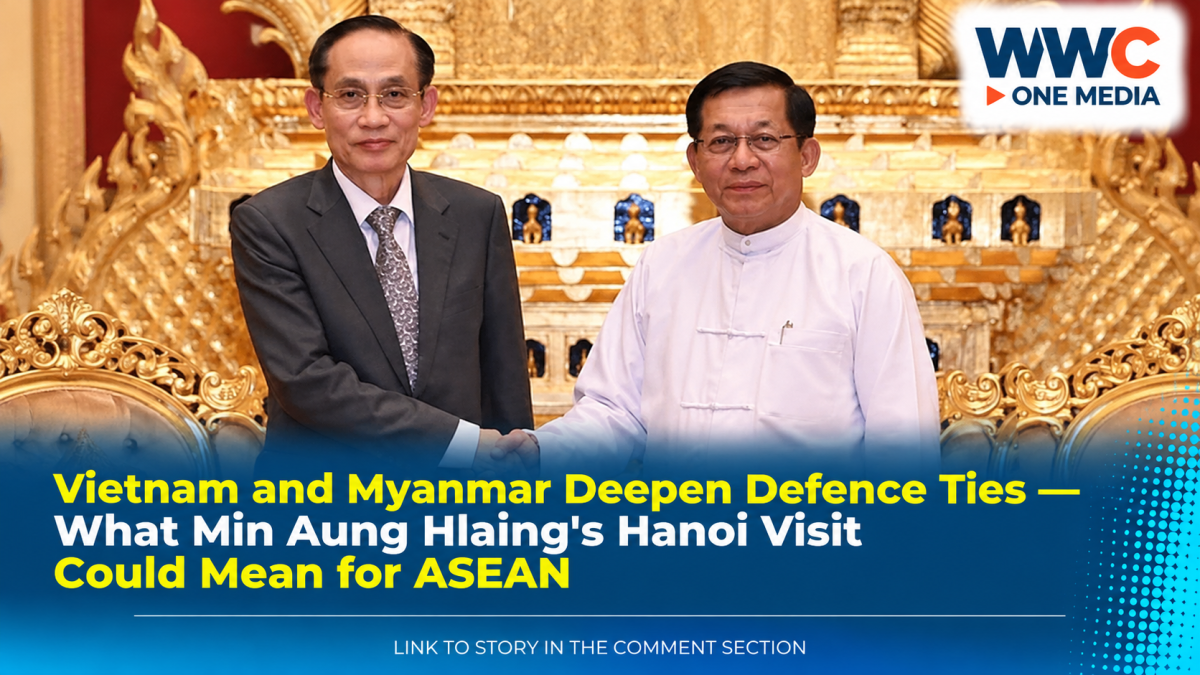
HANOI, Vietnam — Vietnam and Myanmar have agreed to significantly deepen defence and security cooperation, elevating the sector into a major pillar of their bilateral relationship as Myanmar President Min Aung Hlaing made a high-profile visit to Hanoi.
The agreement, reached during talks with Vietnamese leader To Lam on Sept. 5, includes expanded cooperation in military training, exchanges involving young officers, search-and-rescue operations and disaster response.
The two Southeast Asian nations also agreed to increase information sharing and strengthen coordination against crime.
But the significance of the meeting extends beyond defence.
Min Aung Hlaing’s visit represents another step in Myanmar’s continuing effort to rebuild regional engagement after years of diplomatic isolation following the military’s 2021 coup and the conflict that followed.
Defence becomes a major pillar of bilateral ties
According to Vietnam’s government, Hanoi and Naypyidaw agreed to elevate defence and security cooperation into a key component of their bilateral relationship.
The areas identified for deeper cooperation include:
- Military training
- Exchanges between young military officers
- Search-and-rescue operations
- Disaster response
- Information sharing
- Coordination against crime
The two countries also reaffirmed commitments to prevent individuals or groups from using one country’s territory to conduct activities harmful to the other.
The agreement marks a significant expansion in the public emphasis placed on security cooperation between Vietnam and Myanmar.
Why Min Aung Hlaing’s Vietnam visit matters
Min Aung Hlaing’s three-day trip to Vietnam, from Sept. 4 to 6, is part of a broader campaign to strengthen Myanmar’s international and regional relationships.
The Myanmar leader has increased overseas engagement since assuming the presidency earlier in 2026.
But his government continues to face major international scrutiny over Myanmar’s political crisis, which began after the military overthrew the elected government led by Aung San Suu Kyi in February 2021.
The coup triggered widespread protests, a violent crackdown and a civil conflict that continues to affect large parts of the country.
Myanmar has also faced diplomatic isolation within ASEAN, whose members have continued to press for progress under the bloc’s Five-Point Consensus on the crisis.
Vietnam becomes another key stop in Myanmar’s regional outreach
The Vietnam trip is particularly significant because it gives Min Aung Hlaing another opportunity for high-level engagement with an ASEAN government.
Reuters reported that Vietnam was the seventh country Min Aung Hlaing had visited since assuming the presidency in 2026, reflecting his efforts to expand diplomatic and economic ties.
The visit also follows other international trips aimed at strengthening Myanmar’s relationships and attracting investment.
For Myanmar’s leadership, meetings with regional governments offer an opportunity to demonstrate that the country is not completely isolated.
For Vietnam, the engagement creates a channel for discussing bilateral security, trade and regional issues directly with Myanmar’s government.
The talks went beyond military cooperation
Defence was not the only subject on the table.
Vietnam and Myanmar also agreed to expand cooperation in economic, trade and investment areas.
Potential sectors include:
- High-tech agriculture
- Food processing
- Telecommunications
- Information technology
- Digital transformation
- Energy
- Transport infrastructure
Vietnam also expressed its readiness to share experience related to national development and economic security.
The two governments said they would work to strengthen political trust through more high-level engagement and improved bilateral cooperation mechanisms.
Technology and business were also part of the visit
Min Aung Hlaing’s trip to Vietnam was not limited to government meetings.
Reuters reported that the Myanmar leader also visited facilities connected to major Vietnamese companies, including electric vehicle manufacturer VinFast and defence-linked telecommunications group Viettel.
The business and technology component of the visit underlines Myanmar’s interest in attracting investment and expanding cooperation in sectors considered important to economic development.
Viettel already has a presence in Myanmar’s telecommunications sector through Mytel, making the company’s role particularly relevant to the relationship between the two countries.
The meetings highlight how defence, technology and economic interests are increasingly overlapping in the wider bilateral relationship.
ASEAN’s Myanmar problem has not disappeared
Despite Min Aung Hlaing’s increasing overseas travel, Myanmar’s relationship with ASEAN remains complicated.
Myanmar’s political leaders have faced restrictions from attending ASEAN summits after the military government failed to implement the bloc’s Five-Point Consensus, which was designed to address the country’s political crisis.
ASEAN has continued to call for:
- An end to violence
- Dialogue among all parties
- Humanitarian assistance
- Greater progress toward a political solution
That means bilateral engagement with individual ASEAN countries does not necessarily signal a complete restoration of Myanmar’s standing within the regional bloc.
The Vietnam visit is better understood as part of a broader effort by Myanmar’s leadership to rebuild relationships one country at a time.
Vietnam and Myanmar also pledge closer ASEAN coordination
During their meeting, the two leaders said they would strengthen coordination within ASEAN and Mekong subregional frameworks.
They also reaffirmed support for peace, stability and freedom of navigation and overflight in the South China Sea.
That language is significant because regional security concerns extend beyond Myanmar’s domestic crisis.
Vietnam remains one of the ASEAN countries most directly involved in disputes and strategic tensions surrounding the South China Sea.
By including regional coordination in the discussions, the two governments signalled that their relationship is being framed within broader Southeast Asian security and economic interests.
The defence agreement comes at a sensitive time
The decision to deepen military and security cooperation will attract attention because of Myanmar’s continuing internal conflict and the international controversy surrounding its government.
The agreement does not mean Vietnam is formally endorsing every aspect of Myanmar’s domestic political situation.
However, the public decision to elevate defence and security cooperation sends a clear message that Hanoi sees value in maintaining and expanding direct engagement.
For Myanmar, stronger defence and security ties with another ASEAN member provide an important diplomatic gain.
For Vietnam, maintaining dialogue with Myanmar may offer greater influence and access as the region continues searching for ways to address the country’s prolonged crisis.
A push for legitimacy and engagement
One of the central political questions surrounding Min Aung Hlaing’s overseas travel is whether Myanmar’s government can gradually reduce its diplomatic isolation.
The Associated Press reported that the Vietnam trip was part of a continuing effort to normalise relations and attract foreign investment.
Min Aung Hlaing’s government remains under pressure from Western sanctions and international criticism over Myanmar’s human rights situation and the ongoing conflict.
But regional diplomacy operates differently.
Myanmar remains geographically and economically connected to its neighbours.
That creates incentives for surrounding countries to maintain communication even when political disagreements remain unresolved.
Can stronger bilateral ties change Myanmar’s regional position?
That remains unclear.
The Vietnam meeting is undoubtedly a diplomatic development for Myanmar.
But it does not automatically resolve the deeper issues that have strained Myanmar’s relations with ASEAN and the wider international community.
The country’s political crisis remains unresolved.
The civil conflict continues.
And ASEAN’s broader position on Myanmar has not fundamentally changed.
Still, every high-level visit gives Min Aung Hlaing another platform to pursue greater international engagement.
The Hanoi meeting therefore matters not only because of the agreements signed or discussed.
It matters because it demonstrates that Myanmar’s leadership continues to find opportunities for high-level diplomacy within the region.
The bigger question for Southeast Asia
The Hanoi talks leave ASEAN with another complicated question.
How should the region engage with Myanmar?
Complete isolation has not ended the country’s conflict.
But deeper bilateral engagement could also raise concerns about whether pressure on Myanmar’s government is weakening.
Vietnam and Myanmar appear to have chosen a practical approach focused on direct cooperation.
Military training.
Security.
Trade.
Technology.
Infrastructure.
And regional coordination.
For Myanmar, that is a significant diplomatic opening.
For Vietnam, it is an expansion of bilateral engagement with a neighbouring ASEAN member facing a prolonged crisis.
What happens next?
The agreements reached in Hanoi provide a framework for closer cooperation, but their long-term impact will depend on implementation.
The key issues to watch include:
- Whether military training exchanges expand
- How defence and security information sharing develops
- Whether economic and investment agreements produce concrete projects
- Whether Vietnam’s engagement influences wider ASEAN diplomacy
- How Myanmar’s other ASEAN partners respond
- Whether Min Aung Hlaing’s regional outreach leads to broader diplomatic acceptance
For now, the most immediate takeaway is clear.
Vietnam and Myanmar are moving closer on defence and security.
Min Aung Hlaing has gained another high-level ASEAN diplomatic engagement.
And Myanmar’s campaign to break through years of isolation is continuing.
The Hanoi meeting may not change ASEAN’s position overnight.
But it shows that while Myanmar’s political crisis remains unresolved, its leader is still finding new doors opening across the region.
WWC ONE MEDIA J.M.D


Leave a Reply