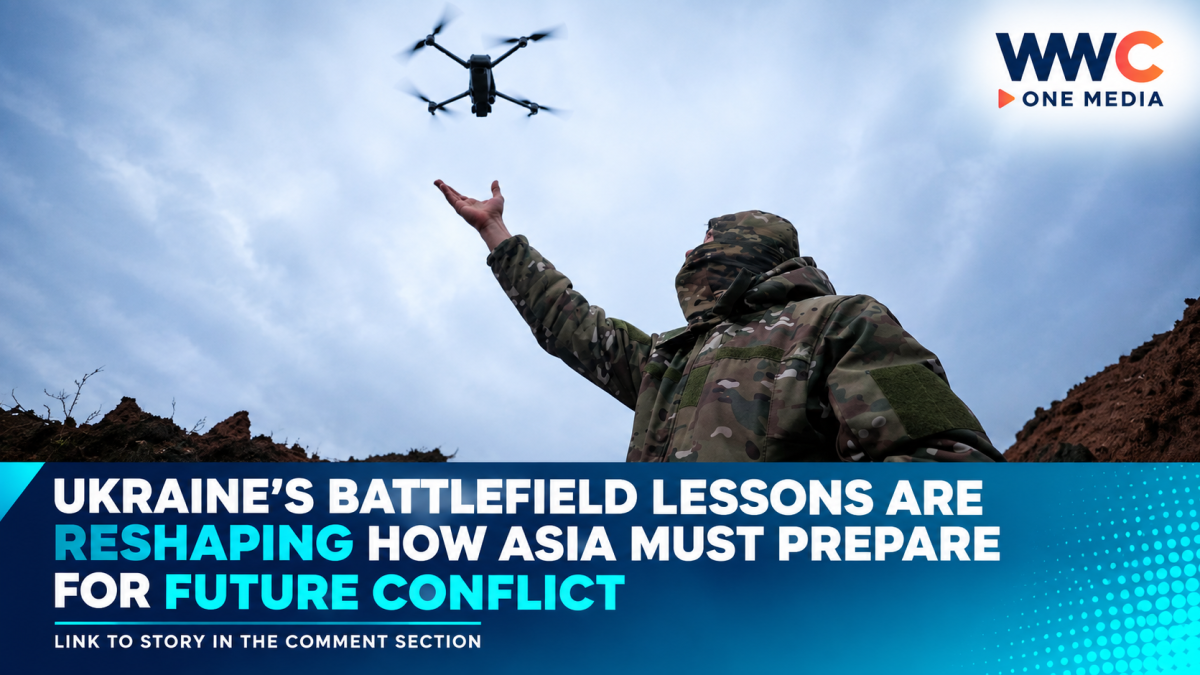
The war in Ukraine is offering Asian governments an increasingly detailed picture of how future conflicts could unfold, with drones, cyberattacks, disinformation, economic pressure and attacks on critical infrastructure becoming as important as traditional battlefield weapons.
The warning behind the phrase “Ukraine today is Asia tomorrow” is that the technologies and tactics emerging from the war could eventually shape security challenges in the Indo-Pacific. The battlefield is becoming a testing ground for capabilities that can be adapted elsewhere, while the conflict is also demonstrating how difficult and expensive modern warfare can become.
One of the most significant lessons is the growing importance of attrition. Rather than relying solely on large, decisive military operations, adversaries can use sustained attacks and disruption to gradually exhaust personnel, equipment, infrastructure and financial resources. The result can be a prolonged conflict in which endurance becomes a central strategic factor.
Ukraine has also demonstrated how rapidly relatively inexpensive drones can transform military operations. Small unmanned systems are being used for reconnaissance, targeting and attacks, while both sides continue to adapt their technology and tactics. The scale of drone production has become particularly important, with concerns that China’s ability to manufacture inexpensive drones could give it a significant advantage in a future conflict.
Cybersecurity is another major part of the emerging battlefield. Ukraine has faced attacks against government systems and critical infrastructure alongside conventional military operations. The combination of cyber operations, disinformation and physical attacks creates a form of hybrid conflict that can be difficult to attribute and defend against.
That creates a particular challenge for Asian countries, where highly connected economies depend heavily on digital networks, shipping routes, energy infrastructure and global supply chains. A major confrontation could therefore disrupt societies without beginning with a conventional attack on military bases.
The experience of Ukraine also highlights the importance of resilience. Governments need to consider not only how to deter attacks but also how quickly essential services, communications and infrastructure could recover after being targeted.
These lessons are relevant to debates over security in East Asia, including concerns surrounding Taiwan and the broader regional balance involving China, Japan, the United States and other countries. Japan has previously promoted the idea of stronger multilateral security arrangements, while other regional proposals have emphasized dialogue and confidence-building rather than military alliances.
The debate is complicated by the uncertainty surrounding the future role of the United States in Asia. The question is not simply whether Washington will remain involved, but how regional countries could respond if American engagement changes or if existing security arrangements prove insufficient during a crisis.
There is also no single Asian equivalent of the European security environment. Countries across the region have different threat perceptions, military capabilities, relationships with China and the United States, and approaches to diplomacy. Those differences make any broad regional security framework difficult to construct.
Still, the Ukrainian experience has made one point increasingly difficult to ignore: modern conflict can spread across military, economic, technological and information domains simultaneously.
For Asian governments, preparing for such a future means looking beyond traditional weapons and troop numbers. Cyber resilience, drone technology, critical infrastructure protection, supply-chain security, information integrity and the ability to sustain essential services could all become decisive elements of national security.
The question now is how much of the Ukrainian experience Asia can absorb before a similar crisis forces governments to learn those lessons under pressure.