
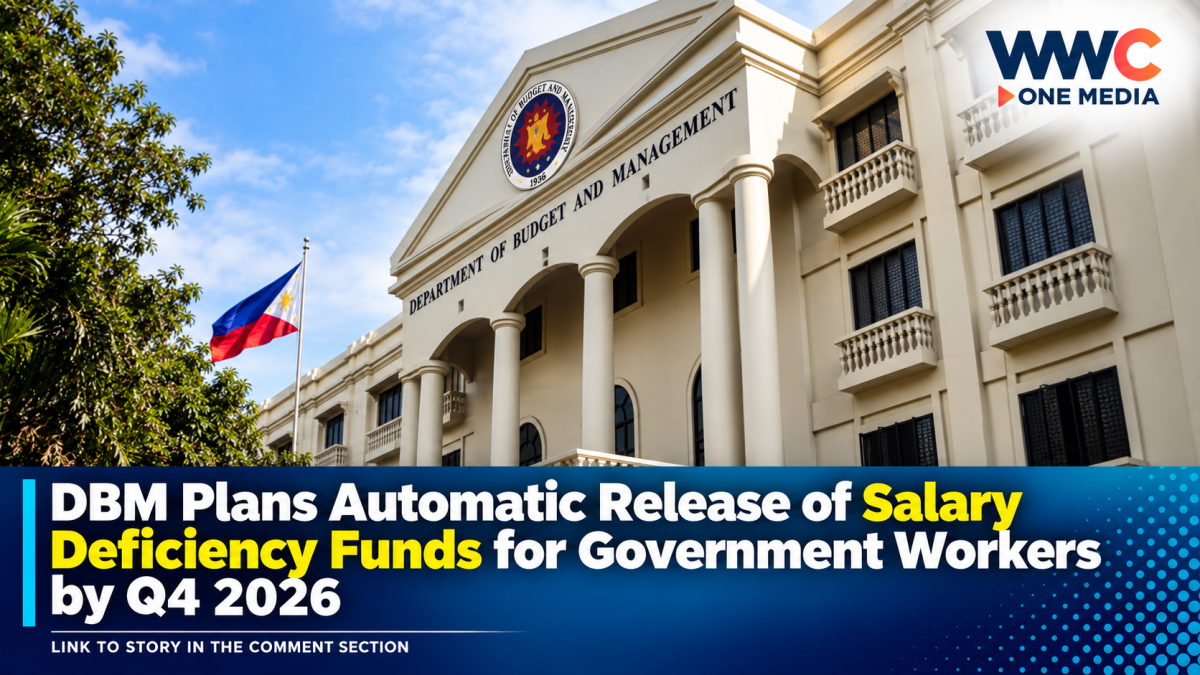
MANILA, Philippines — Thousands of government employees who have been waiting for salary adjustments tied to promotions, reclassifications or other personnel changes could soon see a faster funding process as the Department of Budget and Management (DBM) moves to test an automatic release system for salary deficiencies in the fourth quarter of 2026.
The planned reform aims to remove a layer of paperwork that currently requires government agencies to formally request additional Personnel Services (PS) funding from DBM when their approved personnel budget falls short of actual salary requirements.
Budget Secretary Kim Robert De Leon said the new approach would instead rely on updated agency plantilla or master-list data to identify salary funding gaps.
Under the proposed system, agencies would primarily need to keep their personnel information updated. If DBM detects a funding deficiency based on those records, the department could release the necessary funds without waiting for a separate request.
The reform is particularly significant for employees whose salaries change after promotion or position reclassification, situations that can result in agencies needing additional funding to cover the higher compensation.
From request-based to automatic funding
At present, agencies may have to submit information to DBM identifying employees who were promoted and the corresponding salary levels so the department can calculate the additional funding required.
That process can create delays, particularly when large agencies have numerous personnel movements and salary adjustments to process.
De Leon said the planned system would shift the process from one that depends on individual agency requests to one that is driven by updated personnel data.
The reform is still being developed. According to recent reporting on De Leon’s announcement, DBM was targeting the issuance of a formal circular before the end of September, followed by a live test during the fourth quarter of 2026. The initial testing is expected to involve DepEd and other agencies that commonly encounter personnel-services funding deficiencies.
Why this matters to government employees
Salary deficiencies can arise when an agency’s existing Personnel Services allocation does not fully cover authorized compensation requirements.
These can include funding needs connected with promotions, salary step increments, reclassified positions and filled but previously unfunded positions, among other authorized personnel requirements.
DBM has already been working with agencies on the computation and validation of such deficiencies. In August 2026, for example, DBM and DepEd personnel conducted a workshop involving salary funding deficiencies for reclassified and filled-but-unfunded positions, as well as salary step-increment requirements.
The issue also fits into the broader government effort to implement updated compensation for public servants. DBM’s current budget documents show that the third tranche of the updated salary schedule for civilian government personnel is being implemented under Executive Order No. 64, series of 2024, with National Budget Circular No. 601 providing implementation guidance for 2026.
What the proposed change does—and does not—mean
The announcement does not mean every government employee will automatically receive an additional salary payment in Q4.
Rather, the proposed system is designed to make the release of funding for legitimate salary deficiencies more automatic once the necessary personnel data are updated and the deficiency is identified.
The formal rules are still being prepared, meaning the exact mechanics, coverage and implementation procedures will depend on the DBM circular and subsequent rollout.
The reform could nevertheless have a major impact on government workers because it seeks to address one of the recurring bottlenecks in salary administration: the time between an employee becoming entitled to a higher salary and the release of the additional funding needed to pay it.
Part of a wider push to streamline government spending
The move comes as DBM continues to modernize the government’s budget and personnel-management processes.
Official DBM records show continuing work on personnel-services deficiencies, salary adjustments and funding requirements across national government agencies. The department has also been incorporating salary-related requirements into broader national budget planning.
For government employees, the proposed reform could ultimately mean less paperwork for agencies and potentially shorter waiting periods for authorized salary adjustments.
But the crucial next step remains the issuance of the formal DBM rules.
If the Q4 test succeeds, the bigger question will be whether the automatic system can eventually replace the request-based process across government—and how quickly employees waiting for salary deficiencies could feel the difference.




Leave a Reply