
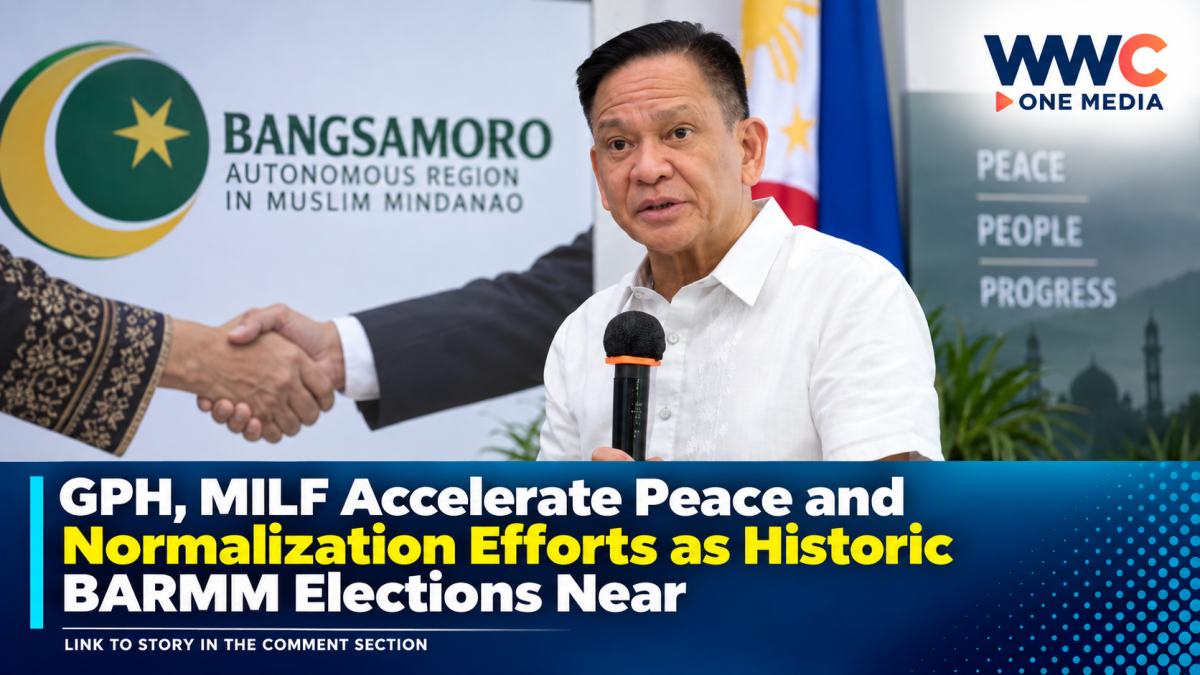
MANILA, Philippines — With the Bangsamoro Autonomous Region in Muslim Mindanao (BARMM) preparing for its first parliamentary elections, the Philippine government and the Moro Islamic Liberation Front (MILF) are stepping up efforts to complete key commitments under their landmark peace agreement.
The renewed push comes just days before the September 14, 2026 BARMM parliamentary elections, a vote widely seen as a major test of the Bangsamoro peace process and the region’s transition from decades of armed conflict toward autonomous democratic governance.
The Government of the Philippines (GPH) and MILF are working to advance the normalization track of the Comprehensive Agreement on the Bangsamoro (CAB), which was signed in 2014 after years of negotiations aimed at ending the armed conflict in Mindanao.
Why normalization matters
Normalization is one of the two major tracks of the CAB. While the political track focuses on establishing and strengthening the Bangsamoro’s autonomous government, normalization is aimed at helping former combatants and conflict-affected communities transition to peaceful civilian life.
The process includes measures such as MILF combatant decommissioning, socioeconomic assistance, weapons-related arrangements, security mechanisms, transitional justice and the transformation of former conflict areas and camps.
The government and MILF resumed formal implementation work in August after a period in which parts of the normalization process had been temporarily paused.
PeaceGovPH said the two sides’ implementing panels reconvened in Davao City and agreed to resume normalization activities, stressing that the objective was to continue implementing commitments already made under the peace agreement rather than reopen settled issues.
The clock is ticking
The timing is significant.
The first regular parliamentary elections in BARMM are scheduled for September 14, with millions of voters expected to participate in choosing the region’s first elected parliament. The election is intended to mark another major step away from the transition government and toward a fully elected Bangsamoro political system.
But the approaching election does not mean the peace process is complete.
An independent pre-election assessment by the Asian Network for Free Elections and the National Democratic Institute said important normalization commitments remain outstanding, including socioeconomic support for former combatants and progress on transitional-justice measures. It also warned that the credibility and perceived fairness of the election could have consequences for post-election stability and the continuation of the peace process.
Decommissioning remains a key piece
The decommissioning of MILF combatants has been one of the most visible components of normalization.
The program is intended to help former combatants leave the armed struggle and transition into civilian life through a combination of socioeconomic assistance, livelihood opportunities and other support.
Government information previously reported that more than 26,000 MILF combatants had been decommissioned, demonstrating significant progress since the implementation of the CAB.
But decommissioning is only one component of a much larger process.
The normalization agenda also involves addressing security concerns, transforming former MILF camps, supporting communities affected by conflict and advancing mechanisms designed to prevent a return to armed confrontation.
Amnesty and former combatants
Another important element is the government’s amnesty program for former members of the MILF and Moro National Liberation Front (MNLF).
President Ferdinand Marcos Jr. issued Proclamations 405 and 406 in November 2023, granting amnesty to qualified former combatants and supporters as part of efforts to advance the normalization process.
Government and MILF mechanisms have continued working on intake and related processes to enable qualified individuals to benefit from the amnesty framework.
These measures are important because normalization is not simply about ending armed conflict. It is also about creating conditions in which former combatants can participate in civilian, economic and political life without returning to violence.
Peace process resumes, but challenges remain
The renewed GPH-MILF engagement comes after months of difficulties in the implementation of the peace agreement.
MindaNews reported in August that the GPH and MILF implementing panels had finally resumed formal meetings after a temporary pause, describing the development as a return of momentum to the Bangsamoro peace process.
The resumption was welcomed as an opportunity to address unfinished commitments before the transition period moves into a new phase.
At the same time, independent observers have cautioned that unresolved normalization issues could continue to affect confidence in the peace process.
The Third-Party Monitoring Team, which has been tasked with monitoring implementation of the GPH-MILF peace agreements, has previously emphasized that the normalization track requires sustained attention as the transition period progresses.
Why the September 14 vote could be a turning point
The BARMM parliamentary elections represent more than an ordinary regional election.
They are intended to complete a major part of the political transition envisioned under the peace agreement by replacing the interim political arrangement with an elected parliament.
The first regular parliament is expected to have 80 seats, combining party-list, district and sectoral representation. Around 2.4 million voters are expected to participate, according to recent election analysis.
That makes the election a crucial test not only for the Bangsamoro government but also for the broader peace settlement.
A credible and peaceful vote could strengthen public confidence in the political track of the peace agreement.
But election success alone will not automatically complete normalization.
The bigger challenge after the polls
The coming election may therefore mark the beginning of another phase rather than the end of the peace process.
Once voters choose the first regular Bangsamoro parliament, attention is likely to shift toward whether the government and MILF can finish the remaining normalization commitments while ensuring former combatants and conflict-affected communities receive the assistance promised under the peace agreement.
The challenge will be to make sure that the political transition and normalization process move forward together.
For communities that have lived through decades of armed conflict, the ultimate measure of the peace agreement will not simply be the conduct of an election.
It will be whether peace translates into security, livelihoods, functioning institutions and a lasting reduction in the conditions that once fueled conflict.
And with the historic BARMM vote only days away, the government and MILF now face a critical question:
Can they turn renewed cooperation into enough progress to carry the Bangsamoro peace process into its next chapter?


Leave a Reply