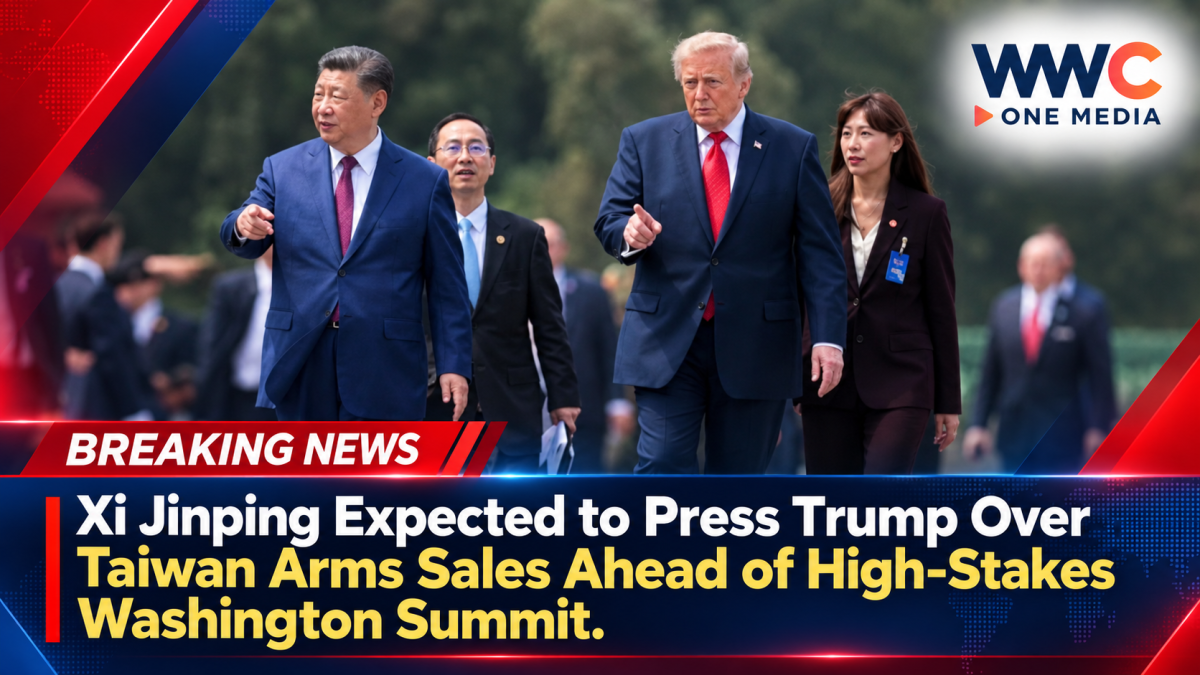
WASHINGTON/TAIPEI — Chinese President Xi Jinping is expected to press U.S. President Donald Trump to curb American arms sales to Taiwan when the two leaders meet in Washington this week, according to people familiar with discussions cited by Reuters.
The issue is emerging as one of the most sensitive points ahead of Xi’s September 24 meeting with Trump, with Beijing seeking to invoke the 1982 U.S.-China joint communiqué while Taiwan continues to await deliveries from previously approved American weapons packages.
Beijing points to the 1982 communiqué
According to Reuters, Chinese officials are expected to argue that Washington should honor language in the 1982 joint communiqué concerning the gradual reduction of U.S. arms sales to Taiwan.
The communiqué stated that the United States intended to gradually reduce arms sales to Taiwan and did not seek to maintain a long-term policy of such sales.
However, the broader historical record includes a significant qualification. Former President Ronald Reagan issued an accompanying memorandum stating that the U.S. position was conditioned on China’s continued commitment to peacefully resolving differences with Taiwan.
Reuters reported that people familiar with Beijing’s position said China may also ask Washington to halt deliveries of weapons that Taiwan has already ordered.
Taiwan’s pending weapons packages add pressure
The dispute comes as Taiwan continues waiting for a major U.S. arms package.
Taiwan News reported that Taipei is awaiting an arms package worth approximately NT$444.91 billion (US$14 billion), including Patriot Advanced Capability-3 Missile Segment Enhancement interceptors and National Advanced Surface-to-Air Missile Systems.
Reuters reported separately that the package has remained on hold, while Taiwan’s defense authorities said on September 23 that Taipei would continue working closely with Washington to implement arms sales already approved and maintain progress on planned packages.
The situation has attracted additional attention because Trump and Xi are meeting while the status of U.S. security support for Taiwan remains a major issue in Washington-Beijing relations.
Taiwan says it will continue working with Washington
Taiwan’s Defense Ministry said Wednesday that it would maintain close contact with the United States over arms sales.
A ministry official said Taipei would continue coordinating with the U.S. Department of War to promote implementation of arms sales according to established plans.
Taiwan has also been expanding its own defense-production capabilities, including programs involving submarines, fighter aircraft and missiles, while relying on the United States as its most important foreign source of military equipment.
U.S. lawmakers urge Trump to resist Chinese pressure
The issue has also generated debate in Washington.
U.S. Representative John Moolenaar, chairman of the House Select Committee on China, urged Trump last week to reject Chinese efforts to influence U.S. arms exports and security cooperation involving Taiwan and other partners.
Moolenaar argued that China’s military buildup and increasingly confrontational behavior toward neighboring countries—not U.S. arms sales—are responsible for regional instability. His comments represent his position as a member of Congress, rather than an established assessment shared by all U.S. officials.
A group of Democratic senators also issued a statement ahead of Xi’s visit warning about China’s military pressure on Taiwan and urging continued U.S. support for Taipei.
China signals broader concerns ahead of the summit
Beijing’s position extends beyond weapons sales.
China’s ambassador to the United States, Xie Feng, said in a People’s Daily article that Taiwan, democracy and human rights, China’s development path, and its development rights constitute what Beijing describes as four “red lines.”
Reuters reported that the statement came as Xi prepared to meet Trump and that Beijing continues to oppose U.S. arms sales to Taiwan.
Beijing considers Taiwan part of China and has repeatedly objected to U.S. military support for Taipei. Taiwan’s government rejects Beijing’s sovereignty claims and maintains that the future of Taiwan should be determined by its people.
The Trump-Xi meeting comes at a sensitive moment
Xi’s September 23–25 U.S. visit is taking place against a wider backdrop of disagreements involving trade, technology, Taiwan and other international issues.
China’s Foreign Ministry said the visit was intended to facilitate discussions between Xi and Trump on major China-U.S. relations and broader international matters.
Reuters has reported that Taiwan is expected to be among the issues watched closely during the summit, while the United States has recently reiterated support for peace and stability across the Taiwan Strait alongside Japan and South Korea.
The immediate question is therefore not simply whether Taiwan arms sales will be discussed, but how the two governments address the long-running disagreement over U.S. security support for Taipei without disrupting the wider U.S.-China relationship.
For Taiwan, the outcome could affect the timing of weapons deliveries already in the pipeline. For Washington and Beijing, the issue remains tied to competing interpretations of the 1982 communiqué and sharply different positions over Taiwan’s status and security.
WWC ONE MEDIA G,A