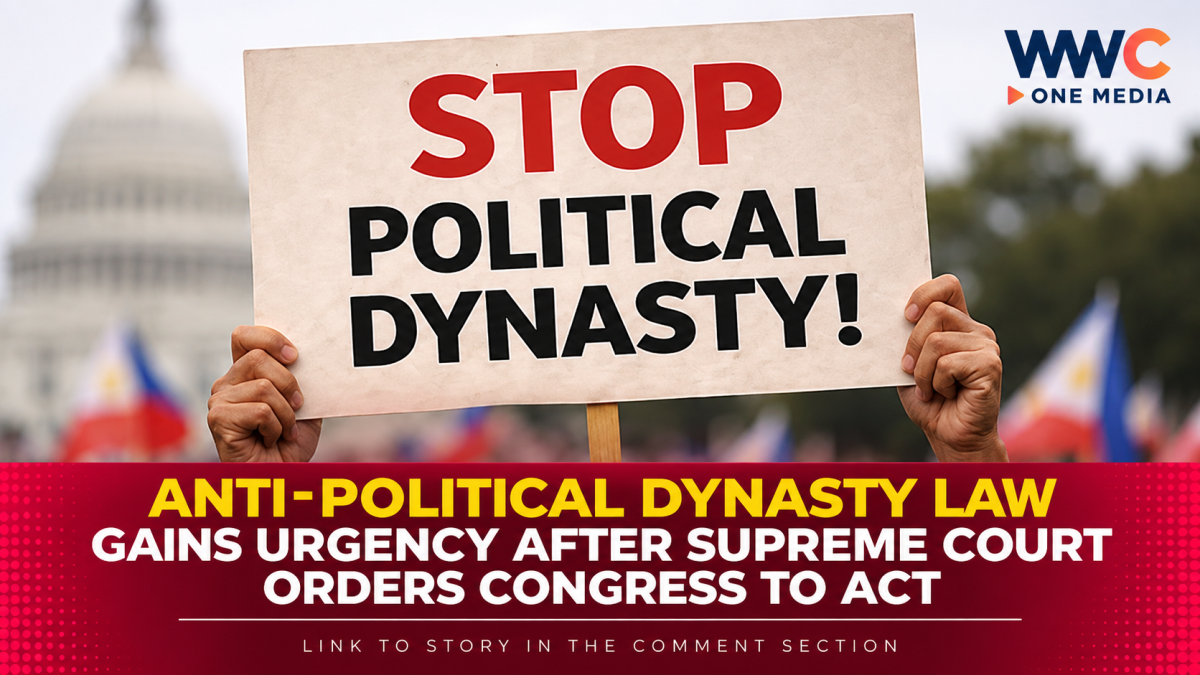
The decades-long push for an anti-political dynasty law has entered a new phase after the Supreme Court ruled that Congress has a mandatory constitutional duty to enact legislation prohibiting political dynasties.
In its Aug. 26, 2026 decision, the Supreme Court unanimously held that Congress’ failure to pass an anti-political dynasty law for 39 years amounted to grave abuse of discretion. The ruling directed Congress to act at the earliest opportunity.
The issue stems from Article II, Section 26 of the 1987 Constitution, which states that the government must guarantee equal access to opportunities for public service and prohibit political dynasties as defined by law.
The Supreme Court clarified that the constitutional provision is not merely an aspiration. Congress has the authority to determine how political dynasties will be defined, which family relationships and positions will be covered, and the specific scope of the prohibition — but it cannot simply leave the constitutional mandate unimplemented indefinitely.
The ruling does not itself create an immediate ban on relatives running for office. The Court specifically rejected an attempt to compel the Commission on Elections to enforce a dynasty prohibition without an enabling law, saying Comelec has no legal basis to determine which candidates would be disqualified in the absence of legislation defining prohibited political dynasties.
The Supreme Court’s decision also discussed the possibility of a prohibition covering relatives as far as the fourth civil degree of consanguinity or affinity. However, the justices stressed that this discussion does not dictate the final contents of the legislation, which remain within Congress’ authority.
Congress had already been working on proposed legislation before the Supreme Court ruling. House Bill No. 8389, for example, sought to prohibit relatives within the second degree of consanguinity or affinity from simultaneously running for or holding office in the same locality. The measure was being considered as Congress worked to implement Article II, Section 26.
The Commission on Elections has also urged lawmakers to move faster. Comelec Chairman George Garcia said the poll body supports an anti-political dynasty law and encouraged Congress to pass one before the filing of certificates of candidacy for the 2028 elections.
The Supreme Court ruling leaves several major questions for lawmakers to settle through legislation, including which relatives would be covered, whether restrictions would apply simultaneously within the same locality or across different levels of government, and what exceptions or transition rules would apply.
For nearly four decades, the Constitution has contained a prohibition against political dynasties while leaving Congress to define its implementation. The latest ruling has now placed that unfinished constitutional mandate directly before lawmakers, making the drafting and passage of an enabling law the next major step in the process.