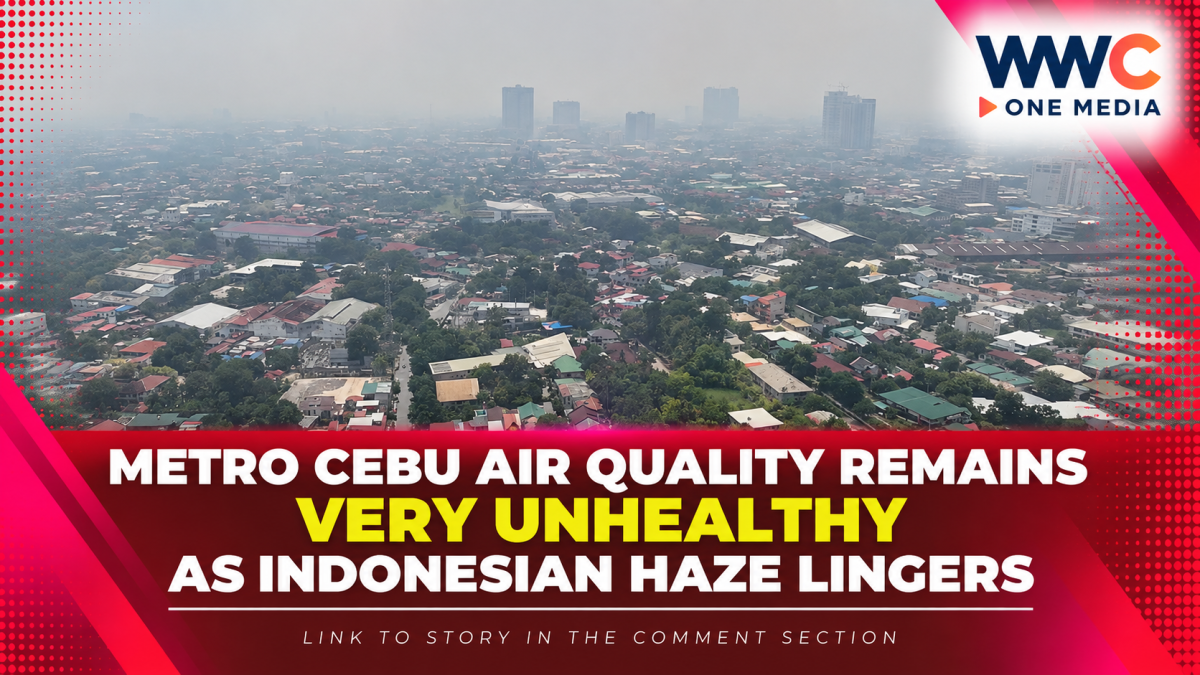
Metro Cebu continued to experience unhealthy air conditions on Monday, September 21, 2026, as transboundary haze from fires in Kalimantan, Indonesia, remained over the region.
The Environmental Management Bureau Region 7 recorded an Air Quality Index of 167 at 4 p.m., placing Metro Cebu in the “Very Unhealthy” category. The reading had improved from the previous days but remained high enough to prompt continued health precautions.
The latest episode followed a sharp deterioration in air quality over the weekend. On September 20, the Metro Cebu monitoring station recorded a peak AQI of 296 at 1 a.m., just below the 301 threshold for the “Emergency” category. By 4 p.m. that day, the reading had fallen to 248.
The haze has been linked by EMB 7 to smoke and fine particulate matter from forest fires in Kalimantan, Indonesia. Prevailing southwest winds have been carrying pollutants toward Central Visayas, although the movement and concentration of the haze can change depending on wind speed and direction.
Fine particulate matter, particularly PM2.5, is a major concern because the particles are small enough to penetrate deep into the respiratory system. Authorities have advised residents, especially those vulnerable to air pollution, to reduce prolonged outdoor exposure.
People with respiratory conditions have been advised to limit strenuous outdoor activities, while those who need to go outside may use properly fitted N95 or KN95 respirators for additional protection.
The deteriorating conditions also prompted several Cebu local government units to suspend in-person classes and shift to remote learning. Local officials have been advised to monitor actual air-quality readings in their areas and follow guidance from environmental and health authorities.
Air quality has fluctuated significantly throughout September. Metro Cebu previously reached an AQI of 252 on September 3, classified as “Acutely Unhealthy,” before conditions temporarily improved. The monitoring station later recorded an AQI of 86 on September 10, bringing the air quality down to the “Fair” category.
The latest readings show that improvement can be temporary while the fires in Indonesia continue and weather conditions remain favorable for the transport of pollutants.
Residents are being urged to monitor official air-quality advisories and reduce unnecessary exposure whenever pollution levels rise, particularly during periods when the haze becomes visibly concentrated across Metro Cebu.