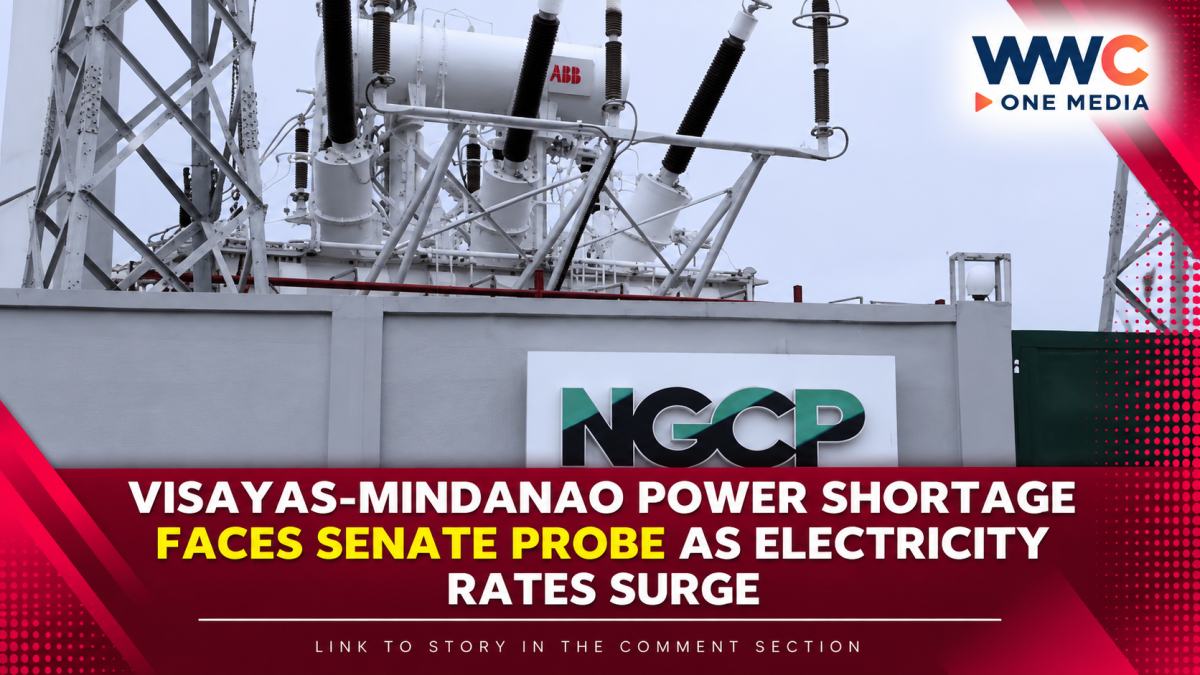
The prolonged electricity shortage in the Visayas and Mindanao is drawing closer scrutiny as Senate President Sherwin Gatchalian urged the Energy Regulatory Commission (ERC) to investigate the persistent supply problems and the sharp difference in electricity prices between the regions and Luzon.
Gatchalian said electricity prices in the Wholesale Electricity Spot Market from July 26 to August 25, 2026 averaged P4.80 per kilowatt-hour (kWh) in Luzon, compared with P18.59/kWh in the Visayas and P19.56/kWh in Mindanao.
He questioned why consumers in regions with high poverty levels are facing significantly higher electricity costs, linking the price disparity to the continuing shortage of power supply.
The situation has been particularly difficult in the Visayas. Data cited by government agencies showed that the Visayas grid recorded 33 red alerts and 96 yellow alerts from January 1 to September 7, 2026.
A red alert indicates that available supply is insufficient to meet demand and the grid’s regulating requirements, while a yellow alert means the operating margin is too low to meet the required contingency reserve.
Recent grid conditions have also been affected by power plants operating below capacity or being forced offline. On September 22, the Visayas grid was again placed under yellow alert, with NGCP reporting 2,504 megawatts of available capacity against projected peak demand of 2,419 MW.
NGCP said 13 power plants were on forced outage while another 16 were operating at reduced capacity, resulting in about 928.4 MW of unavailable capacity.
The continuing shortages have already affected electricity consumers in Cebu and other parts of the Visayas, where utilities have implemented measures such as rotational interruptions and programs designed to reduce pressure on the grid during periods of tight supply.
Gatchalian said the ERC should strictly enforce reliability standards for power generation and distribution companies. He also called for an examination of possible anti-competitive practices or collusion among generation companies to determine whether market participants may be taking advantage of the supply situation. These remain matters for regulatory investigation and have not been established as wrongdoing.
The issue is also being examined in the House of Representatives. A resolution filed in September calls for an inquiry into the continuing power outages in the Visayas, while another seeks an investigation into ancillary-service costs, reserve requirements and the status of generation, energy-storage and transmission development plans.
Energy advocates have meanwhile raised concerns over transmission limitations. Cebu Energy Rights Advocates said the transmission system may be contributing to the difficulty of moving available power between regions and backed proposals to give the Department of Energy and National Transmission Corp. a greater role in national transmission planning.
With electricity prices in the Visayas and Mindanao substantially above those recorded in Luzon, the coming investigations could focus not only on the immediate causes of the shortages but also on generation reliability, transmission capacity, reserve requirements, market behavior and the long-term planning of the country’s power system.
For consumers, the bigger issue is whether these investigations will lead to concrete measures that can prevent repeated alerts, reduce exposure to expensive spot-market electricity and provide a more stable power supply across the Visayas and Mindanao.