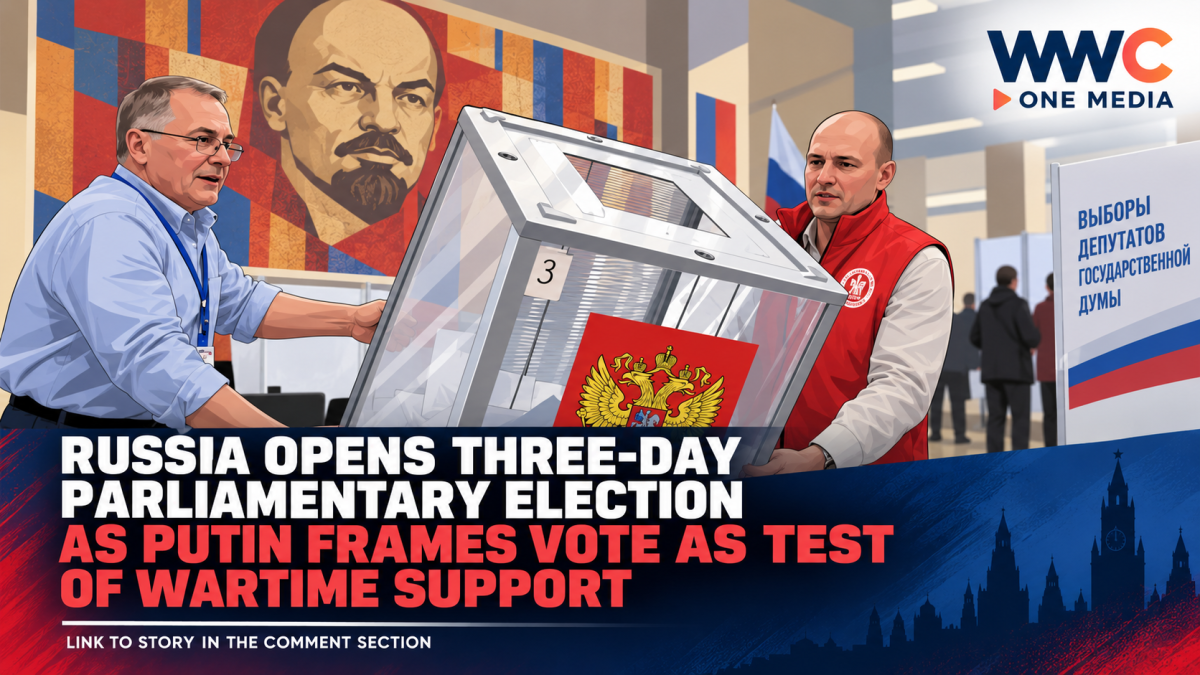
MOSCOW — Russia has begun a three-day parliamentary election that will determine all 450 seats in the State Duma, the country’s lower house of parliament, in the first parliamentary vote since Moscow launched its full-scale invasion of Ukraine in February 2022.
Voting runs from September 18 through September 20, 2026, with polling stations opening across Russia and electronic voting available in participating regions. About 111 million people are eligible to vote, according to the Associated Press.
The election is taking place under markedly different conditions from the previous Duma election in 2021, with the war in Ukraine dominating the political backdrop, restrictions on anti-war opposition and voting also taking place in Ukrainian territories occupied by Russia.
Putin Turns Parliamentary Vote Into a Wartime Political Message
President Vladimir Putin has urged Russians to participate, presenting the election as a demonstration of unity, patriotism and support for Russian soldiers.
In a televised address before voting began, Putin said participation would demonstrate that millions of Russians stand behind the country’s troops and share a commitment to national sovereignty. Reuters reported that he portrayed the election as a response to external pressure and as evidence of Russia’s political cohesion.
That framing has given the election significance beyond the selection of lawmakers. Analysts and international news organizations have described the vote as an important indicator of how the Kremlin wants to portray domestic support for its wartime policies. At the same time, the restricted political environment makes it difficult to interpret the result as a conventional referendum on the war.
United Russia Seeks to Preserve Its Parliamentary Supermajority
All 450 Duma seats are being contested for five-year terms. Half — 225 seats — are allocated through a nationwide party-list vote, while the other 225 are decided in single-member districts.
The ruling United Russia party currently holds 310 seats. Retaining at least 300 would preserve its constitutional supermajority, giving the party the ability to advance constitutional amendments without support from other parliamentary parties.
A VTsIOM survey conducted at the end of August put United Russia at 37% among respondents, compared with 11.6% for the Communist Party. Those figures are a pre-election polling measurement, not a prediction of the final result.
Anti-War Political Forces Face Major Restrictions
The election has also drawn attention to who is not able to compete on equal terms.
Russia’s Supreme Court barred the liberal Yabloko party from the nationwide party-list ballot. Reuters described Yabloko as the only registered political party openly opposing Russia’s war in Ukraine. Some Yabloko candidates remain eligible to compete in individual constituencies.
Other opposition politicians have been excluded after being designated as so-called “foreign agents,” while some dissenting figures have been imprisoned or have left Russia. The Associated Press reported that the political environment has left the ballot dominated by parties that broadly support Putin’s policies.
Russia’s authorities reject accusations that the election lacks legitimacy, saying the voting process follows Russian law and accusing Western countries of attempting to interfere in or disrupt the election.
International Election Monitoring Is Also an Issue
The Organization for Security and Co-operation in Europe was not invited to observe the election.
Reuters reported that the OSCE has said Russia’s political system has become more restrictive since the 2021 parliamentary election, citing restrictions involving candidates, campaign financing and political participation. Russia’s independent election-monitoring organization Golos also closed in 2025 following years of pressure from authorities.
These factors are important when assessing the eventual results because turnout and vote shares will be recorded within an electoral environment that differs substantially from that of previous parliamentary elections.
Voting Extends Into Russian-Controlled Ukrainian Territories
For the first time, Russia is including residents of Russian-controlled parts of Donetsk, Luhansk, Zaporizhzhia and Kherson in the parliamentary election, alongside Crimea, which Moscow annexed in 2014.
Ukraine and much of the international community do not recognize Russia’s annexation claims over these territories. Kyiv has condemned the organization of Russian elections there and has called on foreign governments and international organizations not to recognize the results.
Russia says early voting in some areas is necessary because of security conditions. Reports from occupied areas have shown highly securitized voting arrangements, including mobile voting teams and armed personnel. The precise scale and circumstances of participation in those areas remain contested.
War Veterans Take a Larger Role in the Election
The war is also visible in the candidate field.
The Associated Press reported that nearly 200 candidates in the parliamentary election have served in Ukraine. The Kremlin has promoted veterans as part of a new political and social elite, giving military service a prominent place in campaign messaging.
Their presence reflects how the war has increasingly shaped Russia’s domestic political institutions, from campaign themes to candidate selection.
The Economy Adds Another Layer to the Vote
The election comes as Russia’s wartime economy faces increasing pressure.
The Associated Press reported that massive military spending has pushed the federal budget deficit to around 2.8% of GDP, while high interest rates, labor shortages and weaker consumer and business confidence have added to economic concerns. At the same time, elevated oil revenues have continued to provide the government with funds to finance the war.
That economic backdrop means the election is unfolding amid both the Kremlin’s message of stability and continuing concerns about the long-term cost of the conflict.
What the Election Will Reveal — and What It Won’t
The September 18–20 vote will establish the composition of Russia’s next State Duma, but its political meaning will depend on how the results are interpreted.
Putin has deliberately linked participation to national unity and support for Russian troops. Meanwhile, the exclusion of major anti-war political forces, restrictions on opposition candidates, limited international monitoring and voting in Russian-controlled Ukrainian territory complicate any attempt to interpret the election simply as a measurement of Russian public opinion about the war.
The immediate questions will therefore include turnout, United Russia’s final seat total, the performance of the Communist Party and other parliamentary parties, and how authorities and foreign governments respond to the results.
The ballots will be counted after polls close on September 20, providing the first nationwide parliamentary snapshot of Russia’s political system since the full-scale war in Ukraine began.