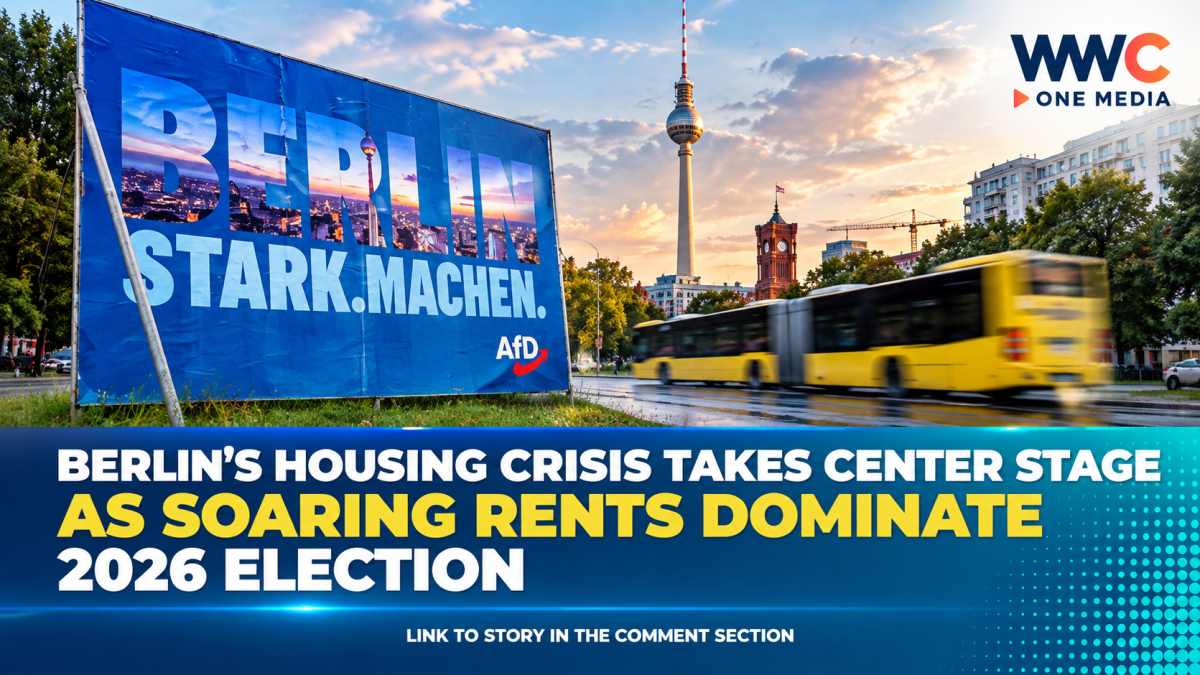
BERLIN — Berlin’s housing shortage has become the defining issue ahead of the German capital’s September 20, 2026 state election, with soaring rents, limited apartment supply and a fierce debate over new construction putting housing at the center of the campaign.
About 85% of Berlin households rent their homes, making housing costs a particularly significant concern for voters. Reuters reports that advertised rents have nearly doubled since 2014, while the city could need roughly 211,000 additional homes by 2040.
The debate is extending beyond rents themselves to a larger question: Where should Berlin build new homes without sacrificing public green space?
One of the biggest flashpoints is Tempelhofer Feld, the enormous former airport site that is now one of Berlin’s most popular public parks.
Rents Have Become a Defining Political Issue
Berlin’s housing market remains under significant pressure despite some recent moderation in rent growth.
The 2026 Berlin Housing Market Report from Berlin Hyp and CBRE said average advertised rents reached €15.80 per square meter in 2025, up only 0.1% from the previous year after much sharper increases in earlier years. However, the report said the supply of rental apartments remained low and that the housing shortage persisted.
Separate reporting by Tagesspiegel found that the average rent for newly advertised apartments in the previous year reached €15.78 per square meter, an increase of 86% over a decade.
For people searching for apartments, the challenge is therefore not simply the headline rental rate. A limited supply means prospective tenants can face intense competition for available homes.
French newspaper Le Monde reported examples of apartment seekers attending viewings alongside dozens of other applicants, illustrating the difficulty of finding housing even for people with stable incomes.
Tempelhofer Feld Becomes the Election’s Biggest Housing Flashpoint
Few places symbolize Berlin’s housing dilemma more clearly than Tempelhofer Feld.
The former Tempelhof airport was transformed into a public park after the airport closed in 2008. In a 2014 referendum, nearly two-thirds of participating Berlin voters backed keeping the site largely free from development.
Now, with the housing shortage significantly more severe, the question has returned to the political debate.
Some parties support limited construction on parts of the enormous site, while others argue that the open space should remain protected and that Berlin should concentrate new housing elsewhere.
Supporters of development argue that the city cannot ignore such a large potential site while thousands of people struggle to find homes.
Opponents say the park provides valuable recreational and ecological space and that Berlin should find housing opportunities without sacrificing one of its most important open areas.
Political Parties Offer Different Housing Strategies
Berlin’s major political parties have proposed significantly different approaches to the housing crisis.
The CDU has emphasized increasing construction, speeding up approvals and making building processes more efficient. Its lead candidate, Stefan Evers, has also proposed measures aimed at improving rent transparency and enforcement.
The SPD has proposed stronger enforcement against excessive rents, including a planned rent-monitoring system, while also supporting the construction of additional affordable housing. Its campaign has included proposals for a dedicated enforcement unit targeting illegal or excessive rents.
The Greens have emphasized converting unused office space into housing and strengthening tenant protections. The party has also supported implementing the result of Berlin’s 2021 referendum on the possible socialization of large housing companies.
The Left Party has proposed stronger rent controls, expanded social housing and measures involving large housing companies. Its platform also includes the possibility of socializing major housing holdings.
The AfD has connected the housing shortage to immigration and supports limited development at Tempelhofer Feld, according to Reuters’ review of the campaign.
These are campaign proposals rather than policies already in effect, and their implementation would depend on legal, financial and administrative constraints.
Berlin’s Housing Debate Goes Beyond New Construction
The disagreement is not simply about whether Berlin needs more apartments.
It is also about what kind of housing should be built, who should own it and how much tenants should pay.
Berlin has a large public housing sector, while private landlords and major housing companies also control substantial numbers of apartments.
The debate has been intensified by a 2021 referendum in which voters backed a proposal calling for the socialization of large housing companies. The measure has not resulted in immediate transfer of properties, and its implementation remains legally and politically contested.
Meanwhile, tenant advocates have continued to demand stronger protections against excessive rent increases.
Berlin’s Economic Success Has Added Pressure
The housing shortage is also linked to Berlin’s economic and population growth.
Reuters reports that the city’s services sector accounts for almost 90% of its economic output and that Berlin has become Germany’s startup capital, with more than 600 companies founded in 2025. Companies including Zalando and N26 have major operations in the city.
Economic growth can create jobs and attract new residents, but it can also increase demand for housing.
That has produced an uncomfortable contradiction for Berlin: the same growth that strengthens the city’s economy can make it more difficult for some residents to afford living there.
Researchers cited by Reuters have described rising land prices and limited space as part of the pressure on the housing market.
Even Berlin’s Cultural Scene Feels the Housing Squeeze
The housing crisis is affecting more than households.
Berlin’s famous cultural and nightlife sectors are also facing rising property costs.
Reuters reported that some clubs and cultural venues have had to relocate because they could no longer afford their rents, adding another dimension to the debate over what kind of city Berlin will become as property values rise.
For supporters of Berlin’s cultural identity, the concern is that rising rents could gradually push independent businesses and creative organizations away from central neighborhoods.
Housing Overshadows Other Election Issues
Housing has become unusually prominent in Berlin compared with some other German regional elections, where immigration and migration policy have played a larger role.
RBB’s election coverage identified housing and rents as one of the principal issues being addressed by the major parties, alongside topics including security, transportation, education and social policy.
The September 20 election is also taking place against a broader national political backdrop, but Berlin’s campaign has remained heavily focused on the city’s own housing and affordability problems.
The Question Berlin Must Answer
The election has placed Berlin before a difficult urban-planning dilemma.
The city needs substantially more housing, but available land is limited. Building on open space can generate new apartments while reducing recreational areas. Protecting every major green area, meanwhile, leaves fewer obvious locations for large-scale development.
At the same time, simply constructing more apartments does not automatically guarantee that they will be affordable to lower- and middle-income residents.
That is why the debate has expanded from “How many homes does Berlin need?” to a much bigger question about rent regulation, public housing, private development, land use and the future shape of the city.
With voters heading to the polls on September 20, the housing shortage has become more than an economic problem.
It has become a defining question about what Berlin should look like—and who can afford to live there.