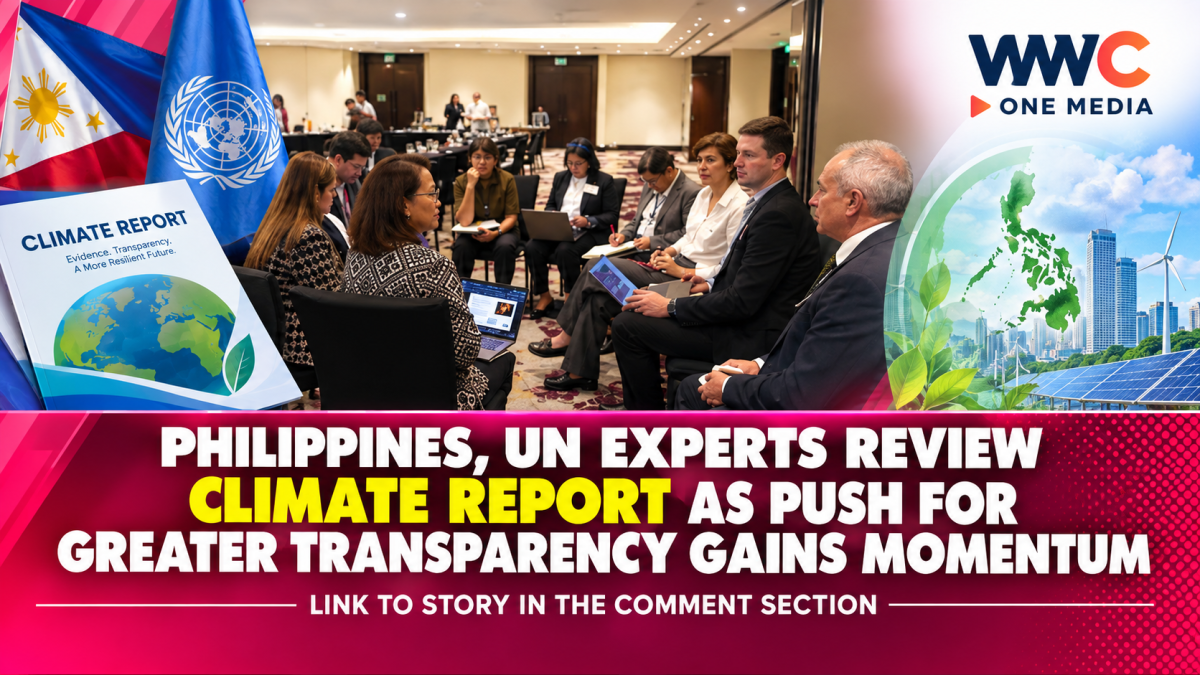
The Philippines and United Nations climate experts have completed a five-day technical review of the country’s first Biennial Transparency Report, an assessment aimed at improving how the government tracks and reports its progress in addressing climate change.
The Climate Change Commission partnered with experts from the United Nations Framework Convention on Climate Change for the review of the Philippines’ first BTR, which covers greenhouse gas emissions, climate mitigation and adaptation efforts, support received and other commitments under the Paris Agreement’s Enhanced Transparency Framework.
The technical review examined the information and methodologies used in the report. Experts raised questions, identified areas where improvements could be made and provided technical recommendations that could strengthen future climate reporting and policy decisions.
Climate Change Commission Vice Chairperson and Executive Director Robert E.A. Borje said the exercise was intended to go beyond improving the report itself. He said the process could help the Philippines identify gaps, strengthen climate action and learn from practices used by other countries.
CCC Deputy Executive Director Romell Antonio O. Cuenca likewise described the review as an opportunity to strengthen the country’s systems for collecting and presenting climate information.
The commission said better climate data can help government agencies determine which measures are working, identify remaining gaps and guide future policies, programs and investments.
The review involved six technical experts from Türkiye, India and Australia, along with representatives from the United Nations and Philippine government agencies responsible for climate-related information. Participating agencies included the Departments of Agriculture, Environment and Natural Resources, Transportation, Energy, and Economy, Planning and Development, as well as the Philippine Statistics Authority.
The review forms part of the Paris Agreement’s Enhanced Transparency Framework, under which countries are expected to provide clearer and more consistent information about their climate actions and progress.
The United Nations has also emphasized that climate transparency is more than a reporting requirement. Reliable information can strengthen decision-making, help direct investments and make it easier to assess whether climate commitments are producing measurable results.
For the Philippines, the importance of the exercise extends beyond international reporting. The country remains highly exposed to typhoons, flooding, extreme heat, sea-level rise and other climate-related risks that can affect communities, agriculture, infrastructure and livelihoods.
The Climate Change Commission said the review will help strengthen coordination among government institutions so that climate information becomes more consistent, reliable and useful for national decision-making.
The commission also said the findings can support programs focused on protecting livelihoods and food security while strengthening communities’ resilience to extreme weather and other climate risks.
The five-day assessment therefore places greater attention on a question that goes beyond how the Philippines reports its climate commitments: whether the information collected can ultimately lead to better policies, smarter investments and more effective protection for communities facing the growing impacts of climate change.