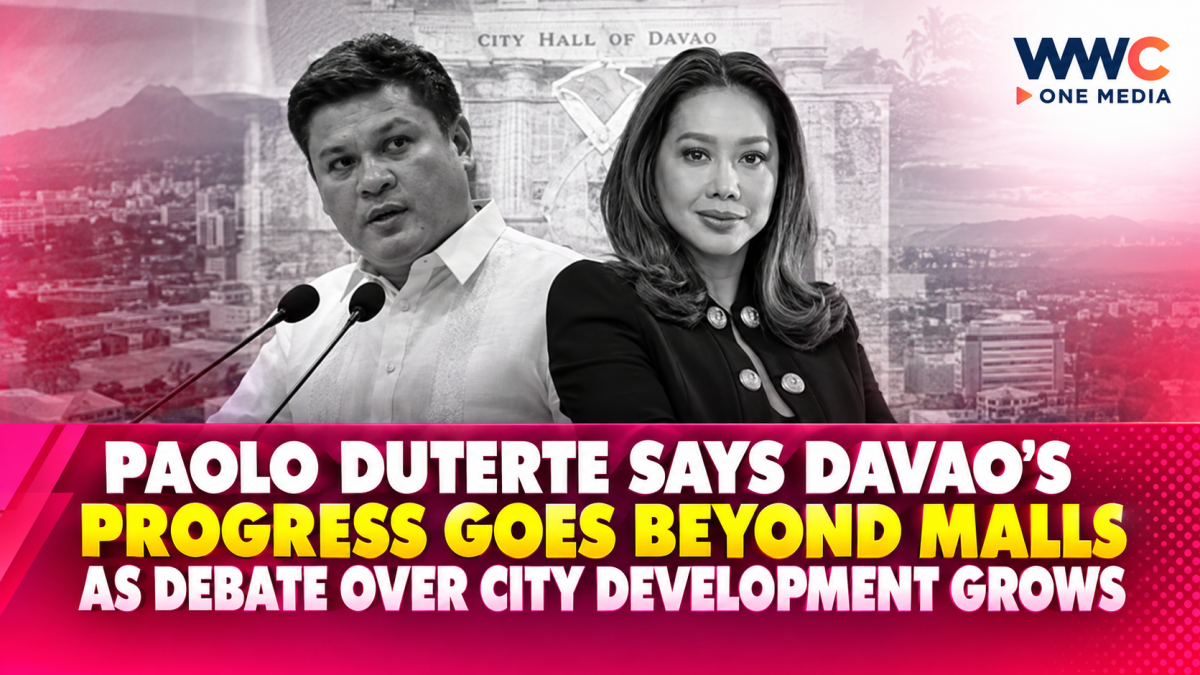
Davao City First District Representative Paolo “Pulong” Duterte has pushed back against the idea that a city’s progress should be measured mainly by the number of malls, high-rise buildings and upscale commercial developments it has.
Duterte made the remarks after broadcaster Korina Sanchez-Roxas said during a September 16 program that Davao still felt “left behind” compared with other major Philippine cities. She cited what she described as a lack of large-scale commercial developments similar to those found in Metro Manila.
Duterte argued that public services, employment and economic activity provide a different way of assessing development.
He pointed to services such as the city’s 911 emergency response system, health services, disaster response, roads and peace-and-order programs as areas that should also be considered when evaluating how a city is progressing.
The lawmaker also said Davao does not need to replicate business districts such as Makati or Bonifacio Global City to demonstrate economic development.
He cited data putting Davao City’s economy at ₱601.68 billion, describing it as the largest city economy in Mindanao and the Visayas. Separate rankings have also placed Davao among cities assessed for economic strength, human capital, quality of life, environment and governance.
The comments come amid a broader national discussion about Davao’s development and governance. The city has attracted continued investment and economic activity, but it has also faced scrutiny over infrastructure, flooding and public spending.
In September, the National Bureau of Investigation said it was examining nearly ₱1.9 billion worth of flood-control projects in Paolo Duterte’s congressional district that were awarded to Genesis88 Construction Inc. The NBI said it could summon Duterte if investigators determined that his testimony was necessary.
The flood-control investigation has also drawn attention to the contractor’s links to the Duterte family. Government records and previous reports have identified Genesis88 owner Glenn Escandor as a longtime Duterte family ally. GMA News reported that the NBI had summoned a senior DPWH official to provide documents related to projects under investigation.
Duterte’s latest remarks, however, focused on how development itself should be viewed.
Rather than using the presence of malls and skyscrapers as the main indicator, he said Davao should be assessed by whether government services work, whether residents have access to jobs and whether the local economy continues to grow.
Sanchez-Roxas had not publicly responded to Duterte’s remarks at the time of publication.
The exchange has added another layer to the ongoing discussion about what economic progress should look like in one of the Philippines’ largest cities — and whether visible commercial growth tells the whole story.