
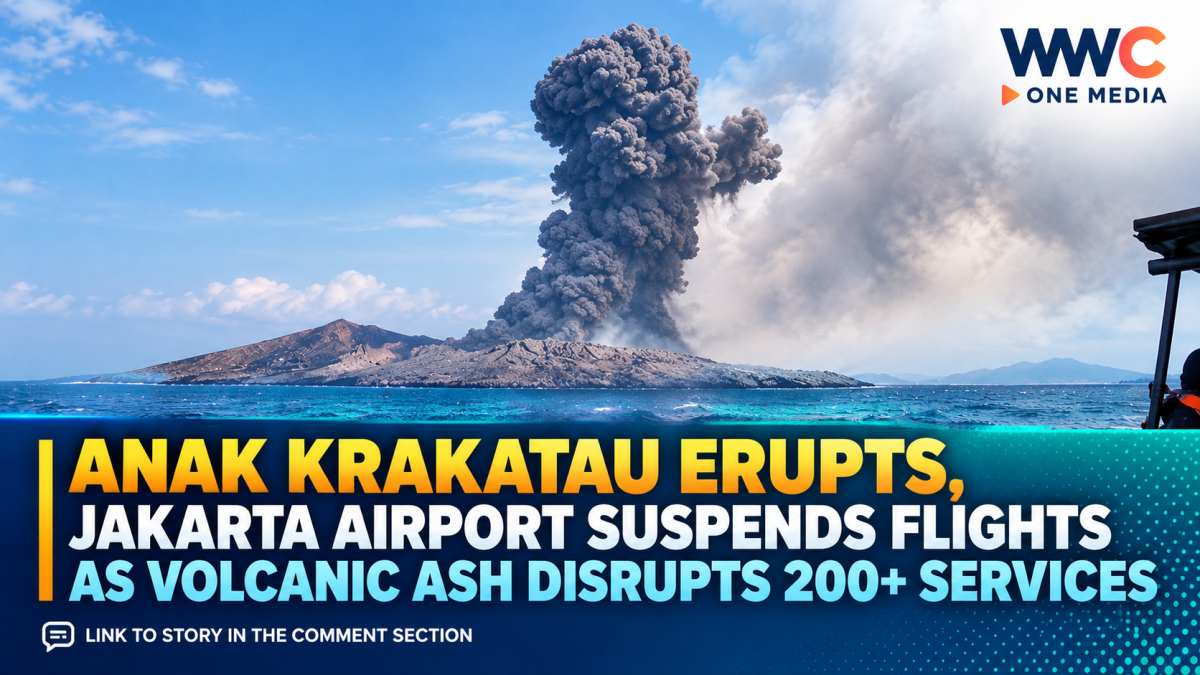
Indonesia’s Mount Anak Krakatau has erupted again, sending volcanic ash across parts of western Indonesia and forcing Jakarta’s main international airport to suspend operations as authorities scramble to protect air travelers.
Indonesia’s Soekarno-Hatta International Airport, the main aviation gateway serving Jakarta, suspended flight operations on Sunday, September 6, after volcanic ash from the ongoing Mount Anak Krakatau eruption was detected in the airport area.
What began as a precautionary closure scheduled through 5:30 a.m. local time was extended first to 9:30 a.m. and later to 1:30 p.m., as authorities continued monitoring the ash hazard.
By the later update, 209 flights had been affected, including international services, according to Indonesia’s Transportation Ministry.
The disruption has spread beyond Jakarta, with other airports and flight routes also affected by the ash cloud.
Why volcanic ash is so dangerous to aircraft
The airport shutdown is not simply a weather-related delay.
Volcanic ash can pose a serious threat to aircraft because the fine particles can enter jet engines, where they may melt and potentially damage engine components. Ash can also reduce visibility and contaminate aircraft systems and surfaces.
That is why aviation authorities generally treat volcanic-ash clouds as a major safety hazard rather than allowing aircraft to simply fly around visible ash.
Indonesia’s authorities detected volcanic ash at Soekarno-Hatta early Sunday, prompting the suspension of operations.
The ash plume reached tens of thousands of feet
The scale of the eruption has made the aviation disruption particularly significant.
Indonesia’s meteorological agency, BMKG, reported ash at roughly 6,000 meters (20,000 feet) on the Java side of Anak Krakatau, while another plume reached as high as approximately 15,000 meters (50,000 feet) over the Sumatra side and parts of Banten province on Java.
The eruption is taking place at Anak Krakatau, the volcanic island located in the Sunda Strait between Java and Sumatra.
The volcano is part of Indonesia’s highly active volcanic belt along the Pacific “Ring of Fire.”
Singapore flights among those disrupted
The effects have also reached international travelers.
Singapore Airlines was among the carriers affected, with flights between Singapore and Jakarta cancelled or rescheduled.
The Straits Times reported that two SIA services on September 5 were cancelled, while other flights were retimed. One Singapore-Jakarta flight was pushed to September 6, while a Jakarta-Singapore service was also delayed.
Scoot and other airlines also experienced disruptions.
Channel NewsAsia reported that international services involving Singapore, Kuala Lumpur, Guangzhou, Hong Kong and Doha were among those affected.
AirAsia separately warned that several flights to and from Jakarta had been cancelled or rescheduled because volcanic ash was affecting regional airspace.
The disruption is spreading beyond Jakarta
Soekarno-Hatta is not the only airport dealing with the consequences.
The Straits Times reported that Radin Inten II Airport in Lampung, Halim Perdanakusuma Airport in Jakarta and Budiarto Airport in Tangerang also faced temporary closures because of the eruption and ash conditions.
ANTARA also reported cancellations involving flights between Lampung and Jakarta after volcanic ash spread into flight paths.
That creates the possibility of a chain reaction: aircraft and crews may be out of position, later flights may be delayed, and passengers could face additional disruptions even after an airport reopens.
Schools and communities affected by ashfall
The eruption is also disrupting life on the ground.
Authorities and local reports said some schools cancelled activities, while residents experienced irritation from volcanic ash.
Indonesia’s disaster mitigation authorities advised people in affected areas to reduce outdoor activity, use masks and eye protection, cover water sources and exercise caution while driving because ash can reduce visibility.
Fishing activities were also disrupted as authorities monitored conditions around the volcano and surrounding waters.
Is there a tsunami threat?
The question is especially sensitive because Anak Krakatau has a deadly history.
The volcano is the offspring of the historic Krakatau volcano, whose catastrophic 1883 eruption became one of the most powerful volcanic events in recorded history.
More recently, a flank collapse of Anak Krakatau in December 2018 triggered a tsunami that killed hundreds of people along the coasts of Java and Sumatra.
However, authorities said the current eruption does not pose an imminent tsunami threat.
Indonesia’s disaster mitigation agency said there was no immediate tsunami risk, while authorities continued monitoring the volcano.
That distinction is important: the current aviation emergency is being driven primarily by volcanic ash and flight-safety concerns, not by a confirmed tsunami threat.
No casualties reported as authorities monitor the volcano
The Associated Press reported that the eruption lasted around 30 seconds during a major event early Sunday, with ash spreading across parts of Jakarta, Banten, West Java and Lampung.
No casualties or evacuation orders had been reported in connection with the eruption in the AP report, although authorities urged people to remain away from the active crater.
The situation nevertheless remains fluid.
Volcanic activity can change rapidly, and the location and altitude of an ash plume can shift with winds and atmospheric conditions. That makes the reopening of airports dependent not simply on whether the volcano is erupting, but on whether aviation authorities determine that flight paths are safe.
What travelers should do
Passengers scheduled to fly through Jakarta or other potentially affected airports should check directly with their airline before travelling to the airport.
Airlines have already begun issuing cancellation, rebooking and refund measures for affected passengers. Cathay Pacific, for example, announced special ticketing arrangements for passengers travelling to, from or through Jakarta during the affected period.
Travelers should also avoid relying solely on an earlier departure time shown on their original booking, because aircraft rotations and subsequent services can remain disrupted even after an airport resumes operations.
The bigger warning from Anak Krakatau
The latest eruption is another reminder of the extraordinary volcanic risks faced by Indonesia.
The country has more than 120 active volcanoes and sits along one of the world’s most geologically active zones.
For now, the immediate concern is the ash.
More than 200 flights have already been caught in the disruption, international routes have been affected and several airports have imposed temporary restrictions.
And with Anak Krakatau continuing to erupt, the next question is no longer simply when Jakarta’s airport will reopen—it is how long the volcano’s ash will continue to interfere with one of Southeast Asia’s busiest aviation corridors.

Leave a Reply