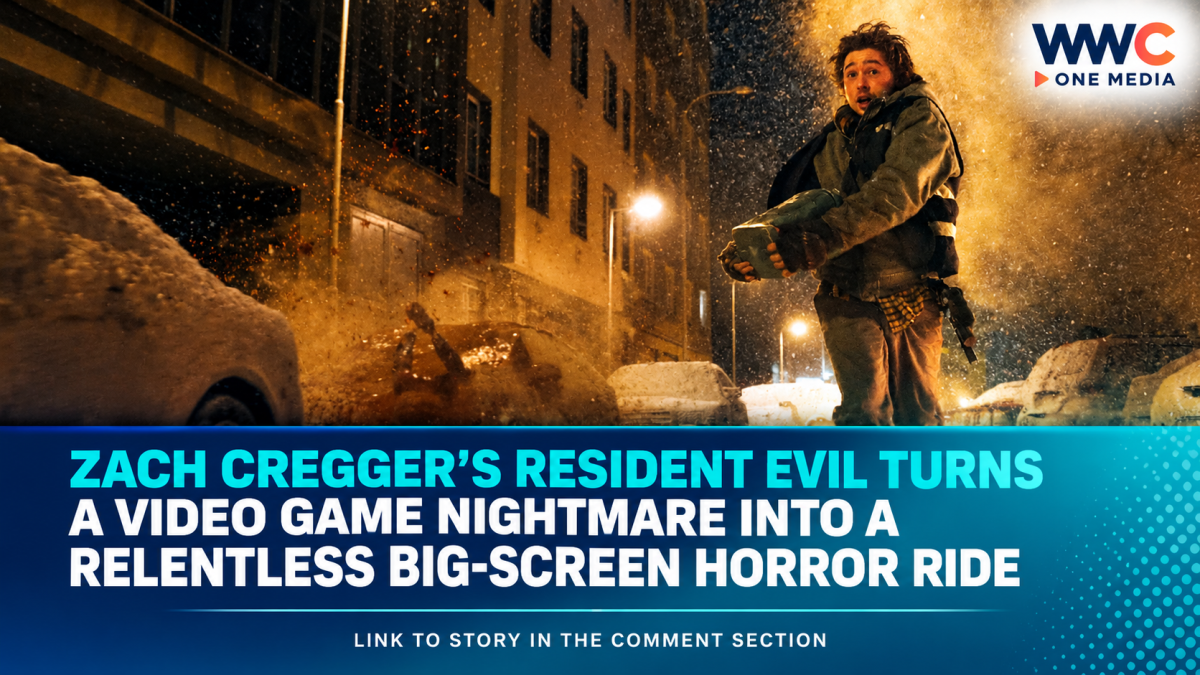
Zach Cregger’s Resident Evil is taking a different route from the earlier live-action films, choosing not to directly recreate one of Capcom’s games but instead to capture the feeling of actually playing one.
The new horror film follows Bryan, an ordinary medical courier played by Austin Abrams, whose routine delivery takes him into a terrifying Raccoon City. From there, the story builds around survival, exploration, sudden attacks and the uncertainty of what might be waiting behind the next door.
That approach is at the heart of Cregger’s version. The filmmaker, who previously directed Barbarian and Weapons, is a longtime Resident Evil fan and has said his intention was to create a love letter to the experience of playing the games rather than simply adapting their existing storyline.
For fans, that distinction becomes visible throughout the film.
Characters move through different environments in a way that resembles the games’ progression through interconnected maps. Puzzles, locked doors, weapons, sudden enemies and first-person perspectives are incorporated into the film, while the iconic typewriter save points and other familiar details serve as reminders of the games that inspired it.
The film also embraces one of the stranger qualities of the Resident Evil franchise: its ability to mix genuine horror with absurd humour.
Cregger reportedly leaned into comedy while writing the screenplay, later trimming some of it during editing. The result is a movie that can shift from tension and fear to deliberately funny moments without completely abandoning its horror atmosphere.
That balance has also been reflected in the film’s wider critical reception. The movie opened with an estimated US$60 million in North America, the biggest domestic opening in the franchise’s history, while international markets added another US$48.3 million for a worldwide opening of about US$108.3 million.
The response is notable given the franchise’s previous live-action history. Earlier films received mixed critical reactions, while Cregger’s version has scored substantially stronger reviews, with Rotten Tomatoes reporting a 95% critics score and a B+ CinemaScore from audiences shortly after release.
Critics have also highlighted the film’s ability to work without requiring extensive knowledge of the games. Reviews have pointed to its combination of horror, humour, gore and fast pacing, while noting that the story does not become weighed down by lengthy explanations of Resident Evil lore.
That accessibility could be important because Cregger is attempting something difficult: making a film that feels recognisable to longtime players without requiring newcomers to understand decades of game mythology.
The movie’s relatively lean 95-minute runtime helps maintain that momentum. Rather than spending large portions of the film explaining the fictional universe, the story keeps its focus on Bryan’s increasingly dangerous journey through Raccoon City and the creatures he encounters along the way.
At the same time, the film does not abandon the bizarre creature-driven identity that has always been central to Resident Evil. The new adaptation reportedly places greater emphasis on grotesque biological mutations and practical creature effects, expanding the horror beyond conventional zombies.
For Tatler’s review, the key achievement is that Cregger captures the emotional rhythm of playing Resident Evil: vulnerability, panic, curiosity, frustration and the occasional absurdity that comes from confronting something terrifying with limited resources.
That may explain why the reboot has connected with both critics and audiences despite taking a different path from the games’ established stories.
Rather than attempting to recreate a familiar chapter frame by frame, Cregger has built a new nightmare around the sensations that made the games so enduring.
Resident Evil therefore arrives as more than another video-game adaptation. It is a horror film built around the experience of being trapped inside a Resident Evil game — and that difference could be exactly what gives the franchise a fresh life on the big screen.