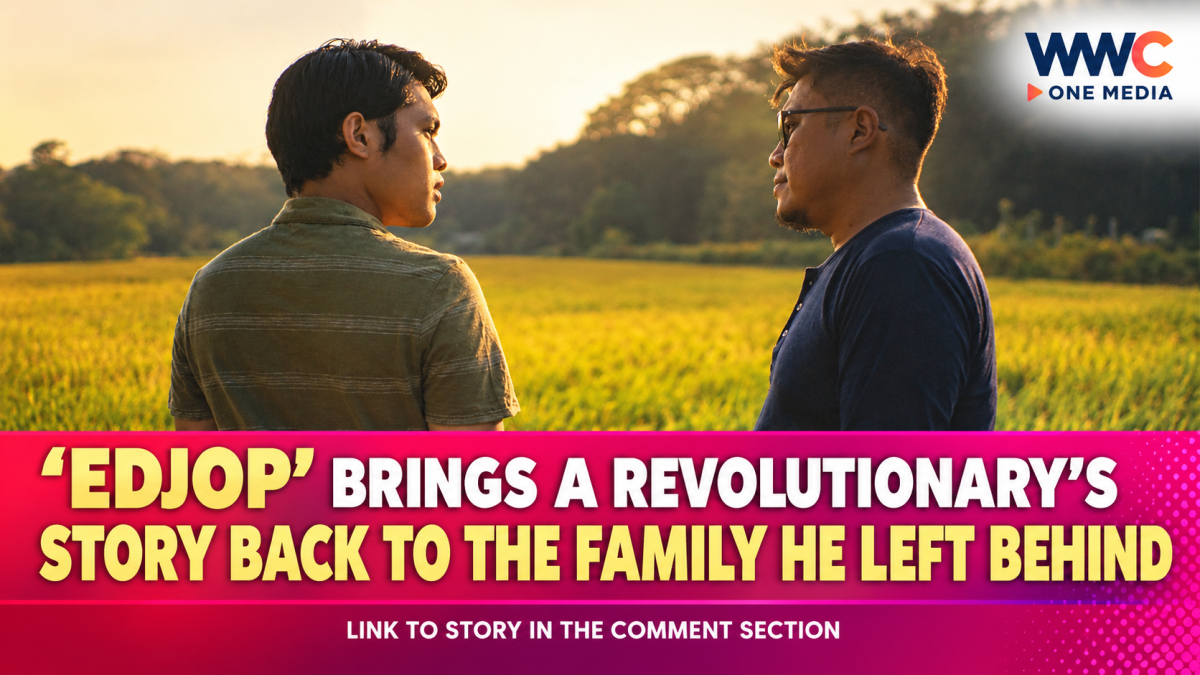
The new Filipino biopic Edjop does more than revisit the life of Edgar “Edjop” Jopson, the student leader who became an underground revolutionary during the Martial Law era. It asks a more personal question: what happens when a man remembered by history as a political figure is remembered by his own daughter as a father she barely knew?
Directed by Katski Flores, Edjop premiered in Philippine cinemas on Sept. 16, 2026. The film follows two timelines — Jopson’s transformation from an upper-middle-class Ateneo student leader into an underground activist, and the later life of his daughter, Scarlet Victoria “Joyette” Jopson, who grows up carrying the complicated legacy of a father killed when she was only three.
Elijah Canlas plays Edjop, while Jodi Sta. Maria portrays the adult Joyette. Kakie Pangilinan plays the younger Joy, Edjop’s wife, while Cedrick Juan and Menchu Lauchengco-Yulo are among the supporting cast.
Canlas had initially been offered the role of the younger Edjop but pushed to play the character throughout different stages of his life. His performance traces Edjop’s gradual political transformation rather than presenting him simply as a finished revolutionary figure.
That transformation is central to the film. Edjop begins as a student leader from a relatively privileged background before becoming increasingly involved in labor organizing and the underground revolutionary movement. The film also revisits his encounters with the political climate of the Marcos era, including his well-known confrontation with Ferdinand Marcos Sr. during the student movement.
But Edjop deliberately avoids making its protagonist the only story that matters.
The emotional centre belongs to Joyette.
As a child, she could not fully understand why her father was absent or why his name carried such weight. As an adult, she becomes an endurance athlete and eventually competes in the 2019 North Pole Marathon. Her physical journey through extreme conditions becomes a parallel to her attempt to understand the father whose life had already become part of Philippine history.
That structure gives the film a different perspective from a conventional political biopic. Instead of asking only who Edjop was, it asks what his choices meant for the people who remained after his death.
Sta. Maria’s portrayal of Joyette reportedly brings that conflict into sharper focus. Her character is not immediately comfortable with the mythology surrounding her father. She has to reconcile the public memory of Edjop with her private experience of growing up without him. Another review similarly noted that the film’s most distinctive question is not simply about Edjop’s political life, but about what it means to be the daughter of a man whose history is larger than your own memories of him.
The film’s production was itself a long journey. Edjop took around five years to complete after production began in 2021, with the filmmakers facing script changes, production disruptions and concerns surrounding the political sensitivity of the material. Co-writer Jade Castro was also unlawfully arrested during the film’s second phase of shooting, according to Tatler’s account.
That history is important because Edjop does not present itself as a documentary.
Flores and the filmmakers have acknowledged that some scenes are based directly on recorded history, while other moments were reconstructed or imagined to bridge gaps in the historical record. Flores described the movie as occupying a space between documentary and historical fiction.
That distinction matters, particularly for a film dealing with a politically charged period in Philippine history.
The movie’s strongest moments appear to come when it allows the characters and their experiences to carry the weight rather than relying entirely on explanation. One review praised the film’s cinematography and editing, while noting that some of its metaphors and political explanations can feel overly explicit.
Another review highlighted how the film strips away some of the distance surrounding Edjop, presenting him not only as a revolutionary remembered in history books but also as a husband, father and son whose decisions had consequences beyond politics.
Ultimately, Edjop is less interested in turning Edgar Jopson into a flawless historical symbol than in examining the complicated legacy left behind by a man whose life became inseparable from one of the most turbulent periods in Philippine history.
Its most revealing question may therefore not be whether Edjop should be remembered, but how he should be remembered — through the political legacy that made him famous, or through the family that had to live with the consequences of his choices.
That tension is what gives the film its emotional weight. History may remember Edjop as a revolutionary. For Joyette, however, he was also the father she lost before she was old enough to know him.