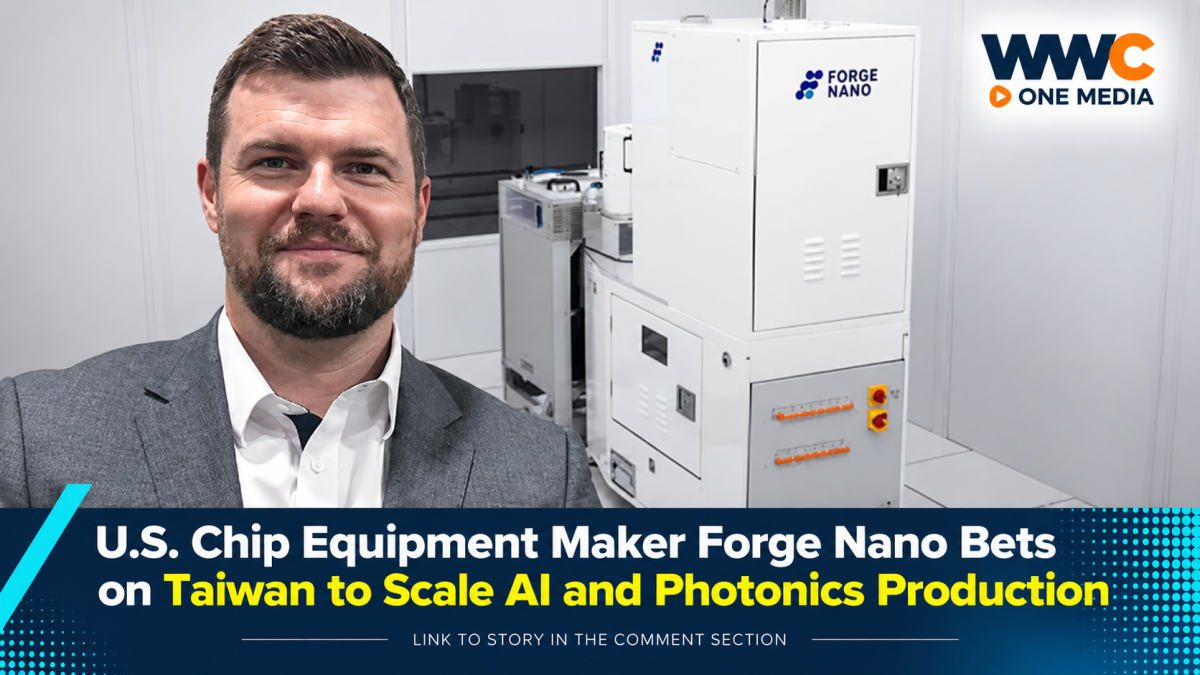
TAIPEI — U.S. semiconductor equipment maker Forge Nano is deepening its bet on Taiwan, moving beyond simply selling chip-manufacturing technology in the market as it builds local engineering, service and production capabilities aimed at the rapidly expanding AI and photonics industries.
The company is positioning Taiwan as a key manufacturing and customer-support hub as demand grows for technologies that can help produce next-generation chips, optical components and AI infrastructure.
Forge Nano CEO Paul Lichty told Nikkei Asia that Taiwan’s highly developed semiconductor ecosystem makes the island an important location for the company’s expansion, particularly as chipmakers and photonics manufacturers race to improve production yields, reliability and throughput.
The move comes as the global AI boom pushes demand for increasingly sophisticated semiconductor and optical technologies.
Forge Nano Is Building More Than a Sales Operation
Forge Nano announced in March that it had opened a Taiwan engineering and service office, describing the move as part of a broader strategy to support high-volume photonics manufacturing.
The company said its Taiwan operation includes local engineering and field-service personnel, a bonded warehouse for spare parts and a regional service network designed to reduce equipment downtime.
But the expansion goes further.
Forge Nano is also working with Manz Taiwan on a joint-development manufacturing arrangement, allowing local tool assembly, subsystem localization and greater regional production capacity.
That means Taiwan is being positioned not simply as a market for Forge Nano equipment, but as part of the company’s regional manufacturing and support infrastructure.
Why Taiwan Matters in the AI Chip Race
Taiwan sits at the center of the global semiconductor supply chain, with major companies spanning chip design, wafer fabrication, advanced packaging and electronics manufacturing.
That ecosystem is increasingly important to photonics—the technology used to transmit and process information with light.
As AI data centers require enormous amounts of data to move between processors and networking systems, silicon photonics and optical technologies are becoming increasingly important to high-speed communications and computing infrastructure.
Forge Nano’s technology is aimed at one of the manufacturing challenges behind those systems: creating extremely thin and uniform coatings on semiconductor structures.
Its atomic layer deposition (ALD) technology deposits material in extremely thin layers, allowing manufacturers to engineer surfaces and interfaces with high precision.
The Technology Behind Forge Nano’s Taiwan Push
Forge Nano’s TEPHRA platform is designed for semiconductor wafer processing and supports applications including photonics, advanced packaging, memory, logic and heterogeneous integration.
The company introduced its TEPHRA platform as a single-wafer ALD system designed to combine precise coating with higher throughput for specialty semiconductor applications.
In 2025, Forge Nano introduced TEPHRA One, a 200mm single-module ALD system designed for applications including RF devices, MEMS, sensors, LEDs and photonics.
The company said the system can deposit oxide, nitride and nanolaminate coatings and was designed to improve processing efficiency while maintaining precise film control.
Photonics Has Become a Major Growth Target
Forge Nano’s Taiwan expansion comes as the company builds a growing portfolio of photonics customers.
In June, Forge Nano announced that a commercial photonics technology company had selected its TEPHRA platform for manufacturing advanced integrated photonic devices.
Two months earlier, the company announced delivery of a TEPHRA system to a Fortune Global 500 communications company for commercial photonics applications.
Forge Nano said the equipment would support next-generation optical and photonics technologies used in high-speed communications and data infrastructure.
These developments illustrate why the company is expanding its Taiwan presence as AI infrastructure accelerates.
Forge Nano Claims Improvements in Photonics Performance
Forge Nano says its ALD technology has demonstrated up to a 23% reduction in insertion loss, along with 240-hour high-temperature/high-humidity reliability testing and conformal coatings in structures with aspect ratios reaching 35:1.
Those figures are company-reported performance results rather than independent industry benchmarks.
The company says the technology could help manufacturers address reliability and yield challenges in next-generation photonics, including co-packaged optics (CPO).
CPO places optical components closer to computing processors and is being explored as a way to address bandwidth and energy challenges associated with moving huge quantities of data inside AI systems.
From U.S. Manufacturing to a Taiwan-Linked Production Network
Forge Nano’s Taiwan strategy is also notable because the company has historically emphasized domestic U.S. manufacturing.
The company describes itself as a U.S.-based semiconductor equipment and advanced materials company and also produces lithium-ion batteries in the United States.
In April, Forge Nano announced a proposed business combination with Archimedes Tech SPAC Partners II that would take the company public on Nasdaq if the transaction closes.
The deal valued Forge Nano at approximately $1.2 billion on a pre-money, pre-merger basis, while including a potential $100 million private investment. The transaction was expected to close in the second half of 2026, subject to shareholder approval and other conditions.
The company said capital from the transaction would support expansion of U.S. manufacturing while also allowing it to pursue additional markets.
Taiwan Becomes a Strategic Link in the Expansion
Forge Nano’s strategy reflects a broader shift in semiconductor equipment: equipment makers increasingly need to work directly with manufacturers during qualification, process development and production ramp-up.
For customers, having engineers and spare parts nearby can reduce downtime and accelerate troubleshooting.
For Forge Nano, establishing local assembly and supply-chain capabilities could also make it easier to scale deliveries across Taiwan and other Asian markets.
The company said its Taiwan expansion is designed to improve supply stability, shorten delivery times and reduce operational risks.
AI Could Make Photonics Even More Important
The larger opportunity extends beyond conventional semiconductor manufacturing.
AI systems require increasingly powerful computing and networking infrastructure, creating demand for faster connections between chips, servers and data-center systems.
That is helping drive interest in photonics, advanced packaging and other technologies capable of moving data more efficiently.
Forge Nano is therefore targeting a part of the semiconductor ecosystem that sits underneath the AI boom: the manufacturing processes required to make advanced devices reliable and scalable.
Its challenge now is turning technology demonstrations and individual equipment orders into sustained high-volume production.
For Taiwan, meanwhile, the arrival of another U.S. semiconductor technology company underscores the island’s continuing role as a critical center for advanced chip and photonics manufacturing.
And as AI pushes the semiconductor industry toward ever more demanding production requirements, the competition may increasingly be decided not only by who designs the next breakthrough chip—but by who can manufacture the tiny structures that make those chips work.