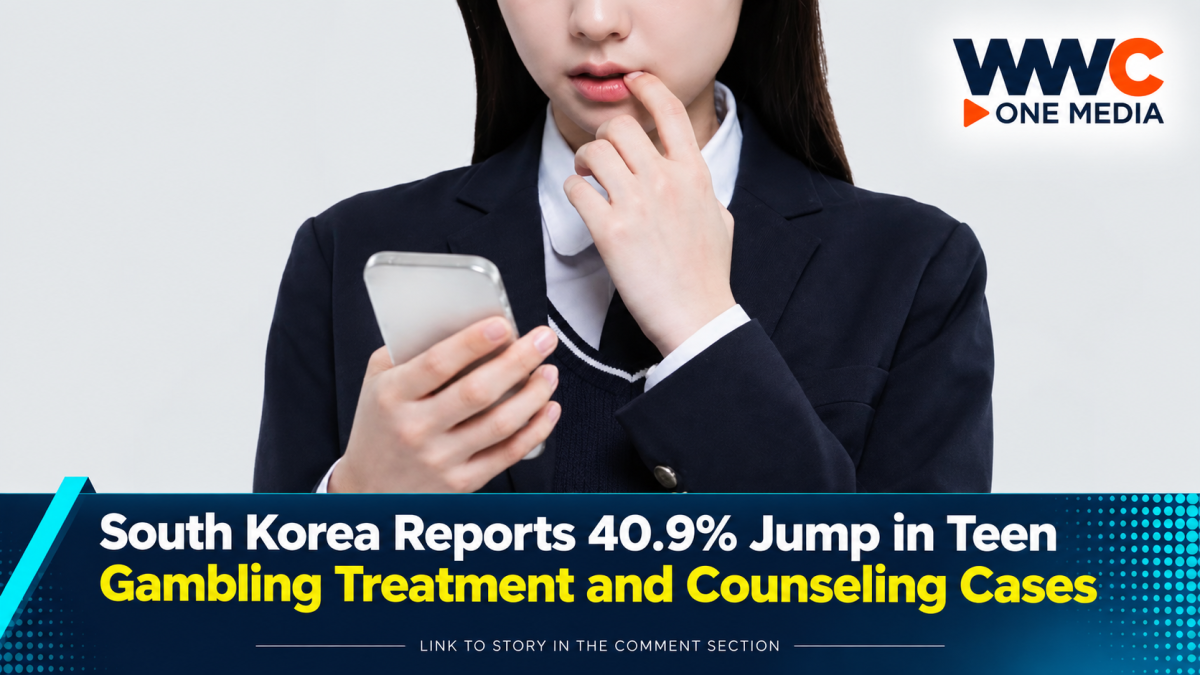
SEOUL — South Korea is facing growing concern over gambling-related problems among teenagers after new government data showed a 40.9% year-on-year increase in the number of young people receiving treatment or counseling in 2025.
A total of 5,838 people aged 19 and under received treatment or counseling for gambling problems last year, according to data from the National Gambling Control Commission submitted to lawmaker Lim Oh-kyeong.
The figure does not represent the total number of teenagers who gamble. Rather, it counts those who reached treatment or counseling services, meaning the broader scale of the problem cannot be determined from this number alone.
Illegal Online Gambling Accounts for More Than Half
Illegal online gambling was the largest category among the reported cases, accounting for 57.7% of the 2025 total.
The finding highlights the growing challenge posed by gambling-related activity taking place through digital environments, where young people can encounter problematic content through devices and online platforms.
Officials and lawmakers have increasingly focused on prevention, early identification and access to counseling as part of efforts to protect minors.
More Than 24,000 Teenagers Identified as High Risk
The latest figures reveal another concern beyond those already receiving professional help.
In 2025, 24,474 teenagers were classified as being in a high-risk group through prevention education, campaigns and self-assessment programs.
However, only 1,235 of those young people were referred to the Korea Problem Gambling Agency, the government-supported organization that provides prevention, counseling and rehabilitation services.
That means the number identified as high risk was substantially larger than the number ultimately connected with specialized services.
Prevention Programs Reached Millions — But Their Impact Is Being Questioned
South Korea conducted approximately 25,000 gambling-prevention education sessions involving 1.73 million participants in 2025.
However, lawmakers have raised questions about how effectively those programs measure whether young people’s attitudes and behavior actually change after the education.
According to reporting based on the submitted data, formal pre- and post-program effectiveness assessments only began being introduced on a trial basis in the second half of 2026.
The distinction matters: counting how many people attend a prevention program does not necessarily show whether the program reduces risky behavior.
Authorities Are Also Testing Early-Intervention Approaches
South Korean authorities have been experimenting with approaches that encourage young people to seek help before problems become more serious.
In 2025, the Gyeonggi Nambu Provincial Police Agency ran a voluntary-reporting pilot program for teenage cyber-gambling cases. During the two-month pilot, 72 teenagers came forward, with 48 referred to professional organizations for counseling and treatment programs.
Police said most participants had encountered gambling through recommendations from friends or online advertising.
The program illustrates a broader shift toward combining enforcement with counseling, prevention and rehabilitation rather than relying solely on punishment.
Earlier Data Also Showed a Sharp Rise
The latest numbers follow other evidence that youth gambling-related problems have been increasing.
Korea JoongAng Daily reported in 2025 that teenagers receiving treatment for gambling addiction under health-insurance data rose from 64 cases in 2022 to 210 in 2024. Police data cited in the same report showed teenage gambling-related offenses increasing from 76 cases in 2022 to 631 in 2024.
Those figures measure different things from the new 2025 counseling data, so they should not be directly combined. Together, however, they show that multiple government datasets have recorded increases involving young people and gambling-related problems.
The Bigger Challenge Is Reaching Young People Earlier
Lawmakers say the latest figures point to a need for stronger monitoring of what happens after a teenager is identified as being at risk.
The gap between the 24,474 high-risk teenagers identified in 2025 and the 1,235 referred for specialized counseling has become a particular focus.
Rep. Lim has called for the government to review the entire prevention system, from identifying young people at risk through counseling and recovery to preventing repeat problems and restricting access to illegal gambling websites.
For families, schools and authorities, the latest data underscore an important point: prevention is not simply about reaching large numbers of students. It also requires identifying those who need additional support and ensuring they can actually access appropriate services.