
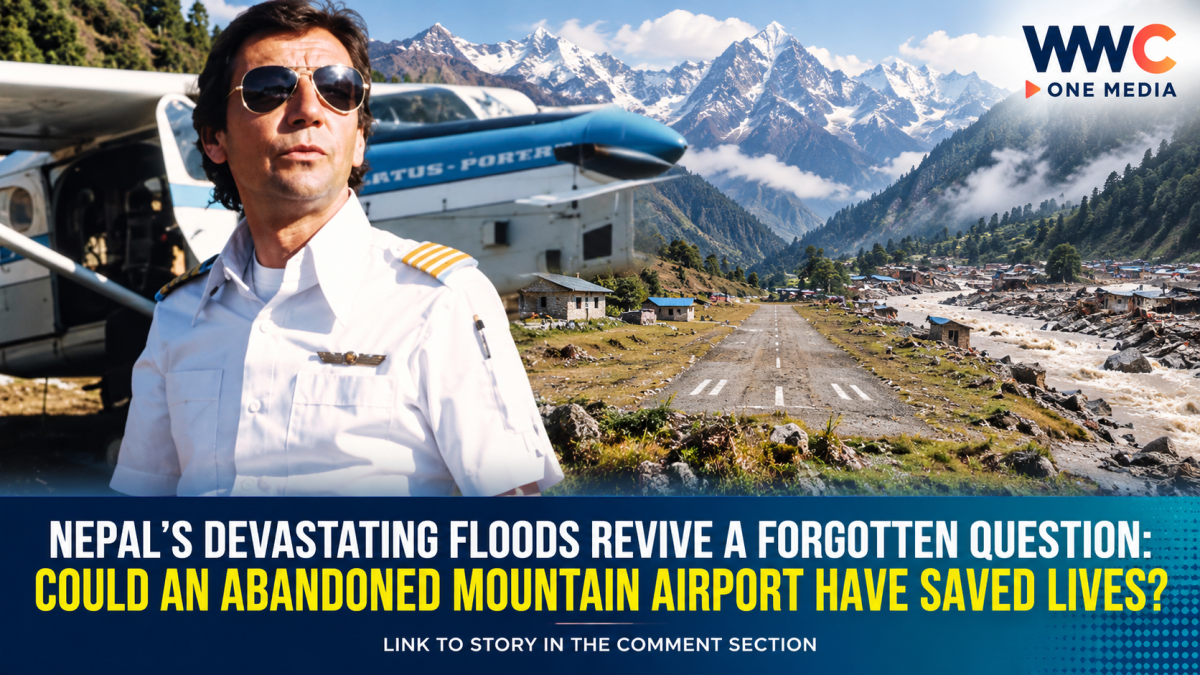
KATHMANDU, Nepal — A forgotten mountain airstrip in the Himalayas has suddenly become part of a much bigger debate after devastating floods and landslides battered northern Nepal, exposing the enormous challenges of reaching isolated communities during a disaster.
The focus is Langtang Airport, a small airstrip in Rasuwa that has been out of operation for years but remains on Nepal’s official aviation records.
The latest floods have prompted aviation officials and veteran pilots to ask a difficult question: Could the airport have provided a crucial additional lifeline if it had remained operational?
The question comes as Nepal continues to deal with the consequences of the catastrophic Aug. 26 disaster, which sent enormous amounts of ice, rock, mud and debris through river valleys after what experts believe was a glacier collapse.
The disaster devastated parts of Rasuwa and Nuwakot, destroying roads, bridges, homes and critical infrastructure. Helicopters became indispensable for reaching some communities after ground routes were cut off.
A runway that could have offered another lifeline
Langtang Airport sits at an elevation of about 3,658 meters (nearly 12,000 feet) above sea level.
Its unpaved runway measures approximately 420 meters long and 30 meters wide.
According to the Civil Aviation Authority of Nepal, Langtang remains classified as a domestic airport “not in operation.” Current records also show that the airstrip has no fuel facility, rescue service or firefighting service.
That means the runway cannot simply be treated as a ready-made emergency airport today.
But aviation officials and former pilots argue that its potential value during disasters should not be dismissed.
During the recent floods, helicopters had to shoulder much of the burden of transporting survivors, relief supplies and rescue personnel. At the Nepal Army’s training centre in Trishuli, an open area was used to help coordinate helicopter operations because the disaster had disrupted normal access and aviation infrastructure.
The Kathmandu Post reported that nearly 1,000 helicopter take-offs and landings took place in Trishuli and surrounding areas during roughly a week of emergency operations.
An operational Langtang facility, equipped with appropriate communications and air-traffic-management capabilities, could potentially have absorbed some transport duties and freed helicopters for search-and-rescue missions.
But that remains a counterfactual—not proof that reopening the airport would have prevented deaths.
Langtang once served remote communities
Langtang Airport was not always a forgotten strip of pavement.
Decades ago, rugged Pilatus Porter aircraft used the airstrip to carry tourists, charter passengers, supplies and equipment into a remote part of Rasuwa that lacked road access.
Former aviation officials recalled flights connected to development projects and humanitarian operations, including aircraft operated by the United Nations Development Programme and the then-Royal Nepal Airlines.
The runway’s short length was not necessarily an obstacle for aircraft specifically designed to operate from difficult mountain airstrips.
There were even discussions in the late 1980s about whether the facility could be improved sufficiently for Twin Otter operations.
Veteran pilots recalled studies examining possible runway improvements, although the proposed expansion of operations never materialized. Changes in Nepal’s aviation sector, aircraft availability and the decline of Pilatus Porter operations also contributed to the airport’s eventual inactivity.
The airport’s value may go beyond commercial flights
Former aviation officials argue that an airport in a disaster-prone mountain region should not necessarily be judged only by its ability to generate commercial revenue.
Its value could also be measured by what it provides when roads disappear, bridges collapse and communities become isolated.
That argument has gained new relevance following the latest disaster.
Reuters reported that the Aug. 26 floods caused widespread destruction across northern Nepal, with roads and bridges washed away and rescue operations severely complicated by the mountainous terrain. Helicopters were among the few ways to reach some isolated areas.
The disaster also damaged major hydropower infrastructure. Reuters later reported that the flooding generated an estimated 2.2 million tons of debris, while numerous bridges and power projects were damaged. Nepal’s reconstruction needs could run into billions of dollars.
A disaster that exposed Nepal’s infrastructure vulnerabilities
The Langtang debate is therefore about more than one abandoned runway.
It raises a broader question about how Nepal prepares for disasters in some of the world’s most difficult terrain.
The country’s mountainous geography means roads can be cut off by landslides, rivers can destroy bridges and conventional ground-based rescue operations can become nearly impossible.
The latest catastrophe demonstrated exactly how quickly that can happen.
Rescue teams have been forced to search through enormous quantities of mud and debris, while workers trapped in hydropower tunnels have presented another extraordinary challenge.
AP reported that around 900 hydropower workers were believed to be missing, with hundreds thought to be trapped underground. Rescue teams have struggled with collapsed access routes, flooded tunnels and a shortage of heavy equipment and specialized capabilities.
Yet there have also been remarkable breakthroughs.
Reuters reported on Sept. 5 that a Chinese worker, Lu Haitao, was rescued alive after being trapped approximately 225 meters inside a hydropower tunnel for 10 days. Two Nepali workers had also been rescued from another tunnel shortly before him.
Those rescues underscore both the possibilities and the immense logistical difficulties facing emergency teams.
Reopening Langtang would not be simple
Despite renewed attention, turning Langtang back into a functioning emergency airfield would require considerably more than clearing the runway.
The airport currently lacks essential infrastructure, including fuel, rescue and firefighting services. Mountain aviation also presents unique safety challenges because of altitude, weather, terrain and limited runway length.
Any proposal to restore the airport would therefore need technical studies, safety assessments, communications systems, emergency facilities and an examination of whether aircraft could reliably operate there under modern aviation standards.
Still, the floods have revived an uncomfortable question for Nepal’s disaster planners:
Should strategically located but commercially inactive airports be preserved or upgraded as part of the country’s emergency-response network?
The answer may become increasingly important as Nepal confronts a combination of steep terrain, extreme weather, glacier-related hazards and rapidly developing infrastructure.
For now, Langtang’s runway remains silent.
But after the latest catastrophe, that silence is attracting attention once again.
What makes this story significant
The key point is not that Langtang Airport could have single-handedly prevented the disaster or saved a specific number of lives. There is no evidence establishing that.
Rather, the floods have exposed how dependent Nepal’s remote mountain communities can become on helicopters when roads and bridges fail—and have renewed debate over whether dormant aviation infrastructure could serve a strategic role in future emergencies.
With Nepal facing recurring earthquakes, landslides, floods and glacier-related hazards, the question may no longer be whether an abandoned runway can make money.
It may be whether the runway can help save lives when everything else is washed away.
WWC ONE MEDIA J.M.S




Leave a Reply