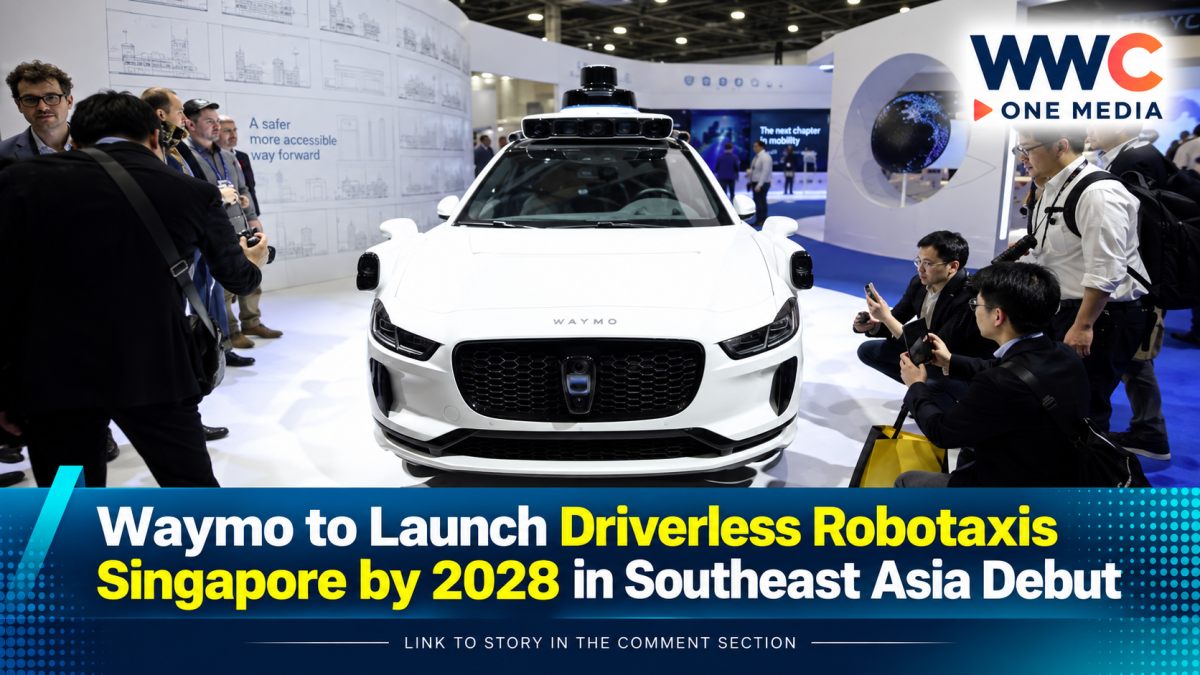
SINGAPORE — Driverless taxis are heading to Singapore. Waymo, Alphabet’s autonomous-driving unit, plans to begin offering fully autonomous ride-hailing services in the city-state in 2028, marking the company’s first entry into Southeast Asia.
The planned rollout will bring Waymo’s all-electric robotaxi technology to one of Asia’s most tightly regulated transport markets, although the commercial launch remains subject to Singapore’s regulatory requirements and safety approvals.
Waymo Cars to Arrive Before the Public Launch
Waymo said its initial fleet of fully electric Jaguar I-PACE vehicles will begin arriving in Singapore in the coming months.
Before passengers can use the service, trained autonomous-driving specialists will manually operate the vehicles as Waymo collects data and adapts its technology to Singapore’s distinctive road environment.
Testing is expected to begin in preparation for autonomous operations in 2027, with the company working to account for local road layouts, traffic conditions and monsoon weather.
The planned commercial service in 2028 will allow passengers to book Waymo rides through the company’s app.
Singapore Becomes Waymo’s First Southeast Asian Market
The announcement represents a major expansion for Waymo.
The company already operates commercial fully autonomous ride-hailing services in several U.S. cities and has announced international expansion plans covering markets including Tokyo, London and Munich.
Singapore will become Waymo’s first Southeast Asian market, while Tokyo is scheduled to receive the company’s planned commercial service in 2027.
Waymo co-CEO Tekedra Mawakana said Singapore’s focus on transportation reliability, sustainability and technology made it a natural market for the company’s expansion.
But Waymo Still Needs Regulatory Approval
The 2028 target does not mean driverless Waymo taxis have already been cleared for unrestricted operation.
Singapore has been developing a dedicated regulatory framework for autonomous vehicles.
In May, the Ministry of Transport launched a public consultation on legislation covering areas including operator responsibility, liability, insurance, cybersecurity, data management and enforcement.
The proposed framework is intended to establish clearer rules for autonomous vehicles as they move from testing toward wider commercial deployment.
Singapore also requires autonomous vehicles to undergo safety assessments before they can be deployed on public roads.
That means Waymo’s planned 2028 launch will depend on the company satisfying Singapore’s technical and regulatory requirements.
Waymo Enters a Growing Robotaxi Race
Waymo will not be entering an empty market.
Singapore has already become a testing ground for autonomous transportation.
Grab and WeRide operate autonomous shuttle services in Punggol, while ComfortDelGro and Pony.ai are also involved in autonomous-vehicle services there.
The Land Transport Authority said more than 11,500 unique riders had used the autonomous shuttle services by July 12, 2026, with 99% of approximately 900 survey respondents saying they felt safe during their ride and would recommend the service.
Grab has since announced plans to expand its autonomous fleet in Singapore from 10 to 50 vehicles over six months and broaden its operations beyond Punggol, subject to regulatory approval.
Waymo’s arrival therefore adds another major player to Singapore’s increasingly competitive autonomous-mobility sector.
Singapore Is Already Preparing for the Driverless Future
Singapore’s government has been testing autonomous vehicles for years, including in controlled environments such as airports and ports.
The Transport Ministry has also said Singapore is preparing for broader deployment while recognizing that large-scale autonomous passenger transport will require additional technological and regulatory development.
The country’s approach is focused on gradually moving from trials toward commercial operations while establishing rules for safety, accountability and passenger protection.
That makes Singapore an important test case for how autonomous ride-hailing could operate in a dense Asian city.
What Waymo’s Arrival Could Mean for Singapore
If approved, Waymo’s 2028 service could give Singapore residents and visitors another option for point-to-point transportation without a human driver behind the wheel.
But the technology’s rollout will also raise practical questions about road safety, insurance, employment, cybersecurity, data protection and how autonomous taxis interact with Singapore’s existing public-transport system and ride-hailing industry.
Those issues are already part of Singapore’s wider regulatory discussions surrounding autonomous vehicles.
For now, Waymo’s Singapore plan remains a future commercial target rather than an immediate launch.
The first step is already approaching: bringing the vehicles into Singapore, mapping local roads and adapting the autonomous-driving system before the company seeks to put fully driverless rides into public service.