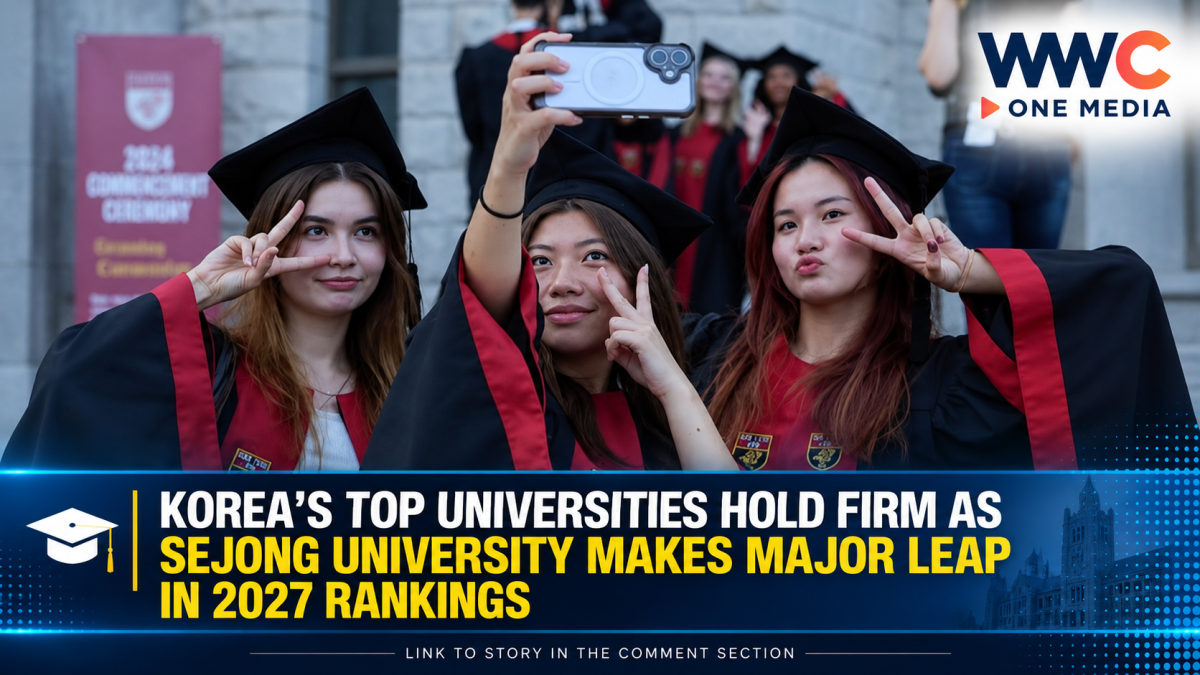
SEOUL — South Korea’s leading universities largely maintained their positions in the latest Korea Times University Rankings, while Sejong University emerged as one of the biggest movers as competition for international students and global academic talent intensifies.
Korea University retained the No. 1 position in The Korea Times University Rankings 2027 for the second consecutive year, scoring 149.52 out of 200 points.
Seoul National University followed with 142.22 points, while Yonsei University placed third with 140.74. Sungkyunkwan University, Hanyang University and Sogang University completed the top six, with all six retaining their positions from the previous edition.
But underneath that stability, the latest rankings reveal a changing landscape — particularly among universities trying to strengthen their international appeal.
Sejong University Makes the Biggest Top-10 Jump
The standout mover was Sejong University, which climbed from 13th to seventh place, breaking into the top 10.
Its education score rose substantially, from 32.8 points to 47.93, while its research performance remained strong at 39.6 points.
The University of Seoul, meanwhile, dropped from seventh to 11th. Its education score declined from 47.02 points to 41.41, contributing to its overall movement down the table.
Ewha Womans University, Kyung Hee University and Dongguk University rounded out the top 10, with each retaining its previous position.
The movement shows that while Korea’s most established universities remain highly competitive, other institutions are making gains by strengthening specific parts of their internationalization strategies.
What the Rankings Actually Measure
The Korea Times ranking is different from conventional university league tables.
Rather than focusing primarily on academic reputation or research output, the 2027 assessment places 65% of its total score on indicators directly related to globalization.
The evaluation expanded this year from 54 to 60 universities and from 18 to 19 indicators, with the total score increasing from 190 to 200 points.
The four major evaluation areas are:
- Education
- Research
- Student support
- Graduate outcomes
The methodology also added a new 10-point indicator measuring the proportion of full-time international faculty.
Research performance was expanded from a one-year measurement to a three-year period, while international-student retention was narrowed to degree-seeking students.
The changes are intended to move the conversation beyond simply counting how many international students a university attracts.
International Students Are Becoming a Bigger Test
The rankings come as South Korea attempts to expand its international student population while improving the quality of the experience for students who choose to study there.
The Korea Times’ analysis found that Korean universities generally performed strongest in education, while student support and graduate outcomes remained weaker areas.
That creates a challenge for universities: attracting international students is only one part of becoming globally competitive.
Universities must also provide academic support, help students adapt to campus life, build international faculty networks and improve pathways into employment or further study.
Seoul Still Dominates Globalization Capacity
Another striking feature of the rankings is the geographic concentration of internationally oriented universities.
Of the 30 universities recognized for excellence in globalization, 23 are located in Seoul, Gyeonggi Province or Incheon, while only seven are outside the capital region.
That regional imbalance is significant as South Korea increasingly seeks to attract international students to universities outside the Seoul metropolitan area.
The government has been promoting regional development and international education as part of a broader strategy to address demographic pressures and strengthen local economies.
New Universities Are Breaking Into the Top 30
Although the top positions remained relatively stable, there was some movement further down the table.
Yeungnam University and Kookmin University entered the top 30 after previously ranking outside that group.
Overall, however, 28 of last year’s top 30 universities remained in the top 30, highlighting the relative stability of the country’s leading institutions.
The result suggests that Korea’s university competition is evolving gradually rather than experiencing a wholesale reshuffling.
Korea’s Global Rankings Tell a Different Story
The Korea Times rankings should not be confused with international league tables such as the QS World University Rankings.
In the 2027 QS rankings released in June, Seoul National University remained Korea’s highest-ranked university globally at 38th, while Yonsei University climbed to 42nd and Korea University reached 52nd.
Those results illustrate why university rankings can produce different outcomes depending on what they measure.
QS considers factors including academic reputation, citations, employer reputation, employment outcomes, international research networks, international students, faculty ratios and sustainability.
The Korea Times ranking, meanwhile, puts much greater emphasis on the quality and depth of internationalization.
So a university’s position in one ranking should not automatically be interpreted as its overall position in every aspect of higher education.
The Next Battle: What Happens After Enrollment?
The latest Korea Times ranking points toward a broader question for South Korean universities.
As international enrollment expands, universities will increasingly be judged not only by how many foreign students they attract, but by what happens to those students afterward.
Can they complete their degrees successfully?
Can they find appropriate career opportunities?
Can international faculty build long-term careers?
Can universities create research networks that extend beyond Korea?
The Korea Times plans to add indicators covering settlement infrastructure and international research diversity in its next edition. International student satisfaction surveys and graduate-outcome tracking are planned for 2028.
That means the competition among Korean universities could become even more focused on what happens after students arrive on campus.
For now, the established leaders remain firmly positioned near the top of the Korea Times’ internationalization-focused rankings — but Sejong’s rise shows that the race is becoming more competitive, and the definition of a globally successful Korean university is changing.
WWC ONE MEDIA G,A