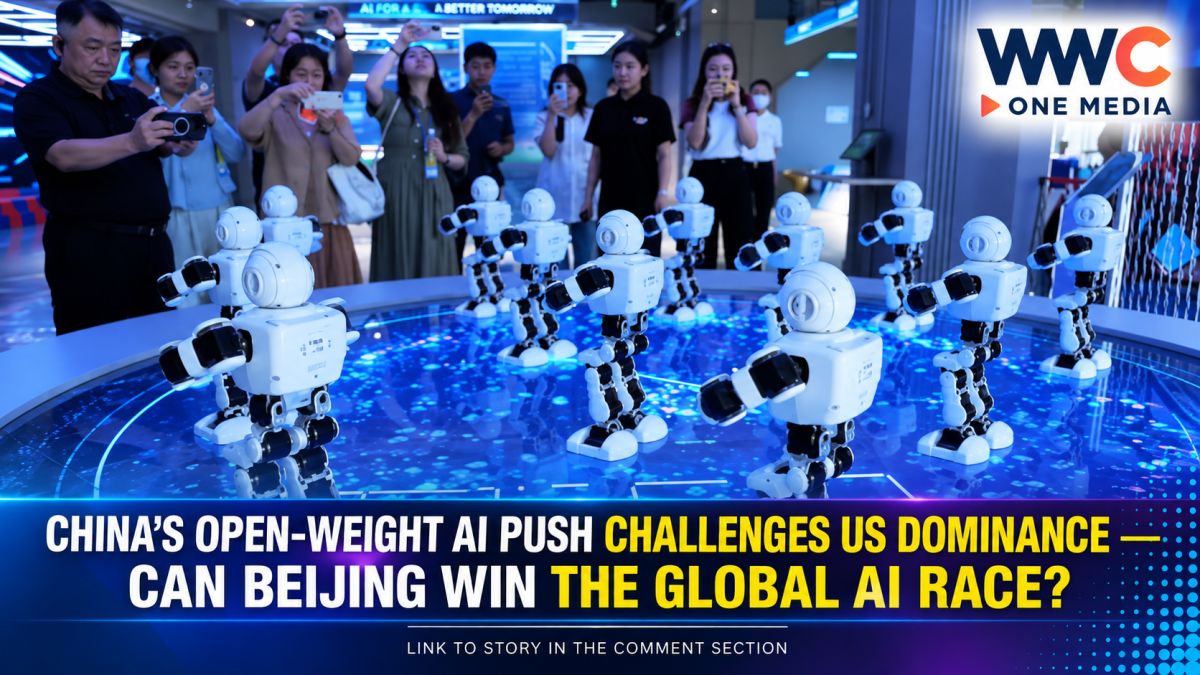
BEIJING — The battle between the United States and China over artificial intelligence is entering a new phase, with Chinese technology companies increasingly using open-weight AI models to challenge the dominance of US-developed systems.
The competition is no longer simply about which country can build the most powerful AI model.
It is increasingly about who can put AI into the hands of the most people, at the lowest cost, while giving governments and businesses greater control over the technology.
China’s strategy is gaining attention because companies such as DeepSeek, Alibaba and Moonshot AI are releasing models whose trained parameters can be downloaded and modified, allowing developers to run them on their own infrastructure rather than relying entirely on a company’s cloud service.
China Bets on Open-Weight AI
The distinction between open-weight and closed AI is becoming increasingly important in the global technology race.
With an open-weight model, developers can obtain the model’s trained parameters and adapt or deploy the system themselves. A genuinely open-source system generally goes further by making additional elements such as source code and, depending on the licence, training information available.
Many leading US AI systems remain closed, while Chinese companies have increasingly embraced open-weight releases.
The approach gives organizations greater flexibility over how models are deployed and can help countries seeking greater digital sovereignty avoid depending entirely on foreign AI providers.
Kimi K3 Becomes a New Symbol of China’s AI Push
One of the latest examples is Moonshot AI’s Kimi K3, unveiled at the World Artificial Intelligence Conference in Shanghai in July.
The Straits Times reported that the model drew significant international attention and was positioned as a competitor to leading US systems on several benchmarks.
Moonshot says Kimi K3 has 2.8 trillion parameters, making it one of the largest open-weight models released to date. The company has also attracted billions of dollars in investment and has been preparing for a potential Hong Kong listing.
Kimi K3 is part of a broader wave that began receiving global attention after DeepSeek’s R1 gained prominence in early 2025.
The success of DeepSeek demonstrated that Chinese developers could produce highly capable AI systems while operating under restrictions on access to some advanced US semiconductor technology.
The Cost Advantage Could Be Crucial
For companies and developing economies, the question is not necessarily which AI model achieves the highest score on every benchmark.
Cost matters.
The Straits Times reported that Chinese open-weight models were substantially cheaper to operate than comparable closed systems from major US developers, potentially making them attractive to companies and countries with limited AI budgets.
A recent Mozilla report cited in technology-industry coverage found that leading Chinese open-weight models were approaching US frontier systems in capability while maintaining major cost advantages in some testing scenarios. However, the models still lagged on certain benchmarks and open-weight systems can require substantial computing resources to operate.
That creates an important opening for China.
Instead of trying to win only by producing the world’s single most powerful model, Chinese companies can compete by making capable AI inexpensive, customizable and widely deployable.
Global Adoption Is Already Shifting
There are signs that developers are increasingly experimenting with Chinese models.
According to the Straits Times, Chinese models accounted for 58% of tokens used by US firms on OpenRouter in July 2026, up sharply from 1.2% in December 2024. The publication attributed part of the increase to the lower cost of Chinese open-weight models.
The figures do not mean Chinese AI has replaced US systems.
Closed models still dominate AI revenue, while US companies retain important advantages in frontier research, computing infrastructure and commercial ecosystems.
But the changing usage figures illustrate why open-weight AI has become a strategic issue rather than simply a technical preference.
The US Still Holds Major Advantages
China’s progress does not mean the AI race has been decided.
The United States continues to have major strengths in frontier-model development, AI research, semiconductor technology, cloud infrastructure and private-sector investment.
AP reported this week that Chinese companies have rapidly narrowed the gap with leading US systems, but also noted that the United States continues to lead in several important areas.
Washington has also attempted to restrict China’s access to advanced chips and semiconductor-manufacturing technology, arguing that these technologies have economic and national-security implications.
At the same time, US officials have accused several Chinese AI companies of using techniques such as model distillation to extract capabilities from US AI systems. Chinese authorities have rejected such accusations as unfounded.
Those disputes add another layer to an already intense technology rivalry.
AI Is Becoming a Geopolitical Contest
The competition is extending beyond laboratories and technology companies.
The Straits Times reported that China has launched the World Artificial Intelligence Cooperation Organisation, seeking to promote international AI cooperation and position Beijing as a voice for countries in the Global South.
The United States, meanwhile, is pushing its own AI ecosystem and partnerships with allies.
That means countries in Southeast Asia, the Middle East, Africa and Latin America could increasingly face decisions over which AI models, cloud platforms and digital infrastructure they want to adopt.
For developing economies, Chinese open-weight systems could offer an attractive combination of lower costs and greater local control.
But governments and businesses must also consider cybersecurity, data protection, technical support, model reliability and long-term dependence on foreign technology.
A New Definition of AI Power
The emerging AI contest could therefore be measured in several ways.
There is the traditional race for the most powerful model.
Then there is the race for the largest developer community, the lowest operating costs, the widest international adoption and the greatest control over AI infrastructure.
China’s open-weight strategy directly targets those latter categories.
The United States remains a major force in frontier AI, while Chinese developers are rapidly improving and gaining international attention.
The result is an AI competition that is becoming less about one decisive technological breakthrough and more about which ecosystem the world chooses to build around.
And as governments and businesses across Asia begin adopting AI at scale, the next battleground may not be who created the smartest model — but whose model becomes the one the world actually uses.
WWC ONE MEDIA G,A