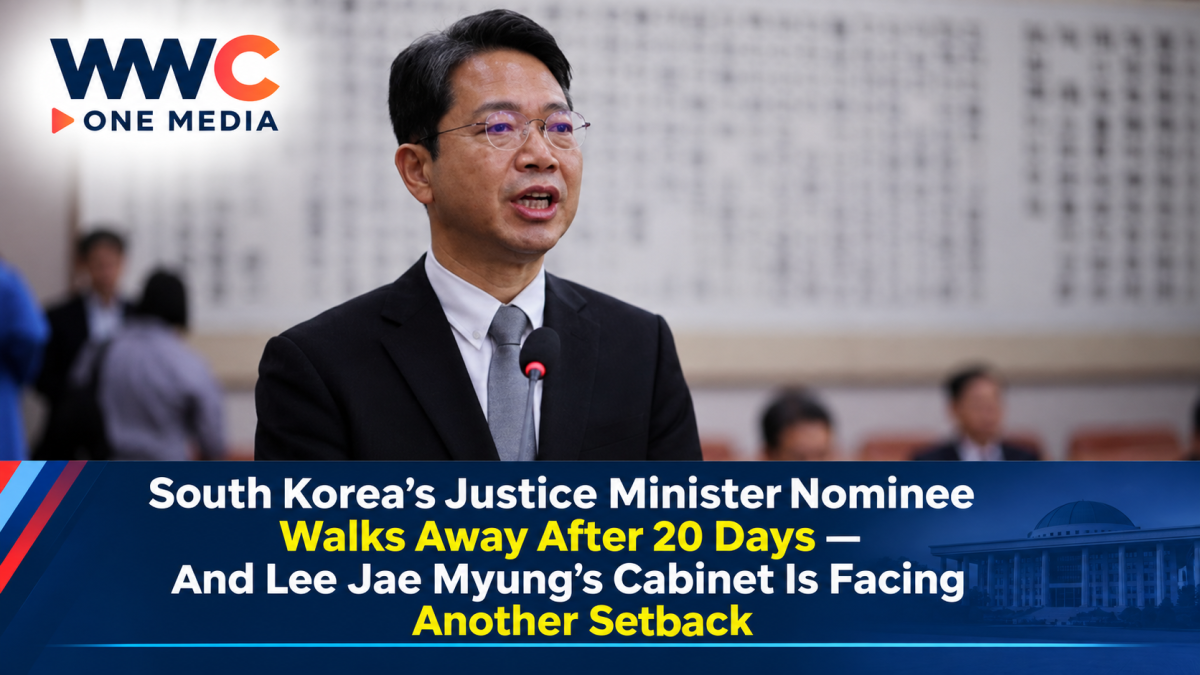
SEOUL — South Korean President Lee Jae Myung’s government has suffered another high-profile personnel setback after Justice Minister nominee Kim Seung-won abruptly withdrew his candidacy, ending a 20-day nomination that had become increasingly controversial.
Kim, a two-term lawmaker from the ruling Democratic Party of Korea and a former judge, announced his withdrawal on Sept. 19 at the National Assembly, saying he had concluded that he had fallen short of public expectations and did not want to become an additional burden on the administration.
His decision came just one day after President Lee said he would make a final decision on the nomination while taking public sentiment into account.
The withdrawal is the second major Cabinet-nominee setback for Lee this month, following the earlier departure of Yong Hye-in, who had been nominated to become gender-equality minister.
The developments have intensified scrutiny of Lee’s personnel-selection and vetting system at a politically sensitive moment for his government.
Kim’s Nomination Unravels Amid Drug-Trial Lobbying Allegations
Kim’s nomination came under pressure during his confirmation process over allegations surrounding a 2021 COVID-19 treatment clinical trial.
Opposition lawmakers accused Kim, then a legislator, of using his political influence to pressure officials at South Korea’s Ministry of Food and Drug Safety to accelerate regulatory approval of a clinical trial involving biotech company Genencell.
Yonhap reported that the allegations included claims that Kim had improperly lobbied the regulator at the request of a broker. Kim denied wrongdoing and maintained that his actions were consistent with his role as a lawmaker.
Korean media reports also said other allegations and questions about Kim’s conduct added to the pressure surrounding the nomination.
Kim nevertheless received support from the ruling Democratic Party, and the National Assembly’s Legislation and Judiciary Committee adopted his confirmation hearing report on Sept. 17.
Two days later, Kim withdrew.
That sequence has prompted questions about why the ruling party continued supporting the nomination despite the controversy and why the administration’s vetting process did not prevent the dispute from escalating.
Kim Says He Fell Short Of Public Expectations
Announcing his withdrawal, Kim said he had made the decision after “deep deliberations.”
He acknowledged that he had not met the standards expected by the public and said he would reflect on his shortcomings.
Kim also said he had wanted to help establish what he described as a new criminal-justice system but would stop short of taking the justice minister post.
The presidential office said it respected his decision and understood that his withdrawal was intended to reduce the burden on the administration.
The government will now have to begin the search for another justice minister.
Lee Acknowledges Problems With His Vetting System
The controversy has also put President Lee’s own personnel-screening system under the microscope.
At a Sept. 18 press conference, one day before Kim withdrew, Lee acknowledged shortcomings in the administration’s screening of nominees and said the government was working to reassess its personnel system.
The comments came as criticism over Cabinet appointments contributed to a decline in his public approval.
A Gallup Korea poll released Sept. 18 put Lee’s approval rating at 37 percent, the lowest level recorded since he took office in June 2025, according to Reuters.
That figure should be understood as a polling measurement at a specific point in time, rather than a definitive assessment of public opinion beyond the survey period.
Reuters has reported that criticism over personnel appointments was among the issues contributing to the decline, alongside dissatisfaction over other government policies.
This Is More Than Just Another Cabinet Vacancy
Kim’s departure comes at a particularly important time for South Korea’s justice system.
The Lee administration is pursuing a major restructuring of the country’s prosecution system, with a planned overhaul scheduled to take effect in October.
Under the reform, the existing prosecution service is set to be abolished and its investigative and indictment functions separated between different institutions.
Although major legislative work has already been undertaken, the government still faces substantial administrative tasks, including reorganizing agencies, establishing detailed rules and determining how responsibilities will be divided.
The Korea Times reported that Kim’s withdrawal could therefore create uncertainty around the leadership needed to implement the next phase of the reforms.
A Second Nominee Has Now Stepped Aside
Kim is not the only Cabinet nominee to withdraw during Lee’s latest reshuffle.
Earlier this month, Yong Hye-in, the nominee for gender-equality minister, also stepped aside amid controversy.
Reuters described Kim’s departure as the second Cabinet nominee to withdraw during September. Korean media have also reported that Kim is the fifth ministerial nominee to fail to take office since Lee became president in June 2025.
The succession of nomination controversies has shifted attention toward how candidates are screened before their names are formally announced.
For Lee’s administration, that means the issue is no longer confined to the individual allegations surrounding one nominee. It also concerns whether the government can strengthen its vetting process before future appointments reach the National Assembly.
Political Reactions Split Along Party Lines
The ruling Democratic Party said it respected Kim’s decision and viewed his withdrawal as a way of reducing the burden on government operations.
The opposition People Power Party, however, argued that withdrawing from the nomination does not resolve the allegations surrounding Kim and called for further investigation.
That disagreement is likely to keep the controversy alive even after Kim’s nomination has ended.
The issue is particularly sensitive because the Justice Ministry is at the center of the government’s planned prosecution reforms.
What Happens Next?
The immediate task for the Lee administration is straightforward: find a new justice minister.
But the political challenge is more complicated.
The next nominee will face close scrutiny over personal finances, professional conduct, past public statements and potential conflicts of interest — particularly after the controversy surrounding Kim’s nomination.
The administration will also need to demonstrate that its revised vetting procedures can identify potentially damaging issues before candidates are formally nominated.
For the justice ministry, timing is particularly important because the government is approaching the implementation phase of its prosecution-system overhaul.
The withdrawal therefore leaves Lee’s administration facing two simultaneous tasks: replacing a nominee who failed to reach the Cabinet and convincing the public that its personnel-screening process can avoid another high-profile breakdown.
For now, Kim Seung-won’s 20-day journey from nominee to withdrawal has become another test of President Lee Jae Myung’s Cabinet reshuffle — and of how quickly his administration can repair the weaknesses it has acknowledged in its own appointment system.