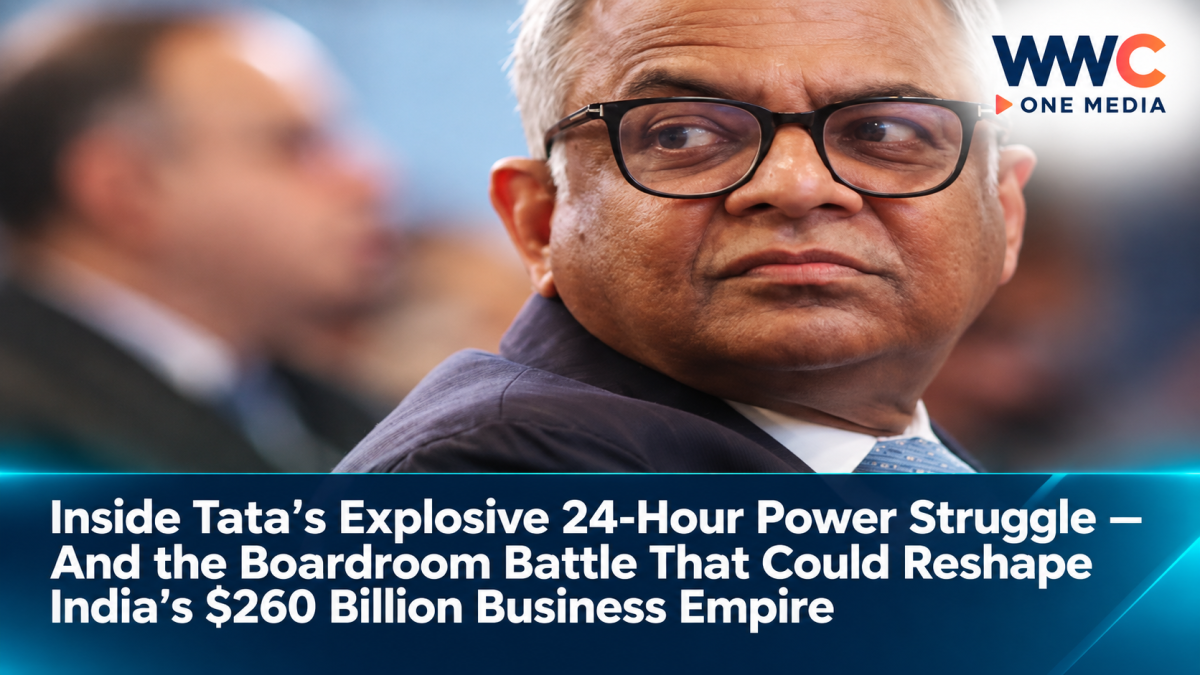
One of India’s most powerful corporate dynasties has been thrown into an extraordinary governance battle after a dramatic Tata Sons board meeting exposed a widening split between the company’s directors and the charitable trusts that control the holding company.
At the center of the confrontation is a decision that appeared settled only weeks ago: N. Chandrasekaran’s future as chairman of Tata Sons.
On Sept. 17, the Tata Sons board backed Chandrasekaran for another five-year term, reversing the chairman’s Aug. 12 decision not to seek reappointment.
The board also agreed to begin steps toward complying with regulatory requirements that could eventually lead to the listing of Tata Sons.
Both moves were immediately challenged by Tata Trusts Chairman Noel Tata, who argued that the board had acted contrary to the company’s governing rules and that the Trusts had not agreed to a Tata Sons listing.
What followed was not merely a disagreement over one executive.
It exposed a much larger question:
Who ultimately has the power to determine the future direction of the Tata empire?
The Boardroom Vote That Changed Everything
The confrontation unfolded during a nearly three-hour Tata Sons board meeting at Bombay House in Mumbai.
According to reporting based on people familiar with the meeting, Noel Tata arrived prepared to argue that Tata Sons should remain privately held and that the company should pursue every available legal and regulatory avenue before accepting a public listing.
The discussion reportedly intensified after the Reserve Bank of India rejected Tata Sons’ request for an exemption from listing requirements earlier in September.
Noel Tata argued that listing was not necessarily inevitable and proposed seeking further discussions with regulators and exploring legal options.
But the board ultimately moved in a different direction.
Chandrasekaran was asked to reconsider his earlier decision to leave.
He agreed.
He then recused himself while the board considered his reappointment.
Four directors voted in favor.
Noel Tata voted against.
The board consequently approved another five-year term for Chandrasekaran.
That decision immediately opened another front in the dispute.
Noel Tata Says the Decision Was Invalid
Tata Trusts rejected the board’s decision, describing Chandrasekaran’s reappointment as illegal and disputing the board’s interpretation of Tata Sons’ governing documents.
The Trusts’ position centers partly on provisions concerning Tata Trusts’ nominee directors.
Noel Tata argued that the Articles of Association require the necessary support of Tata Trusts’ nominees for the appointment or reappointment of the Tata Sons chairman.
But the two Trust-nominated directors were divided.
Noel Tata opposed the reappointment.
Venu Srinivasan supported it.
That split allowed the wider board to approve the five-year extension.
The disagreement over the interpretation of those provisions could now become a legal issue.
Why Tata Trusts Has So Much Influence
To understand the confrontation, it is necessary to understand Tata’s unusual ownership structure.
Tata Sons is the principal holding company of the Tata Group.
Tata Trusts collectively own roughly 66% of Tata Sons, giving the charitable trusts enormous influence over the holding company and, indirectly, the wider Tata empire.
Tata Sons in turn controls stakes in a collection of major businesses operating in automobiles, technology, aviation, hotels, consumer products, energy and other industries.
The structure is unusual because the ultimate controlling shareholder is not a conventional corporate family holding company but a network of charitable trusts.
That model has historically allowed the Tata name to combine commercial activity with substantial philanthropic work.
The current dispute is testing how that model functions when the interests of the holding company’s board and the controlling trusts diverge.
The Listing Fight Is Bigger Than One Chairman
The Chandrasekaran dispute is only one part of the confrontation.
The second—and potentially more consequential—issue is the future of Tata Sons itself.
The Reserve Bank of India has required Tata Sons to comply with regulations applicable to certain large financial holding structures, including a public-listing requirement.
Tata Sons had sought to surrender its Core Investment Company registration, which could have affected the listing obligation.
The RBI rejected that request in September.
Following that decision, the Tata Sons board agreed to begin steps toward regulatory compliance.
Tata Trusts opposes a listing and has argued for exploring alternatives that would allow Tata Sons to remain privately held.
The Trusts have also expressed concern that an IPO could fundamentally alter the structure through which charitable trusts exercise control over the group.
That makes the listing question much bigger than a stock-market event.
It could change the balance of power at the center of one of India’s most important business groups.
A Public Listing Could Change the Ownership Equation
If Tata Sons eventually goes public, outside investors would acquire shares in the holding company.
That could create a more conventional shareholder structure and potentially introduce new pressures involving valuation, capital allocation and governance.
The Tata Trusts would remain a major shareholder, but the relationship between the trusts, other shareholders and the board could become significantly more complicated.
The issue is particularly important because Tata Sons sits above some of India’s most valuable corporate assets.
Reuters Breakingviews estimated the listed Tata operating companies represented about $260 billion in stock-market value around the time of the dispute, although the exact figure fluctuates with share prices.
That means a governance fight inside a privately held holding company can have consequences far beyond its own balance sheet.
The Fight Comes After Months of Tension
The Sept. 17 confrontation did not emerge from nowhere.
Chandrasekaran had announced on Aug. 12 that he would not seek another term after his current tenure ends in February 2027.
At the time, Reuters reported that he cited insufficient board backing amid tensions with the charitable trusts that control Tata Sons.
His announcement appeared to set the stage for a succession process.
But that process was abruptly reversed one month later.
The board’s decision to ask him to reconsider transformed what had been a succession question into a direct governance confrontation.
Indian Express reporting had already documented months of uncertainty surrounding Chandrasekaran’s future and differences between him and Tata Trusts Chairman Noel Tata.
Noel Tata’s Position Was Not Simply About Chandrasekaran
The disagreement over Chandrasekaran’s continuation is intertwined with broader strategic questions.
Noel Tata has opposed a Tata Sons listing and has argued that the company should explore alternatives that preserve its existing structure.
Reports have also pointed to disagreements over the direction of major Tata businesses and investments.
The conglomerate is undertaking major projects in areas including semiconductors, batteries, electronics manufacturing and aviation.
That means questions about who controls Tata Sons are also questions about who has the strongest influence over the group’s next generation of investments.
The Other Tata Trusts Director Became Crucial
One of the most important details in the dispute is the position of Venu Srinivasan.
Srinivasan is one of the Tata Trusts’ nominees on the Tata Sons board.
But unlike Noel Tata, he voted in favor of Chandrasekaran’s reappointment and supported the board’s direction on regulatory compliance.
That created a 1–1 split among the Trusts’ representatives.
The disagreement matters because Tata Trusts’ ownership is enormous, but the board’s formal decision-making mechanisms can operate differently from simple shareholder arithmetic.
This is one reason the dispute could eventually move from the boardroom into legal and regulatory forums.
Shapoorji Pallonji Adds Another Layer
The Tata Trusts are not the only major shareholder with an interest in the outcome.
The Shapoorji Pallonji Group, a significant minority shareholder in Tata Sons, has backed the idea of a potential listing.
Its position adds another dimension to the dispute because the Tata Sons ownership structure includes interests beyond the Tata Trusts.
Reuters reported that the Shapoorji Pallonji Group expressed support for a possible listing following the Sept. 17 board decision.
That means the future of Tata Sons could ultimately involve competing interests among the charitable trusts, minority shareholders, directors and regulators.
Why the Market Is Paying Attention
Tata Sons itself is privately held, but the group controls or owns major stakes in publicly traded companies.
Those companies include Tata Motors, Tata Consultancy Services, Tata Chemicals and others.
The leadership confrontation therefore has an indirect route into financial markets.
Following the board decision, shares of several Tata companies moved sharply.
Reuters Breakingviews reported that Tata Chemicals fell as much as 9.7% intraday on Sept. 18, while Tata Motors fell 3.3% and Tata Consultancy Services dropped 3%. Some of those moves later reversed.
The movements demonstrate that investors are not treating the dispute as an isolated family or governance disagreement.
But the Market Reaction Does Not Tell the Whole Story
Reuters Breakingviews argued that the relatively contained moves in many Tata shares may underestimate the longer-term implications of the dispute.
The reason is straightforward.
Tata’s operating companies depend on the stability of the group structure, its investment strategy and relationships with business partners.
A prolonged governance conflict could potentially complicate major decisions even if individual listed companies continue operating normally.
Reuters specifically highlighted the potential implications for business relationships involving companies such as Singapore Airlines and Starbucks.
That does not mean those partnerships are in immediate danger.
It means prolonged uncertainty at the holding-company level could become relevant to strategic decisions across the wider group.
Tata’s Global Expansion Raises the Stakes
The Tata Group is in the middle of an unusually ambitious expansion.
Its businesses span automobiles, IT services, airlines, hotels, consumer products and industrial manufacturing.
The group has also been investing heavily in India’s emerging semiconductor and electronics ecosystem.
Tata Electronics is building India’s first semiconductor fabrication facility in Gujarat, while Tata is expanding electronics manufacturing capacity, including iPhone production.
Those investments require enormous amounts of capital and long-term strategic planning.
A prolonged disagreement at Tata Sons could therefore arrive at a particularly sensitive time for the conglomerate.
Air India Is Another Major Test
Tata’s aviation ambitions provide another example of why the leadership dispute matters.
Tata Group took control of Air India in 2022 and subsequently merged its aviation businesses into a larger group strategy involving Air India and Vistara.
The group is investing in fleet expansion, infrastructure and network development.
Tata Sons has also approved additional funding for Air India.
The airline is therefore one of several businesses where major long-term capital commitments require clear strategic direction.
The current dispute does not mean those projects are automatically being halted.
But it illustrates why investors and business partners are watching the governance battle closely.
The Legal Questions Could Become the Next Battlefield
The immediate board vote does not necessarily end the dispute.
Tata Trusts has indicated that it may challenge the decisions.
Legal experts cited by Indian business publications have identified several questions that could require judicial interpretation, including the meaning of Tata Sons’ Articles of Association and the powers of Trust-nominated directors.
The December annual general meeting could become another important stage in the confrontation.
According to Indian Express, Tata Trusts’ roughly two-thirds ownership gives it significant weight at the shareholder level even though Noel Tata lost the Sept. 17 board vote.
That creates a potentially unusual situation:
The board has backed Chandrasekaran, but the controlling shareholder has rejected the decision.
The 24-Hour Battle Was Only the Beginning
The events described in the Bloomberg account show how quickly the confrontation escalated.
The board meeting began with ordinary corporate matters.
Then the discussion shifted toward the RBI’s decision and the future of Tata Sons.
Noel Tata presented his position.
The board proceeded with the reappointment of Chandrasekaran.
The chairman left the room during the vote.
After the meeting, Tata Sons released its account of the decision.
Noel Tata and Tata Trusts then challenged that account and questioned the validity of the resolutions.
Within hours, a corporate succession dispute had become a public battle over governance, ownership, regulation and the future structure of the Tata empire.
What Happens Next Could Be More Important Than the Vote
Several questions now remain unresolved.
Will Tata Trusts formally challenge Chandrasekaran’s reappointment?
Will the board continue preparations for a potential Tata Sons listing?
Can the two sides reach an agreement before the annual general meeting?
How will regulators interpret the competing positions?
And perhaps most importantly:
Who has the final say when the Tata Sons board and its controlling charitable shareholder disagree?
Those questions go far beyond the future of one chairman.
They touch the governance model of a 158-year-old institution whose businesses span some of India’s most important industries.
The Bigger Picture: A Fight Over Tata’s Next Era
Tata has survived leadership transitions, economic crises, globalization and enormous changes in India’s business environment.
But the current dispute is unusual because it pits two institutions at the heart of the group’s structure against each other.
On one side is the Tata Sons board, which has backed Chandrasekaran and moved toward regulatory compliance.
On the other is Tata Trusts, the controlling shareholder whose chairman says the board’s decisions violated the company’s governing framework and that Tata Sons should explore alternatives to a listing.
Neither side’s position should be treated as settled fact where the parties disagree; the validity of the competing interpretations may ultimately require shareholder, regulatory or legal resolution.
What is clear is that the Tata succession story has transformed into something much larger.
It is now a contest over governance, ownership, regulation and the future architecture of one of India’s most influential business groups.
And the next decisive moment may not happen inside the Bombay House boardroom at all.
It could happen at the shareholder meeting—or in court.