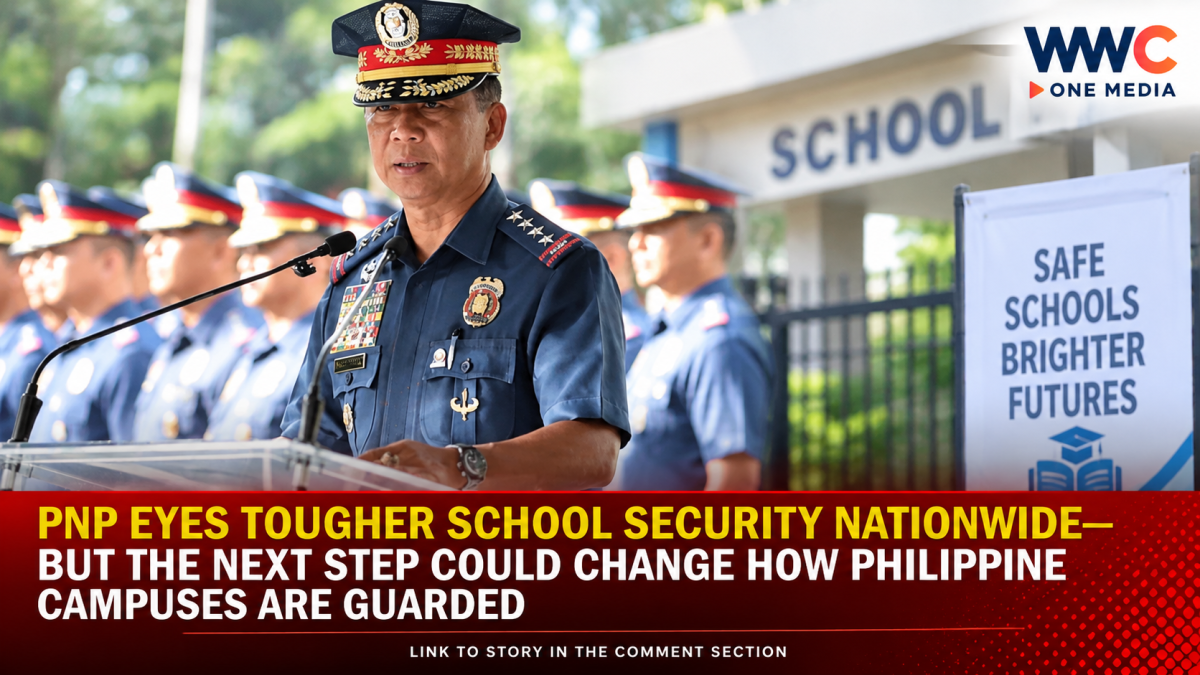
MANILA, Philippines — The Philippine National Police (PNP) is moving to strengthen school security nationwide, directing police units to adopt proven safety measures and become more proactive in preventing threats before they escalate.
PNP chief Gen. Jose Melencio C. Nartatez Jr. said police offices across the country have been instructed to replicate effective school-security practices as authorities respond to a series of violent incidents involving students.
“School safety is a continuously evolving challenge,” Nartatez said, emphasizing the need for efficient security measures that can be applied across schools.
The latest push comes amid heightened national concern over campus violence, including the June 22 shooting at San Jose National High School in Tacloban City, where three students were killed and 20 others were injured. Authorities have since ordered broader reviews of school security procedures.
From reaction to prevention
The PNP has directed regional and local police units to coordinate more closely with the Department of Education (DepEd), school administrators, barangay officials and local governments.
Among the measures being considered or implemented are security assessments, increased police visibility, intelligence and threat monitoring, emergency-response drills, and closer coordination between schools and law enforcement.
Police have also been encouraged to identify security weaknesses before an incident occurs rather than waiting for threats to develop.
The PNP previously said schools with several entrances and exits could consider limiting access to one or two monitored gates. Simulation exercises and emergency drills are also being explored to prepare students, teachers and school personnel for emergencies, including active-shooter situations.
Bag inspections and stronger campus controls
Another measure gaining attention is the possible implementation of mandatory bag inspections in schools.
The PNP has expressed support for the proposal, saying inspections could help prevent weapons and other prohibited items from entering school campuses. However, DepEd has noted that implementation could present logistical challenges, particularly in very large schools with thousands of students arriving at the same time.
DepEd has also been strengthening other security measures, including the use of handheld metal detectors, stricter visitor-management procedures, CCTV coverage, security personnel and safety audits of school infrastructure. These audits examine areas such as perimeter fences, entrances, lighting and emergency exits.
Police presence—but not to police the classroom
The PNP has also proposed greater police visibility around schools, including participation in school activities.
Nartatez previously explained that the goal is not to turn schools into heavily policed environments but to build familiarity between police officers and students while creating an additional layer of security.
The distinction is important as authorities attempt to balance physical security with a school environment where students can still feel comfortable reporting threats and seeking help.
A recent Inquirer report likewise highlighted concerns from psychologists that school security should include psychological safety, not only physical protection.
DepEd considers a hybrid security model
The government’s response is also moving beyond traditional guards.
DepEd has proposed a hybrid campus-security framework combining school security guards, barangay tanods, police patrols, local government personnel and, in some cases, Parent-Teacher Association volunteers.
Under the proposed framework, security resources would be distributed according to school size, with larger campuses receiving more guards while community-based support would supplement security at smaller schools. CCTV cameras, improved lighting, access-control systems and scanners are also part of the broader security strategy.
Safety drills become part of the response
The government has also begun emphasizing preparedness.
In September, schools participated in safety exercises designed to test responses to violent emergencies. Reuters reported that one nationwide exercise included simulated lockdowns, evacuation procedures, police coordination, headcounts, first aid and psychosocial support.
The approach reflects a broader shift toward prevention, preparedness and rapid response, rather than relying solely on police intervention after an incident has already occurred.
Proposed law could make school safety measures nationwide
The push could eventually become more institutionalized.
The PNP has backed Senate Bill No. 2426, or the proposed Comprehensive School Safety Act, which seeks to establish a nationwide framework for school safety, including risk assessments, safety training, emergency procedures, drills and psychosocial support.
Meanwhile, DepEd’s Guidelines on Ensuring a Safe and Motivating Learning Environment (ESMLE) consolidate existing learner-protection policies covering prevention, incident reporting, response procedures and psychosocial support.
A bigger question now facing Philippine schools
The recent measures show that school security is no longer being treated simply as a matter of putting more guards at the gate.
Authorities are looking at access control, police-community coordination, threat assessment, emergency preparedness, anti-bullying enforcement, digital safety, reporting systems and psychological support as interconnected parts of campus safety.
The urgency has intensified following another deadly school shooting in Banga, South Cotabato, on September 18, where a 16-year-old student allegedly killed two fellow students and injured eight others before taking his own life, according to Reuters. The incident has renewed attention on firearm storage and minors’ access to guns.
For the PNP and DepEd, the challenge now is turning these measures into consistent practices across thousands of schools—while ensuring that efforts to make campuses safer do not undermine the supportive environment students need to learn.
The question now is how far these tougher measures will go—and whether the new nationwide approach can prevent the next tragedy before it reaches a school gate.