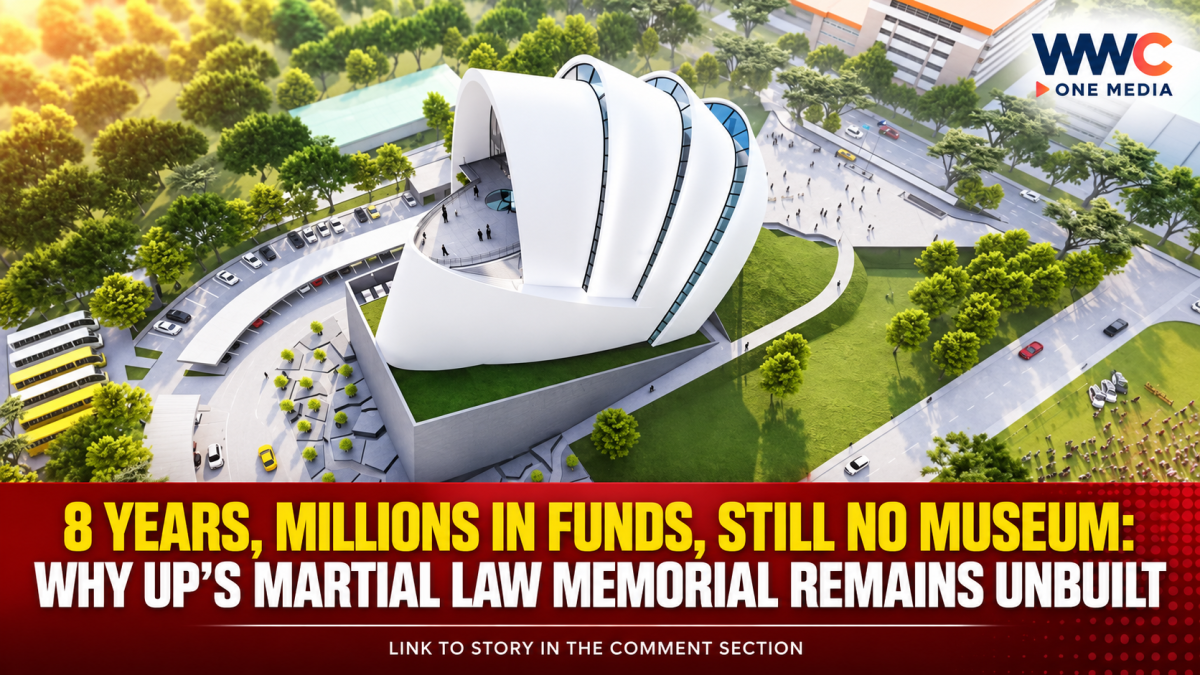
QUEZON CITY, Philippines — Eight years after the University of the Philippines and the Human Rights Violations Victims’ Memorial Commission (HRVVMC) agreed to establish a permanent memorial for victims of Martial Law, the long-planned Freedom Memorial Museum at UP Diliman remains without actual construction underway.
The project has repeatedly faced delays involving the relocation and turnover of the UP Diliman Campus Maintenance Office, even after a key land-transfer agreement was finally completed in 2024.
As the country marks the 54th anniversary of the declaration of Martial Law on September 21, 1972, the museum has once again drawn attention because the permanent structure intended to preserve the testimonies and history of human rights violations remains unfinished.
From a 2018 agreement to an unfinished project
The project traces its roots to September 2018, when UP and the HRVVMC signed a memorandum of understanding to establish a Human Rights Violations Memorial in UP Diliman.
The university committed a 1.4-hectare site along Carlos P. Garcia Avenue for the project. The location was chosen in part because UP had been an important center of student activism and resistance during the Marcos dictatorship.
A national architectural competition followed, with the “Fall of Brutal” design selected as the winning concept in 2019. The proposed museum was envisioned as a permanent educational and memorial facility containing the names and stories of victims, historical materials, artifacts and audiovisual content.
Construction, however, did not proceed according to the original timetable.
The relocation problem that delayed the museum
One of the major obstacles was the presence of the UP Diliman Campus Maintenance Office on the site designated for the museum.
Under the arrangement, HRVVMC funded a new facility for the UP offices and workshops that would have to be relocated. The relocation facility reportedly cost P80 million.
The issue became public in 2024 when HRVVMC officials and UP presented different explanations for the delay.
HRVVMC executive director Carmelo Victor Crisanto told lawmakers that the university had been slow to complete the turnover process. UP, meanwhile, said the principal obstacle was a required deed of transfer and possession that still needed approval from the commission.
The disagreement highlighted how an administrative document and the relocation of existing facilities had effectively prevented the museum project from moving into full construction.
A breakthrough came in 2024—but construction still did not follow
In September 2024, UP and HRVVMC finally signed the deed of transfer covering the new campus maintenance facilities.
UP subsequently announced that site clearing had begun, including the relocation of the Campus Maintenance Office from the 1.4-hectare museum site.
At the time, both institutions said the handover would clear the way for construction. They had also targeted a groundbreaking ceremony for December 2024.
But the project again failed to move into the construction phase on that timetable.
Eight years later, part of the site is cleared—but the museum is still not rising
The latest reporting indicates that approximately 6,000 square meters of the roughly 14,000-square-meter site have been cleared, according to UP President Angelo Jimenez.
However, physical construction of the museum itself had still not begun as of September 2026.
Jimenez has indicated that discussions surrounding the relocation site have continued, including concerns over the suitability and size of the proposed replacement area for the maintenance office.
The Philippine Tribune reported that Jimenez recently said there had been a breakthrough in clearing the old site and that the project was moving forward.
That means the project is no longer simply waiting for the 2024 deed of transfer—but the museum has yet to reach the physical construction stage.
Hundreds of millions have already been allocated
The museum project has also been the subject of questions about funding and implementation.
Recent reporting puts the amount released for the project at around P381 million, with the funds released in 2021. Earlier plans placed the overall project cost at substantially higher levels, while the HRVVMC has also received resources connected to the broader human-rights victims’ reparation program.
The legal basis for the memorial comes from Republic Act No. 10368, or the Human Rights Victims Reparation and Recognition Act of 2013. The law established the framework for recognizing and providing reparation to victims of human rights violations during the Marcos regime and mandated efforts to preserve their history and memory.
A temporary gallery is already telling the stories
While the permanent museum remains unfinished, the HRVVMC has established a Freedom Memorial Museum Gallery in Quezon City.
The gallery provides exhibitions and programs documenting Martial Law experiences and has hosted activities involving survivors themselves. In September 2026, survivors participated in guided tours designed to share firsthand accounts with visitors.
The temporary gallery has therefore become an important venue for historical education while the much larger permanent museum remains in development.
Why the delay matters to Martial Law survivors
For survivors, the issue is not simply about a delayed construction project.
Many of those who experienced imprisonment, torture, censorship and other human-rights violations during the Martial Law period are now elderly.
In previous interviews and reports, survivors and advocates expressed concern that some may not live long enough to see the permanent museum completed. Former Social Welfare secretary and retired UP professor Judy Taguiwalo has been among those calling attention to the importance of completing the project during the survivors’ lifetime.
That concern has added urgency to a project originally conceived as a permanent place where future generations could encounter documented accounts of the period.
The museum is also part of a larger battle over historical memory
The delay comes amid continuing debates in the Philippines over how Martial Law is remembered and taught.
UP Cebu, for example, continues to hold its annual 1081 activities, using exhibitions, performances and educational programs to document and discuss the Martial Law period. In 2026, UP Cebu again marked the anniversary with activities focused on remembering human-rights abuses and the experiences of those who resisted them.
The proposed Freedom Memorial Museum would give those efforts a permanent national institution in the UP Diliman campus.
Its intended purpose is not simply to display historical objects, but to preserve the names, experiences and documentation surrounding victims of human-rights violations for future generations.
The question now: When will construction actually begin?
Eight years after the initial UP-HRVVMC agreement, the project has moved through architectural design, funding, administrative disputes, relocation planning, a deed of transfer and partial site clearing.
Yet the central milestone remains unfinished: the Freedom Memorial Museum itself has still not begun physical construction as of September 2026.
The latest developments suggest that the project has moved closer to clearing the remaining obstacles. But for survivors and their families, the defining question is no longer whether the museum has been approved or designed.
It is when the promised memorial will finally rise.
And after eight years of plans, deadlines and delays, that answer remains unfinished.